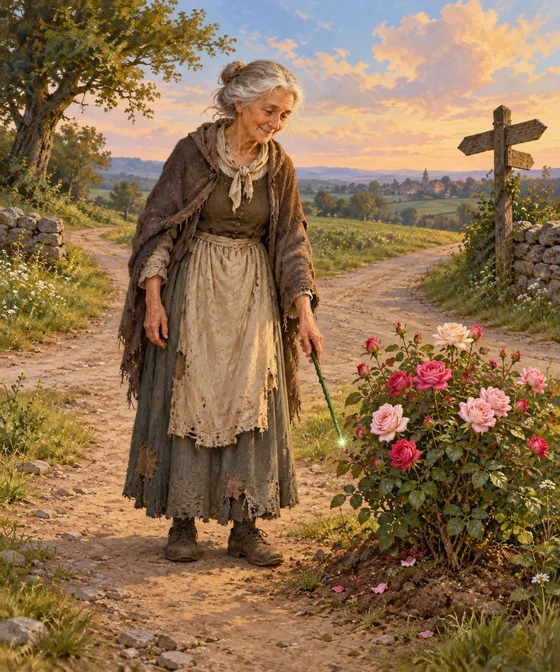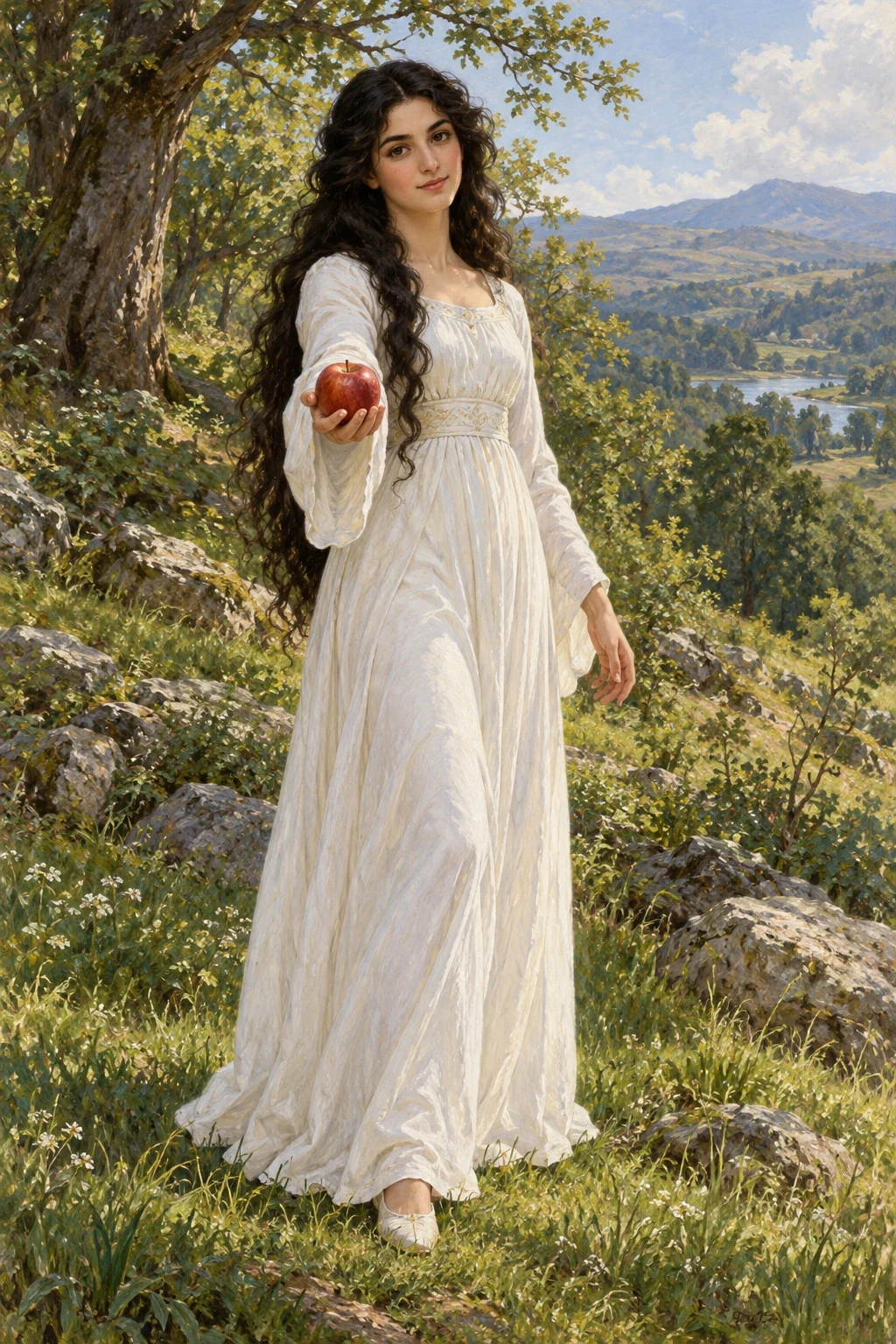
AI-generated interpretation of the first of the three Yezinkas in Fillmore’s Grandfather’s Eyes. White clothing, dark hair and red apple follow the selected narrative; face, dress cut and landscape are editorial choices.
Selected historical English retelling; no exact national costume or geographic place authenticated.
Overview
The Yezinkas of this selected story are three sisters who live in a cave in the woods and appear as beautiful young women. The narrator says that they greet travellers with pious courtesy, put people to sleep and take their eyes. An old blind goat-owner warns his newly hired servant Yanechek against the wooded hill where they caught him. Yanechek nevertheless goes there after two cautious days, taking three slender blackberry switches concealed in his hat. His preparation makes him a deliberate opponent rather than a traveller surprised by an unknown danger.
The first sister wears white, has dark flowing hair and dark eyes, and offers a large red apple. Yanechek refuses because he recognizes the danger of falling asleep. A second sister offers a red rose to smell, and he refuses that too. The youngest approaches with a golden comb and offers to improve his hair. When she reaches him, he strikes her hands with a bramble switch. The narrator explains that a Yezinka struck in this way cannot move. He binds her hands with the thorny stem. Her sisters return at her cries and, while attempting to help her, are caught and bound by the other two switches.
Yanechek fetches his employer and demands the return of his eyes. Under threat of being thrown into the river, the first sister leads them to their cave, where a heap contains many kinds of eyes. She offers a pair that makes the old man see dark treetops, sleeping birds and bats; he identifies them as owls’ eyes. Yanechek throws her into the river. The second offers wolves’ eyes, with underbrush, teeth and tongues in their vision, and suffers the same fate. The third initially offers fishes’ eyes, producing swirling water and flashing fins. Begging for another attempt, she then finds the old man’s own eyes at the bottom of the heap.
The restored man and his goatherd return to a shared life of goats and cheese. The surviving sister never appears on that hill again. The tale presents the witches’ false hospitality and repeated substitutions against the servant’s knowledge and coercive rescue. Its animal-eye episodes are narrative tests, not claims about biological transplantation. The bramble rule restrains their escape but the story subsequently allows the captives to lead the way; this account does not turn it into a general, permanent paralysis or a remedy applicable to every similarly named forest being.
Origins & earliest records
Parker Fillmore’s original English retelling in Czechoslovak Fairy Tales, copyright 1919. His prefatory NOTE expressly rejects literal or scholarly translation and acknowledges abridgment and elaboration for American children. He draws collectively on Czech, Slovakian and Moravian collections, but does not identify this individual tale’s teller, collector, original-language witness or collection locality.
Records & interpretation
Complete selected historical English narrative, printed pp.131–139, plus complete prefatory NOTE. Preserved acquired HTML reused and locally read 23 October; no physical facsimile or original-language edition inspected.
Selected bibliography
Documented works and useful reading. This is not a list of every appearance.
- 01
Czechoslovak Fairy Tales
Parker Fillmore’s original English retelling in Czechoslovak Fairy Tales, copyright 1919. His prefatory NOTE expressly rejects literal or scholarly translation and acknowledges abridgment and elaboration for American children. He draws collectively on Czech, Slovakian and Moravian collections, but does not identify this individual tale’s teller, collector, original-language witness or collection locality.
Family & connections
A source-supported family tree or inspiration record has not yet been compiled for this profile. Related reading below indicates a connection in subject matter, not a proven lineage or creative influence.
References
Sources supporting this profile. Linked pages have their own scope and editorial standards.
- Primary historical English retellingFillmore 1919 — complete selected tale, pp.131–139; prefatory NOTEResearch access: 2026-10-23
Image credits
AI-generated narrative illustrationAI-generated interpretation of the first of the three Yezinkas in Fillmore’s Grandfather’s Eyes. White clothing, dark hair and red apple follow the selected narrative; face, dress cut and landscape are editorial choices.
Selected historical English retelling; no exact national costume or geographic place authenticated.