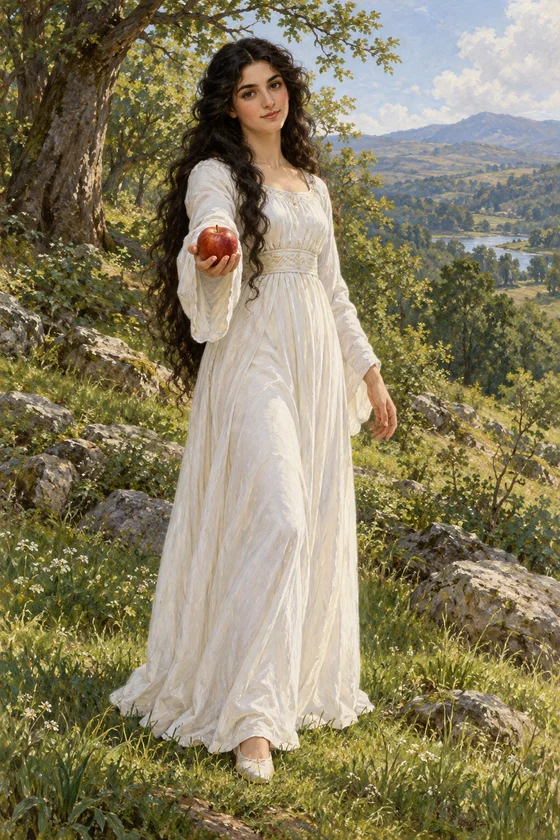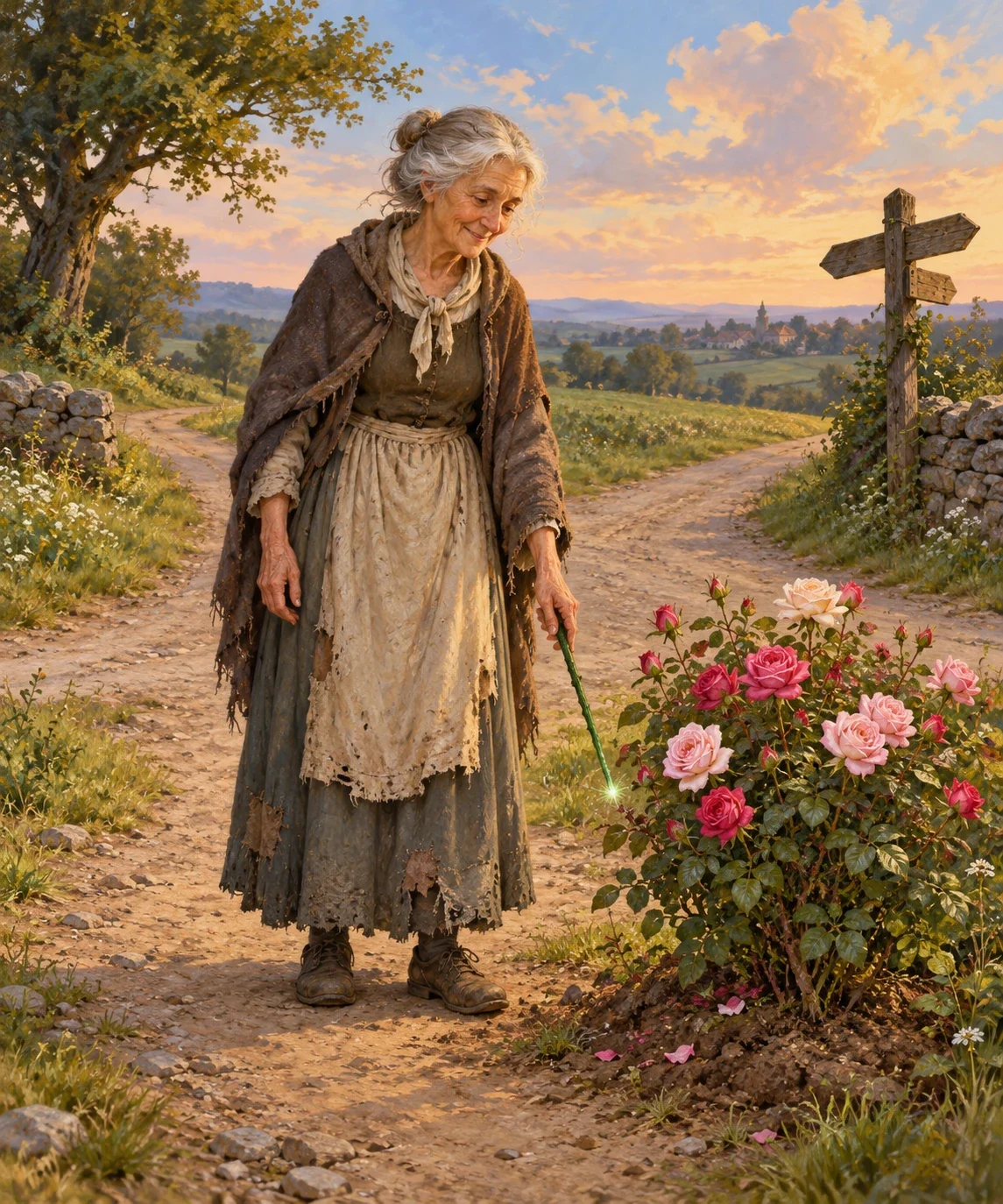
AI-generated narrative interpretation of the elderly godmother beside the rosebush in Fillmore’s tale. The green wand is specified in the source; costume, flowers, landscape and light effect are editorial choices.
Selected historical English retelling; no exact national costume or geographic place authenticated.
Overview
Lukas has lost his farm through careless management when his wife gives birth to their long-awaited daughter. Two women refuse to serve as godmother because the family is poor, including a former friend whose own child had received the wife’s help. Lukas decides to ask the first person he meets while carrying the baby to the chapel. At a crossroads he encounters an old woman, tells her what has happened and receives her willing consent. Her acceptance establishes the relationship before any display of wealth or magic.
At the chapel the priest and sexton initially treat the poor family with impatience. The shabby godmother gives the priest a shining ducat, and the christening proceeds with the ceremony ordinarily offered to wealthy townspeople. The child is named Marishka. The sexton also receives a reward. Returning to the crossroads, the woman places another golden ducat in the child’s clothes and says that the gift will provide for her upbringing. She promises that Marishka will comfort her parents and eventually make a happy marriage. Drawing a green wand, she touches the earth: a flowering rosebush appears and the old woman vanishes.
The single christening coin becomes a handful when Lukas checks it. At home his wife drops the coins in surprise, and the couple find ten wherever one had fallen. She wonders whether an evil spirit is buying their souls. Lukas rejects that interpretation because the woman entered church, received holy water and made the sign of the cross. He believes her to be a good spirit sent by God. His argument is a character’s explanation within the tale; the narrator supplies no personal name, species or explicit identification as a saint, Death or a particular fairy.
The family buys back its former property and begins to manage it prudently. Neighbours who rejected them become generous once they hear about the money, extending the story’s criticism of respect governed by wealth. Marishka grows into a young woman and marries a prince, fulfilling the old godmother’s prediction. The benefactor does not return to demand repayment or impose an additional bargain. Her role rests on freely accepting a rejected child, providing material care and foretelling its future, while the rosebush and disappearance mark powers beyond those of an ordinary neighbour.
Origins & earliest records
Parker Fillmore’s original English retelling in Czechoslovak Fairy Tales, copyright 1919. His prefatory NOTE expressly rejects literal or scholarly translation and acknowledges abridgment and elaboration for American children. He draws collectively on Czech, Slovakian and Moravian collections, but does not identify this individual tale’s teller, collector, original-language witness or collection locality.
Records & interpretation
Complete selected historical English narrative, printed pp.207–217, plus complete prefatory NOTE. Preserved acquired HTML reused and locally read 23 October; no physical facsimile or original-language edition inspected.
Selected bibliography
Documented works and useful reading. This is not a list of every appearance.
- 01
Czechoslovak Fairy Tales
Parker Fillmore’s original English retelling in Czechoslovak Fairy Tales, copyright 1919. His prefatory NOTE expressly rejects literal or scholarly translation and acknowledges abridgment and elaboration for American children. He draws collectively on Czech, Slovakian and Moravian collections, but does not identify this individual tale’s teller, collector, original-language witness or collection locality.
Family & connections
A source-supported family tree or inspiration record has not yet been compiled for this profile. Related reading below indicates a connection in subject matter, not a proven lineage or creative influence.
References
Sources supporting this profile. Linked pages have their own scope and editorial standards.
- Primary historical English retellingFillmore 1919 — complete selected tale, pp.207–217; prefatory NOTEResearch access: 2026-10-23
Image credits
AI-generated narrative illustrationAI-generated narrative interpretation of the elderly godmother beside the rosebush in Fillmore’s tale. The green wand is specified in the source; costume, flowers, landscape and light effect are editorial choices.
Selected historical English retelling; no exact national costume or geographic place authenticated.