
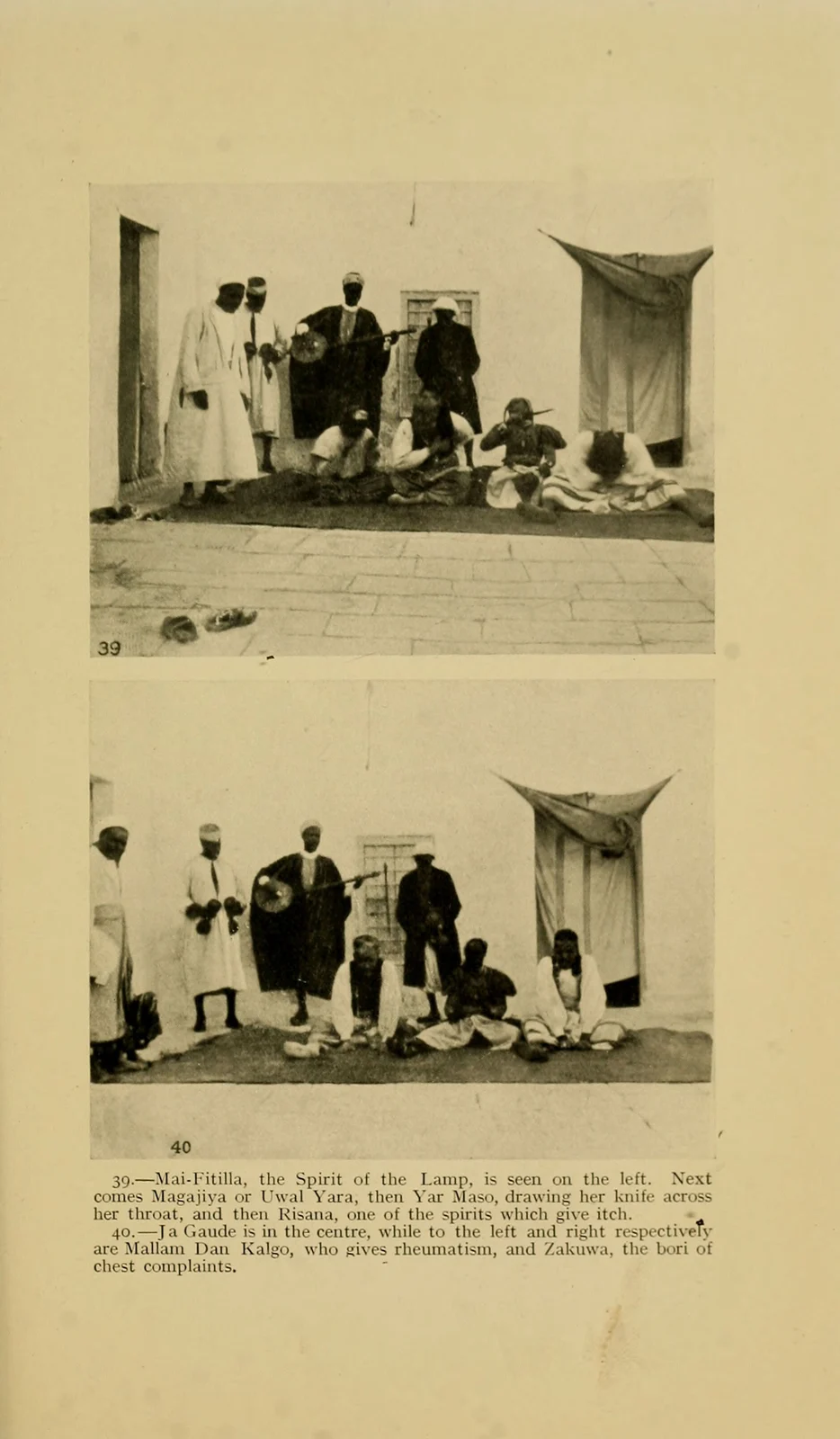
Yar-Maso represented with a knife across the throat in photograph39, 1914
In the upper photograph39, the participant just right of centre represents Yar-Maso and draws a knife across the throat, as its printed caption explains. The threatening gesture belongs to the performed role, not a claim that a supernatural being was photographed.
Overview
Yar-Maso’s names identify her as Daughter of the Knife and daughter of the Chief Butcher, whom Tremearne glosses as head of the market. She is also described as a wife of Mai-Aska. Her arrival changes the ring immediately: she drives away everyone except her own relatives, and other spirits move aside when she announces herself. The account characterizes her as particularly quarrelsome and hostile to unfamiliar bori.
Her announcement asks to kill, drink blood and eat flesh, joining the knife and butcher relationships to a threatening voice. Tremearne says that she can give any illness but records no separate diagnosis or complete episode of an attack. He was unable to obtain her song. The surviving notice is consequently strongest for her kinship, aggressive announcement and exclusion of other participants; its missing song remains an explicit gap in this witness.
Origins & earliest records
A. J. N. Tremearne combines interviews and descriptions of bori performances with comparative interpretation. These selected notices do not consistently name individual speakers; printed attributes are distinguished from his conjectures.
Records & interpretation
Complete selected spirit notice in chapter XXII, printed pp. 325–326; surrounding chapter context read.
Selected bibliography
Documented works and useful reading. This is not a list of every appearance.
- 01
The Ban of the Bori: Demons and Demon-Dancing in West and North Africa
XXII. Bori—the Mohammedan Spirits, printed pp. 325–326; attributed narrative and ritual representation.
Family, evolution & connections
Sarikin Pawa and Yar-Maso
Tremearne’s selected 1914 historical Bori notices, pp. 325–326, 353.
Scroll sideways to see all branches. With a keyboard, focus the tree and use the arrow keys.
Two separate notices explicitly identify this father–daughter relationship. No mother or children of Yar-Maso are supplied. The collector’s differing religious classifications remain source qualifications. These are attributed historical religious relationships, not biological phylogeny or a universal contemporary doctrine.
Mai-Aska
Yar-Maso’s notice calls her a wife of Mai-Aska. Her other relatives are not individually named merely because she drives outsiders from the performance ring.
References
Sources supporting this profile. Linked pages have their own scope and editorial standards.
- Digitized historical ethnographic accountTremearne — Yar-MasoResearch access: 2026-10-05
Image credits
Historical ritual performance photographYar-Maso represented with a knife across the throat in photograph39, 1914
In the upper photograph39, the participant just right of centre represents Yar-Maso and draws a knife across the throat, as its printed caption explains. The threatening gesture belongs to the performed role, not a claim that a supernatural being was photographed.