A sourced illustration has not yet been added. This gap is included in the coverage record.
Overview
The Yagán are a living Indigenous people of the Cape Horn and Tierra del Fuego region. Chile’s public heritage service identifies contemporary communities in Puerto Williams, Punta Arenas and Ushuaia in Argentina. These locations do not define one municipal population or erase the border-crossing history of the people. The same service describes community language workshops, bilingual education and publications. Its account distinguishes linguistic revitalization from a fixed spelling standard: Cristina Zárraga Riquelme’s proposal draws on Cristina Calderón Harban and other fluent speakers, while the page notes the absence of a universally agreed orthography.
Family-authored testimony provides another perspective. In Karina Palma’s January 2018 interview, Cristina Zárraga recalled meeting her grandmother Cristina Calderón in 1999, then spending more than a decade recording and writing down her memories. She described editing the resulting biography so that her grandmother’s voice remained central. Zárraga emphasized transmission within families and to children, including her own family in Germany. She also rejected the recurring description of elders as the last members of their people. This is a named writer’s account of her project and family experience, not a claim that every Yagán shares one biography or language proficiency.
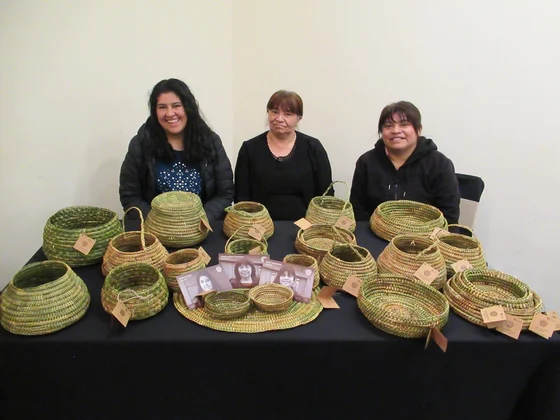
Community involvement has also changed public interpretation. On 10 January 2024, the Puerto Williams museum announced its reopening as Museo Territorial Yagan Usi – Martín González Calderón. Its report says the Bahía Mejillones community requested the name change during consultation and research. The name honours a community practitioner associated with canoe navigation and collaboration with the museum. The renewed exhibition includes basketry credited to Cristina Calderón Harban, Julia González Calderón, Claudia González Vidal and Marta Balfor Clemente, among other makers. These names connect displayed objects with particular people rather than treating craft as an anonymous characteristic of an entire population.
A museum report of 12 January 2026 documents further participation by members of Bahía Mejillones in Chile and Paiakoala in Ushuaia at the fifth Onašaga archaeology and heritage meeting. Organized with Argentina’s CADIC, the programme brought community presentations into conversation with academic research and included the presentation of Zárraga’s Wata Čis. Cuento antiguo. The report establishes that presentation, not the book’s original publication date. These written sources document continuing cultural work across institutions and families; the books, recordings, exhibition objects and archaeological sites themselves were not inspected for this profile.
History & identity
Contemporary community participants speak through an attributed interview and public cultural institutions. No prehistoric archaeological date is equated with an unchanging present identity.
Sources & representation
Complete 2018 interview and 2024/2026 museum reports read, alongside complete heritage-service language overview. No audio, full books or exhibition inspection claimed.
Selected bibliography
Documented works and useful reading. This is not a list of every appearance.
- 01
Cristina Calderón. Memorias de mi abuela Yagán
Discussed by its author in the 2018 interview; publication and edition chronology not resolved here. Full book not read.
- 02
Wata Čis. Cuento antiguo
Presentation documented by the January 2026 museum report; original publication year and full text not inspected.
Language & cultural connections
Source-supported language and cultural connections have not yet been compiled for this profile.
References
Sources supporting this profile. Linked pages have their own scope and editorial standards.
- Attributed interview or public heritage sourceLengua yagánResearch access: 2026-10-05
- Attributed interview or public heritage sourceMemorias de mi abuela Yagan — interview with Cristina ZárragaResearch access: 2026-10-05
- Attributed interview or public heritage sourceReinaugurado museo más austral del mundo con nuevo nombre y museografíaResearch access: 2026-10-05
- Attributed interview or public heritage sourceMuseum report on the fifth Onašaga archaeology and heritage meetingResearch access: 2026-10-05
Image credits
A sourced illustration has not yet been added. This gap is included in the coverage record.