
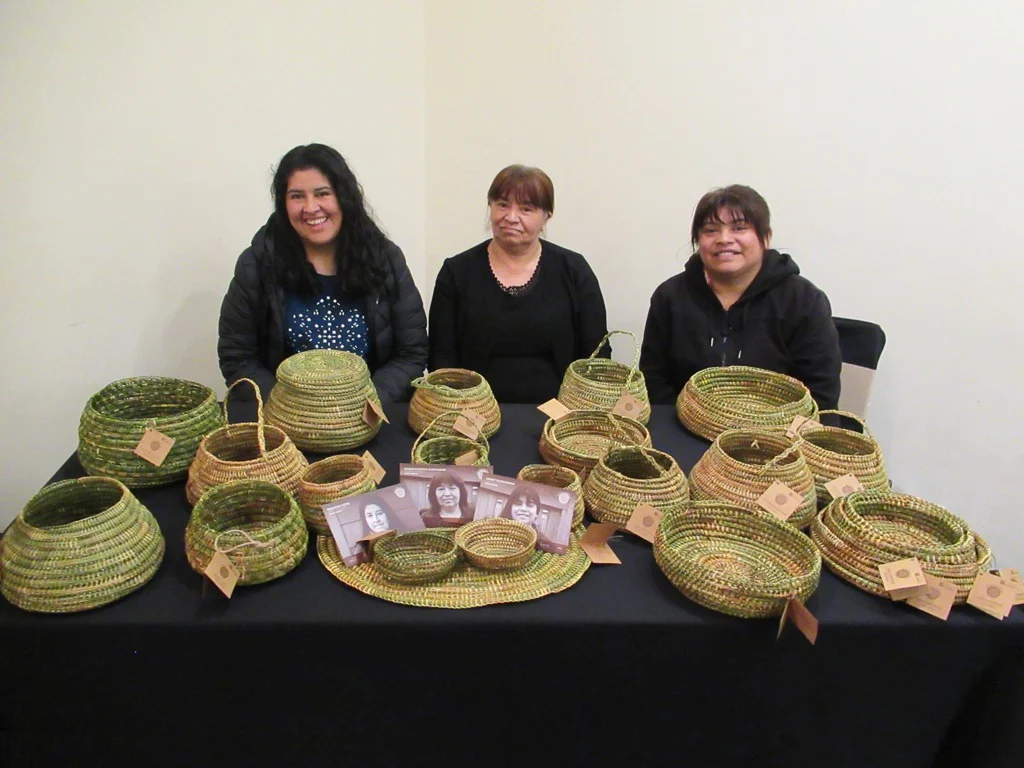
Three basket makers sit behind a table displaying rounded woven baskets, handled baskets and shallow trays, with small portrait cards among the work.
Basket makers and their work, photographed by David Stanley in November 2019. His caption identifies their work with Kawésqar basket-making traditions in Chile; it does not name the makers or establish a uniform practice across all Kawésqar communities.
Overview
The Kawésqar are a living Indigenous people associated with the channels of western Patagonia. Chile’s heritage service identifies communities in Puerto Edén, Puerto Natales and Punta Arenas. Their regional neighbours, the Yagán, remain distinct even when institutions present practitioners from both peoples together.
Puerto Edén’s Indigenous community initiated a language council in 1997. The heritage service credits José Tonko Paterito and Oscar Aguilera with an official alphabet created in 1999, a sound archive donated in 2009 and collaborative teaching manuals. Those materials are identified through an institutional account; their recordings and full texts were not inspected. An alphabet or archive does not establish equal fluency among community members.
A report published on 19 August 2019 describes the distribution of a leaflet and digital material containing selections from 164 additions to the lexicon developed in 2016. These included terminology for technology, modern navigation, authorities and greetings. Juan Carlos Tonko Huenucoy, identified then as vice-president of the Puerto Edén community, connected the initiative with learning from elders and challenging assertions that Kawésqar culture had disappeared. His dated statement is an individual contribution, not a declaration of identical views across all communities. The council’s work demonstrates deliberate adaptation to contemporary life.
The heritage service’s March 2022 remembrance of Raúl Edén Ulloa gives a named example of related knowledge. A Puerto Edén navigator and language-council participant, he also recreated implements of fishing and daily life. His junco-fibre fishing-net replica received an Indigenous craft distinction in 2021. Contemporary museum programming offers other examples: its 2021 Originaria materials pair Susan Vargas’s Kawésqar basketry with Angelino Soto’s painting, and Carolina Quintul’s basketry with Lenka Guisande’s ceramics. These are credited collaborations, not anonymous survivals or evidence that every Kawésqar practises the same craft. The written notices were read; the linked videos and physical artworks were not inspected. The 2022 remembrance distinguishes Raúl’s personal expertise in the northern channels from a generic account of basketry. Blas Flores, the heritage official quoted there, presents his craft as one aspect of wider cultural knowledge. Raúl’s participation in language renewal and his reconstruction of practical objects are thus complementary parts of the same documented life.
History & identity
Selected Chilean heritage and museum witnesses emphasize living communities and named participants in Magallanes. Linguistic preservation is distinguished from the continued existence of the people.
Sources & representation
Complete written language overview and bibliography, full 2019 lexicon report, complete 2022 remembrance and museum multimedia descriptions read. No linked audio, manuals or videos inspected.
Selected bibliography
Documented works and useful reading. This is not a list of every appearance.
- 01
Manuales para la Enseñanza de la Lengua Kawésqar
Series identified in the heritage-service bibliography; individual editions and full texts not inspected.
- 02
Originaria — selected 2021 collaboration notices
Written multimedia catalogue descriptions only; no artwork or video inspection.
Language & cultural connections
Source-supported language and cultural connections have not yet been compiled for this profile.
References
Sources supporting this profile. Linked pages have their own scope and editorial standards.
- Public heritage or museum sourceLengua kawésqarResearch access: 2026-10-05
- Public heritage or museum sourceKawésqar difunden nuevas palabras incorporadas a su lenguaResearch access: 2026-10-05
- Public heritage or museum sourceSerpat recuerda legado de Cristina Calderón y Raúl EdénResearch access: 2026-10-05
- Public heritage or museum sourceMuseo Regional de Magallanes — MultimediaResearch access: 2026-10-05
Image credits
Contemporary documentary photograph of a specifically attributed Kawésqar basket-making displayThree basket makers sit behind a table displaying rounded woven baskets, handled baskets and shallow trays, with small portrait cards among the work.
Basket makers and their work, photographed by David Stanley in November 2019. His caption identifies their work with Kawésqar basket-making traditions in Chile; it does not name the makers or establish a uniform practice across all Kawésqar communities.