
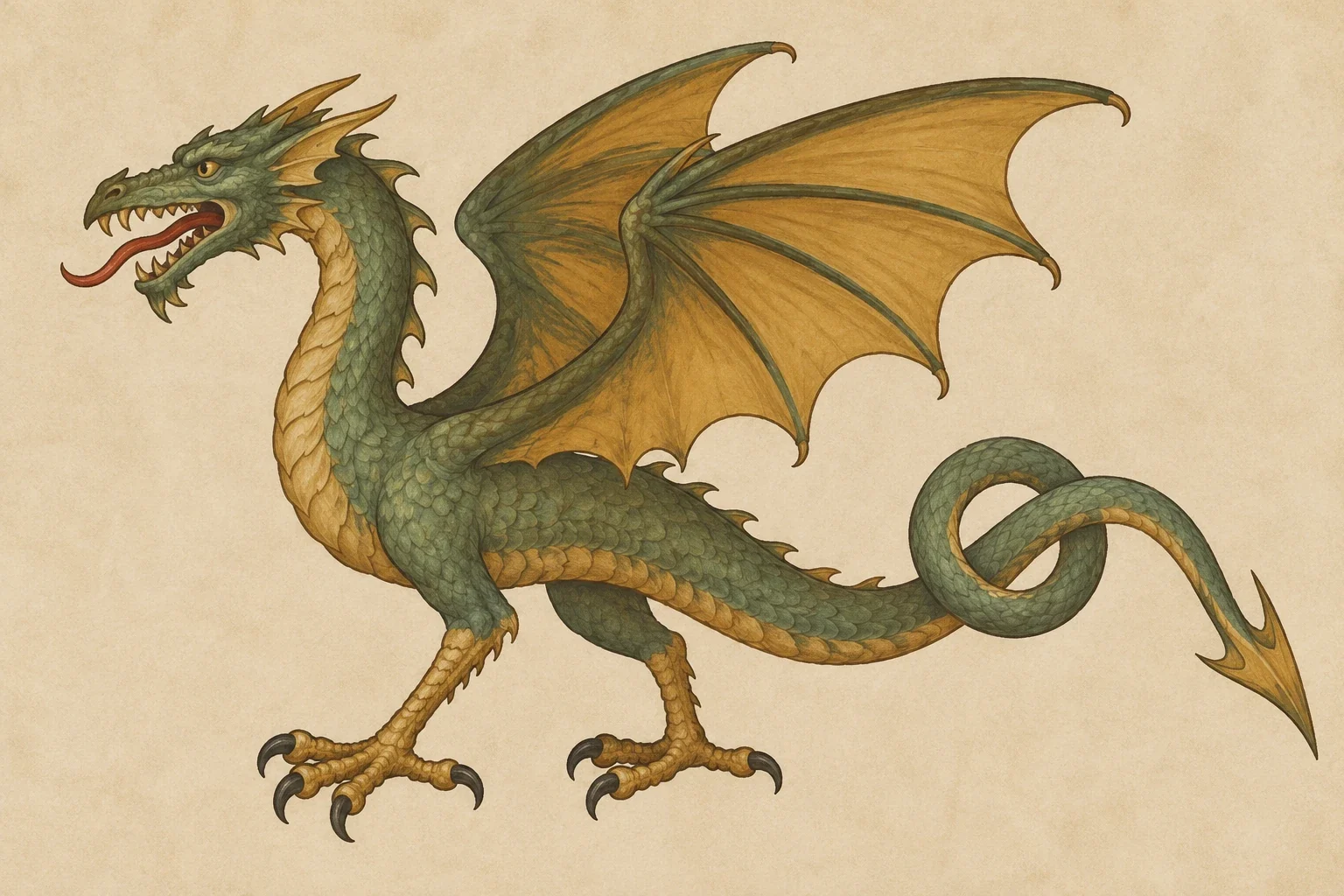
AI-generated interpretation of a heraldic wyvern convention described by Vinycomb; exact form and colours imagined.
An original standalone heraldic-style figure, not an authenticated coat of arms or a biological reconstruction. The two legs, wings and barbed knotted tail follow one convention in the historical account; exact anatomy, posture, colours and ground are artistic interpretation. No source artwork was supplied as an image reference.
Overview
John Vinycomb's 1906 account places the wyvern among the imaginary creatures of British heraldry. His usual form resembles a flying serpent or dragon but has two eaglelike legs and a barbed, serpentine tail. The tail may be knotted, a condition described in the heraldic language as nowed. This is a convention for representing an armorial creature, not a claim about a living reptile. Vinycomb associates the monster with meanings that he attributes to older heralds, including pestilence, envy, tyranny and the defeat of a vicious enemy. Those symbolic readings should remain attached to his discussion rather than becoming a universal meaning for every use of the figure.
Named arms and crests make the account more specific than a definition based only on limb count. Vinycomb lists a red wyvern, described with wings endorsed, on a silver or white field for Drake of Ashe in Devon, identifying the family as baronets and giving the date 1600. Leicester's crest is a contrasting exception: its red wyvern spreads its wings, has no legs and is marked with wounds. Ruddings uses a flying wyvern on a diagonal band between lions. These are the author's armorial examples; the individual grants and original objects were not independently examined here. Their variations show why a description of one emblem cannot determine every wyvern's appearance.
Other examples occupy roles beside or above a shield. Vinycomb gives Viscount Arbuthnot two flame-emitting wyverns as supporters. He also describes the Portuguese king's supporters as golden wyverns standing on their tails and carrying banners, with a half-wyvern crest above a coronet. Flame, posture and accessories therefore belong to particular representations in this account. The discussion also allows wingless forms, calling a dragon or wyvern without wings a lindworm. Its separate Guivre passage concerns a Milanese serpent and a reported origin legend; that material is not silently added to every British wyvern. Vinycomb's distinctions and overlapping names document historical heraldic usage, not one fixed classification shared by every writer, language or later fantasy world.
Origins & earliest records
John Vinycomb, Fictitious & Symbolic Creatures in Art, with Special Reference to Their Use in British Heraldry, Chapman and Hall, London, 1906; The Wyvern, pp. 98–101. The edition dates this discussion, not the first depiction or earliest use of the name.
Records & interpretation
Complete Wyvern section read through its Lindworm and Guivre passages and illustration captions, ending before The Chimera. The original arms, grants, Garter plate and Bayeux textile were not independently inspected; captions and the author’s claims remain attributed.
Selected bibliography
Documented works and useful reading. This is not a list of every appearance.
- 01
Fictitious & Symbolic Creatures in Art — The Wyvern, pp. 98–101
Complete selected section, including separate Lindworm/Guivre passages and captions; title page identifies Chapman and Hall, London.
Family, evolution & connections
Wyvern (The Witcher)
Vinycomb’s heraldic wyvern is usually a two-legged winged serpent, with named armorial examples varying in posture, limbs, wings and accessories. Wyverns are smaller relatives of the setting's dragons, able to attack from the air but lacking dragonlike fire breath in Wild Hunt's description.
Wyvern (A Song of Ice and Fire)
Vinycomb’s 1906 heraldic account usually gives the wyvern two eaglelike legs and a barbed serpentine tail, while also describing a legless Leicester crest. These are variable armorial representations. The link to Wyvern (A Song of Ice and Fire) is comparative; it identifies neither a specific creator-consulted source nor shared biology or a universal classification.
References
Sources supporting this profile. Linked pages have their own scope and editorial standards.
- Historical English heraldic accountJohn Vinycomb, The Wyvern (1906), pp. 98–101Research access: 2026-10-24
Image credits
AI-generated heraldic interpretationAI-generated interpretation of a heraldic wyvern convention described by Vinycomb; exact form and colours imagined.
An original standalone heraldic-style figure, not an authenticated coat of arms or a biological reconstruction. The two legs, wings and barbed knotted tail follow one convention in the historical account; exact anatomy, posture, colours and ground are artistic interpretation. No source artwork was supplied as an image reference.