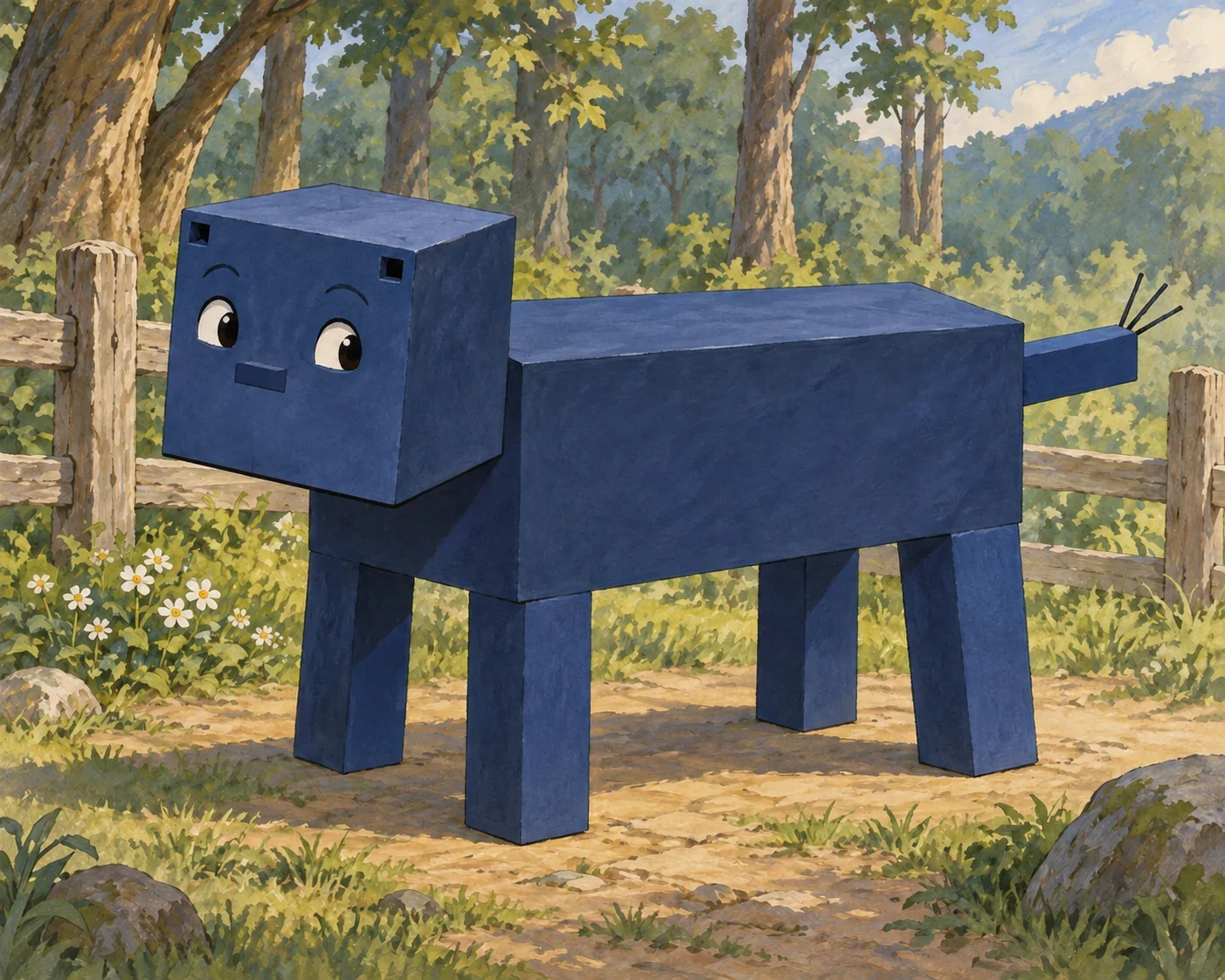
Unofficial AI interpretation of Baum’s Woozy: dark-blue block body, flat nose, lower-edge mouth, four legs and three tail hairs. Pose, expression, fence and forest are imagined.
Unofficial AI interpretation of Baum’s Woozy: dark-blue block body, flat nose, lower-edge mouth, four legs and three tail hairs. Pose, expression, fence and forest are imagined. Full-frame display derivative; no upscaling.
Overview
The narrator of The Patchwork Girl of Oz calls this the only Woozy that has ever lived, inside or outside Oz. Its anatomy consists of squares, flat surfaces and edges: a cube-like head, a larger rectangular body twice as long as it is wide or high, four straight four-sided legs, and a short, straight, square tail. Its thick, smooth skin is dark blue. There are no projecting ears; it hears through two openings at the upper corners of its head. A flat nose occupies the front surface, and its mouth opens along the head’s lower edge. The only hair anywhere on the animal consists of three stiff, stubby hairs at the end of its tail.
Ojo, the Patchwork Girl and the Glass Cat find it confined behind a high wooden fence around a forest. Local farmers have imprisoned it because it eats their honeybees; its unusually tough skin has prevented them from destroying it. Despite its appearance and hunger, the Woozy is good-humoured. It accepts Ojo’s bread and cheese and offers assistance in return. Ojo needs three Woozy tail hairs as one ingredient of the remedy for Unc Nunkie and Margolotte, who have been accidentally petrified. The Woozy willingly permits an attempt, but neither Ojo nor the Patchwork Girl can pull the hairs out. It agrees to accompany them with the hairs still attached.
The fence initially defeats it because it cannot climb, has no claws to grip with and no teeth to gnaw the boards. It nevertheless claims great speed, jumping ability and a terrifying growl. Its angry eyes really do emit fire. By repeating a phrase that irritates it, its new companions provoke the sparks that burn a way through the fence. The episode turns the creature’s supposed menace into a practical aid to their journey. Later, when it confronts the quill-throwing Chiss, its growl fails to produce the fear it boasted of causing, and it admits that the noise may only have seemed dreadful because it was close to its own ears.
The Woozy becomes a companion in Ojo’s quest rather than simply an ingredient-bearing obstacle. The Shaggy Man joins the journey and rescues the travellers from grasping plants; further attempts at removing the tail hairs continue to fail. At the conclusion the Wizard praises the Woozy as a faithful friend and arranges for it to live in the Royal Menagerie, with care and sufficient food. This outcome answers its earlier isolation and starvation without changing the book’s unusual account of its anatomy.
First appearances & development
Created by L. Frank Baum for The Patchwork Girl of Oz (1913). Chapter Nine, “They Meet the Woozy,” introduces its form, confinement and relationship to Ojo’s search; subsequent chapters develop its escape and companionship. The final chapter records its placement in the Royal Menagerie. The narrator’s building-block comparison explains the geometry in the text; no unverified external design influence is claimed.
Canon & continuity
Primary literary evidence is the 1913 narrative, with particular attention to the distinction between the Woozy’s boasts and events actually shown. Project Gutenberg’s catalogue marks the original book public domain in the USA. The proposed image is a new AI interpretation of the verbal description, without reuse of original illustrations.
Selected bibliography
Documented works and useful reading. This is not a list of every appearance.
- 01
The Patchwork Girl of Oz
Primary narrative; chapters Nine–Eleven establish anatomy, escape and companionship, and the ending records the Royal Menagerie outcome.
Family & connections
A source-supported family tree or inspiration record has not yet been compiled for this profile. Related reading below indicates a connection in subject matter, not a proven lineage or creative influence.
References
Sources supporting this profile. Linked pages have their own scope and editorial standards.
- Primary literary textThe Patchwork Girl of Oz — full primary textResearch access: 2026-10-11
- Bibliographic and rights recordProject Gutenberg catalogue: The Patchwork Girl of OzResearch access: 2026-10-11
Image credits
Unofficial modern AI interpretationUnofficial AI interpretation of Baum’s Woozy: dark-blue block body, flat nose, lower-edge mouth, four legs and three tail hairs. Pose, expression, fence and forest are imagined.
Unofficial AI interpretation of Baum’s Woozy: dark-blue block body, flat nose, lower-edge mouth, four legs and three tail hairs. Pose, expression, fence and forest are imagined. Full-frame display derivative; no upscaling.