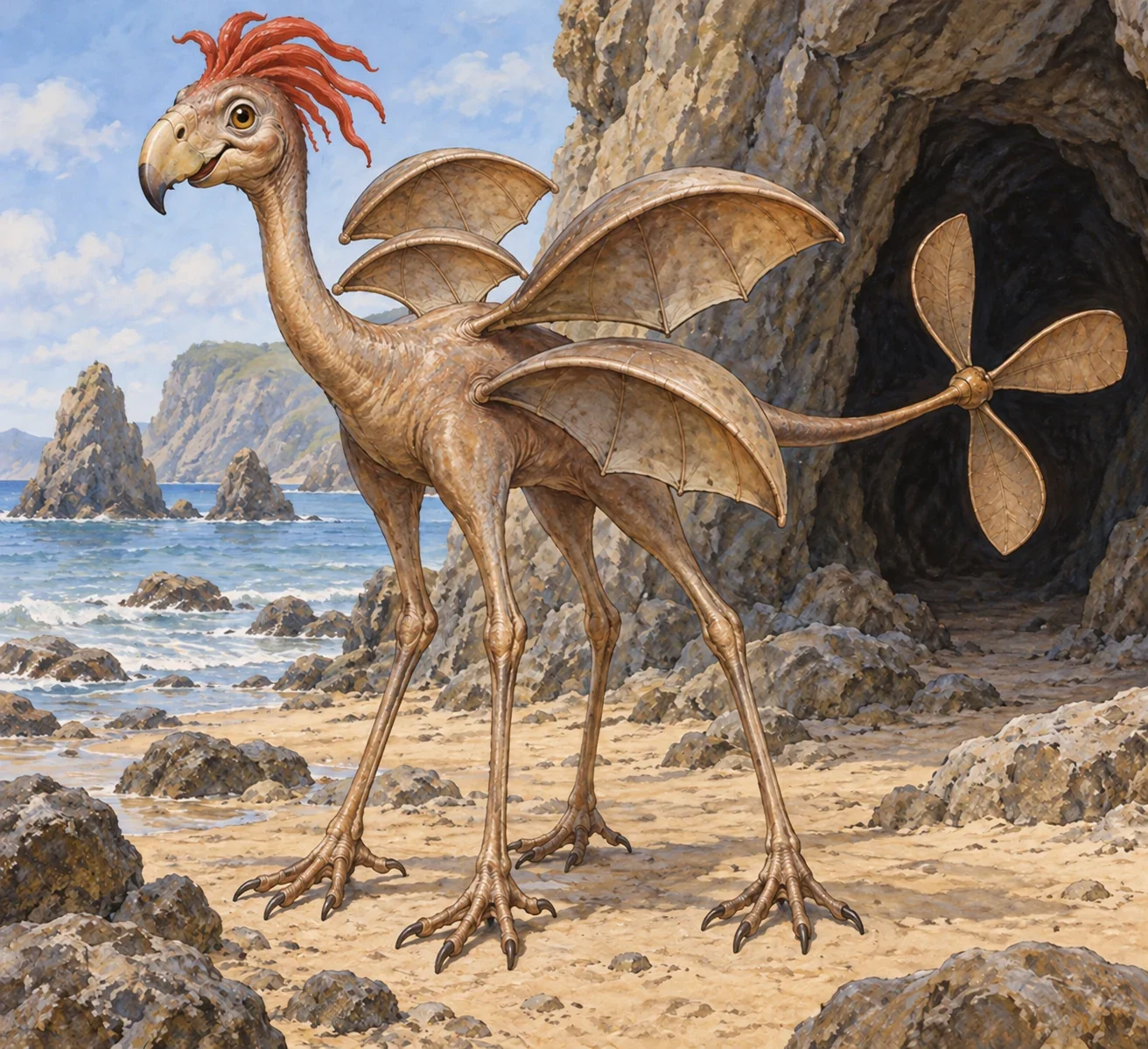
Unofficial AI interpretation of Baum’s Ork: four skin wings, four stork-like legs, scarlet crest and organic propeller tail. Skin colour, tail blade count, pose and shore setting are imagined.
Unofficial AI interpretation of Baum’s Ork: four skin wings, four stork-like legs, scarlet crest and organic propeller tail. Skin colour, tail blade count, pose and shore setting are imagined. Full-frame display derivative; no upscaling.
Overview
The Ork who joins Trot and Cap’n Bill in The Scarecrow of Oz combines features that keep it from fitting their ordinary categories of fish, beast or bird. It has four legs like a stork’s, a parrot-like head, and a beak curved downward at the front and upward along its edges. Its only feathers are wavy scarlet plumes forming a crest on top of the head. The wings are small, hollow skin surfaces shaped like inverted chopping bowls. Four are identified in the conversation. Its tail is an organic arrangement of skin, bone and muscle, with fan-like surfaces pivoted to the body like a boat or airship propeller.
The traveller says that its wings support its body while the revolving tail supplies forward speed. Its front claws function with finger-like dexterity, enabling it to hold food and a candle. It calls its home Orkland and says that Orks rule the living things there. In its account of childhood, its father calls it Flipper. Unlike the other Orks it describes, it is restless and curious about human beings. Having left without saying goodbye, it loses its way while travelling and has been trying for months to locate home. These social and biographical details come from this individual’s story, not an independently surveyed account of every Ork.
Trot and Cap’n Bill meet it after all three have been caught by a whirlpool and assisted by mermaids. It emerges from a pool into their cavern and accepts a share of their limited biscuits. When the escape tunnel ends above a dark gulf, its ability to fly becomes useful to companions who cannot. It explores by candlelight, finds another passage and carries them across, despite being afraid itself. Walking through the long tunnel then hurts its feet and exposes its impatience with hunger. Those limitations accompany its resourcefulness rather than making it an effortless means of rescue.
Later the Ork returns after finding Orkland, locates the lost Button-Bright and carries him back to his friends. It learns of King Krewl’s cruelty and leaves to obtain help. At the planned burning of the Scarecrow, a flock of at least fifty Orks descends; air driven by their revolving tails scatters the fire before a burning brand reaches him. The Orks overpower Krewl, free the Scarecrow and ensure that his orders are obeyed. This rescue gives the traveller’s mechanical-looking tail a political and narrative consequence, while remaining separate from unrelated creatures called Orks in other fictional worlds.
First appearances & development
Created by L. Frank Baum for The Scarecrow of Oz (1915). The original book was illustrated by John R. Neill. The selected early cavern encounter and later Jinxland rescue establish the creature’s form and role. Boat and airship propellers are comparisons explicitly made in the prose; they are not presented as evidence of a separately documented design commission or interview.
Canon & continuity
Primary story passages: the end of chapter 2 and chapter 3 for anatomy, speech and cavern assistance; chapters 17–18 for the return, Button-Bright rescue and intervention against Krewl. The retained Gutenberg edition includes later publisher front matter, which is not used as Baum’s original narrative. Its catalogue identifies the book as public domain in the USA. No historical illustrations are reused.
Selected bibliography
Documented works and useful reading. This is not a list of every appearance.
- 01
The Scarecrow of Oz, selected cavern and Jinxland episodes
Selected primary narrative: chapter 2 ending, chapter 3 and chapters 17–18. Original illustrations by John R. Neill are not used as the new image.
Family & connections
A source-supported family tree or inspiration record has not yet been compiled for this profile. Related reading below indicates a connection in subject matter, not a proven lineage or creative influence.
References
Sources supporting this profile. Linked pages have their own scope and editorial standards.
- Primary literary textThe Scarecrow of Oz — primary story textResearch access: 2026-10-11
- Bibliographic and rights recordProject Gutenberg catalogue: The Scarecrow of OzResearch access: 2026-10-11
Image credits
Unofficial modern AI interpretationUnofficial AI interpretation of Baum’s Ork: four skin wings, four stork-like legs, scarlet crest and organic propeller tail. Skin colour, tail blade count, pose and shore setting are imagined.
Unofficial AI interpretation of Baum’s Ork: four skin wings, four stork-like legs, scarlet crest and organic propeller tail. Skin colour, tail blade count, pose and shore setting are imagined. Full-frame display derivative; no upscaling.