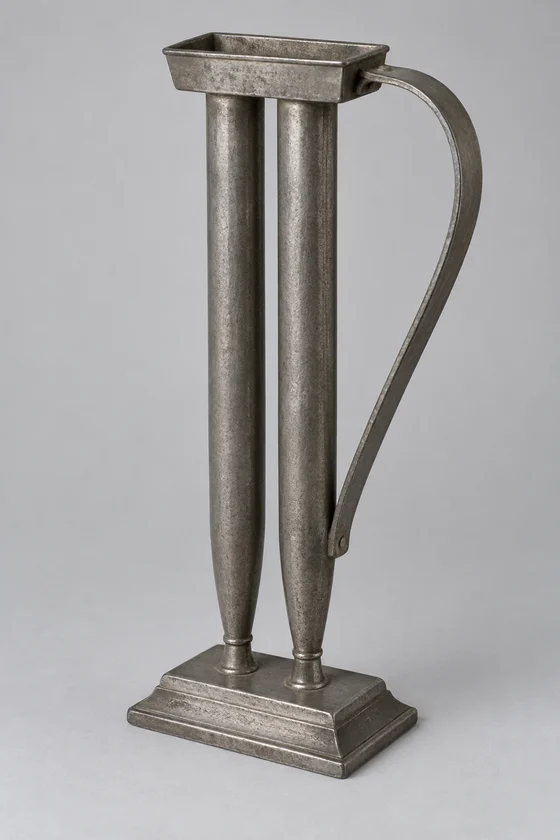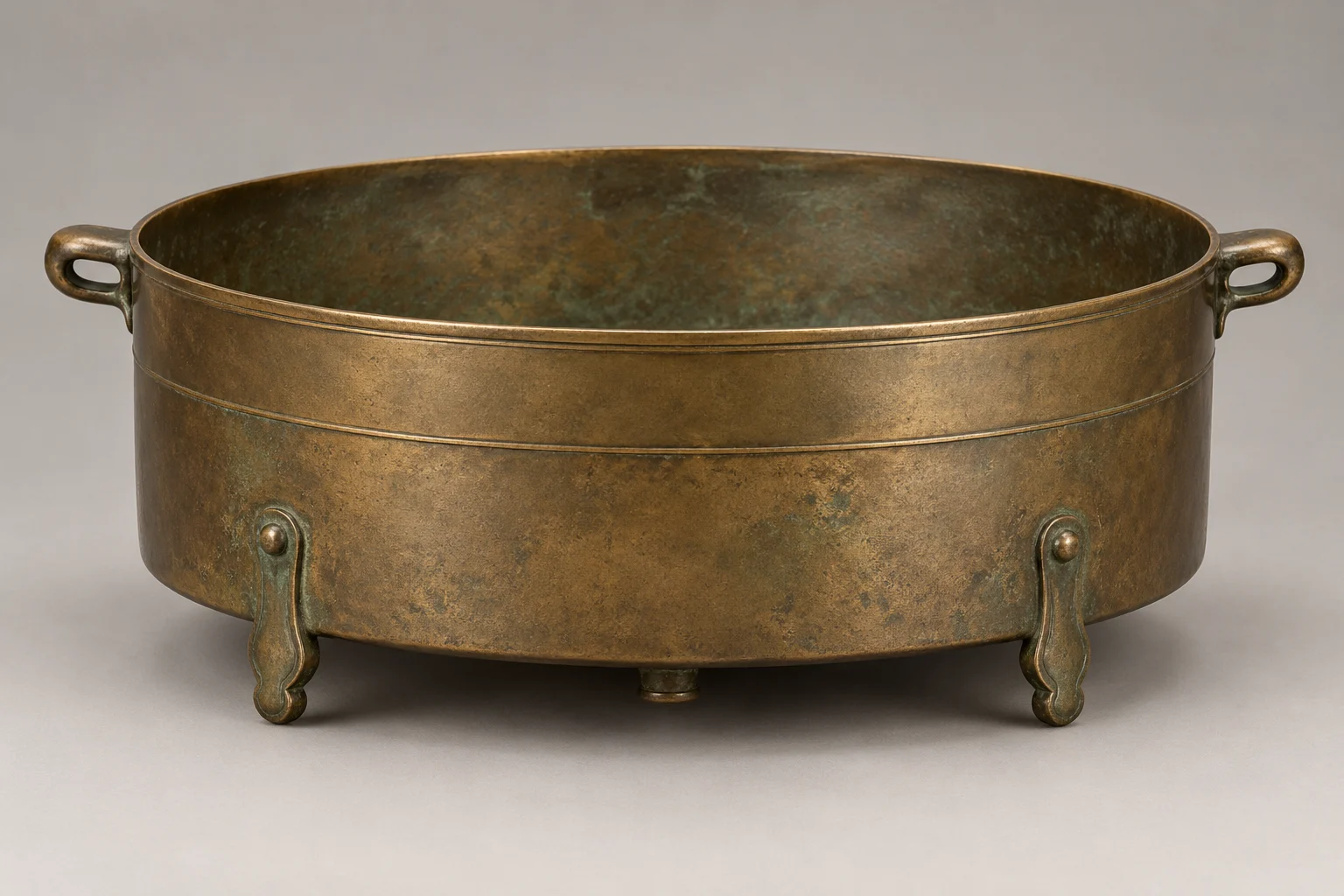
Generated interpretation of a published historical form; not an authenticated specimen or exact replica. The illustrated inscription is omitted; capacity is not reconstructed. Handles and supports are simplified.
Overview
Burgess identifies the broad open vessel in Figure 56 as the Winchester bushel and calls it bronze. In his account, Winchester preserved an original bushel on which other measures were based, alongside smaller standards dating across several reigns. The illustration gives the selected vessel a low cylindrical body, an open elliptical-looking rim in perspective, small projecting side handles and ornamental supports visible below the front. A band of lettering crosses its outer wall. The profile follows the published identification without assigning every neighbouring measure to the same date or claiming that the historical drawing establishes an exact capacity for a newly illustrated vessel.
The surrounding chapter connects civic authority with custody of standards. Burgess describes discrepancies between local measures and the need for reference examples held in towns such as Winchester and Exeter. He cites a recorded payment to William Nele in 1486 for copies of the old English standard to be distributed to shires and cities, placing the bushel within a system of replication and comparison rather than ordinary tableware. The text also distinguishes Winchester holdings from later Exeter examples and from measures in private collections. These are the account's historical statements; no present museum inventory, legal standard or independent calibration has been consulted. A contextual exterior study accordingly leaves the inscription and calibrated capacity unreconstructed.
History & identity
Fred. W. Burgess discusses this illustrated object in Chats on Old Copper and Brass. The retained imprint states first publication in 1914 and a second impression in 1925; the preface is dated London, 1914. Burgess writes for collectors and acknowledges museum and private lenders as well as drawings by Ethel Burgess. This is a historical collector’s account and published visual witness, not a modern verification of the object’s history.
Sources & representation
Complete Chapter XI, especially 0430 and 0432, supplies the name, material and standards context;0428 and 0434 distinguish different collections and examples. The whole native i_237.jpg was viewed. The payment record is read as quoted by Burgess, not as an independently inspected archive document. The illustration does not establish unseen rear fittings or a measured capacity.
Selected bibliography
Documented works and useful reading. This is not a list of every appearance.
- 01
Chats on Old Copper and Brass
T. Fisher Unwin Ltd., London; retained second impression 1925, first published 1914, with preface dated 1914. Complete Chapters IX and XI and full preface read.
Language & cultural connections
Source-supported language and cultural connections have not yet been compiled for this profile.
References
Sources supporting this profile. Linked pages have their own scope and editorial standards.
- Historical collector’s account with captioned native illustrationsChats on Old Copper and Brass, retained 1925 impression of the 1914 workResearch access: 2026-10-18
Image credits
AI-generatedGenerated interpretation of a published historical form; not an authenticated specimen or exact replica. The illustrated inscription is omitted; capacity is not reconstructed. Handles and supports are simplified.