Generated interpretation of a published historical form; not an authenticated specimen or exact replica. Internal cavities and wick attachments are not reconstructed. Handle attachment and lower collars are interpretive.
Overview
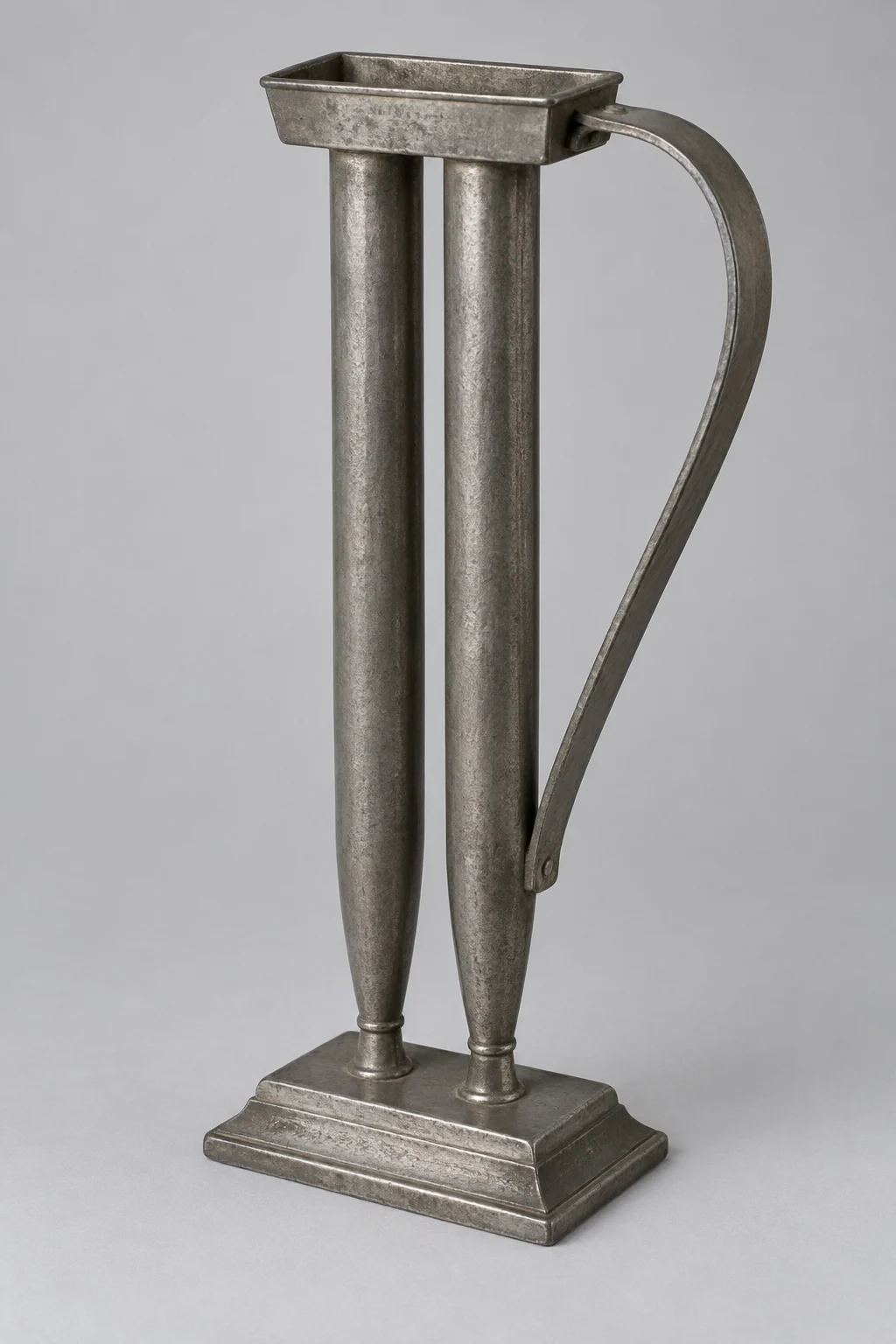
Burgess distinguishes the moulding of candles with cotton wicks from the older preparation of rushlights by dipping dried rushes in fat. He says candle moulds varied in size and in the number of cavities, and specifically identifies Figure 46 as an example with only two tubes. The illustration shows two long parallel outer tubes narrowing towards their lower ends, held between an upper tray and a low stepped base. A broad curved handle joins the upper part to the side of the assembly. These are the visible exterior forms; the drawing does not expose the interiors, wick fastenings or a complete sequence of assembly and use.
The mould belongs to the chapter's account of providing light for long winter evenings. Burgess places household preparations among women's domestic tasks, then contrasts the persistence of home candle-making in country districts with its growth into an urban trade. He associates the London makers with Candlewick Street, which he identifies with the later Cannon Street. Those statements describe his historical narrative, not a universal division of work or an independently established history of this particular mould. His surrounding discussion follows candles into storage boxes, holders and snuffers, and eventually contrasts such collected objects with electric lighting. The selected mould therefore represents a production step within the lighting cycle, rather than a candlestick or lamp.
History & identity
Fred. W. Burgess discusses this illustrated object in Chats on Old Copper and Brass. The retained imprint states first publication in 1914 and a second impression in 1925; the preface is dated London, 1914. Burgess writes for collectors and acknowledges museum and private lenders as well as drawings by Ethel Burgess. This is a historical collector’s account and published visual witness, not a modern verification of the object’s history.
Sources & representation
Figure 46 caption and complete Chapter IX, especially 0347, identify the two-tube form and household/trade context. The entire native i_197.jpg was viewed. Burgess says moulds were frequently brass but does not expressly identify this specimen’s alloy, maker, date, dimensions or manufacturing locality.
Selected bibliography
Documented works and useful reading. This is not a list of every appearance.
- 01
Chats on Old Copper and Brass
T. Fisher Unwin Ltd., London; retained second impression 1925, first published 1914, with preface dated 1914. Complete Chapters IX and XI and full preface read.
Language & cultural connections
Source-supported language and cultural connections have not yet been compiled for this profile.
References
Sources supporting this profile. Linked pages have their own scope and editorial standards.
- Historical collector’s account with captioned native illustrationsChats on Old Copper and Brass, retained 1925 impression of the 1914 workResearch access: 2026-10-18
Image credits
AI-generatedGenerated interpretation of a published historical form; not an authenticated specimen or exact replica. Internal cavities and wick attachments are not reconstructed. Handle attachment and lower collars are interpretive.