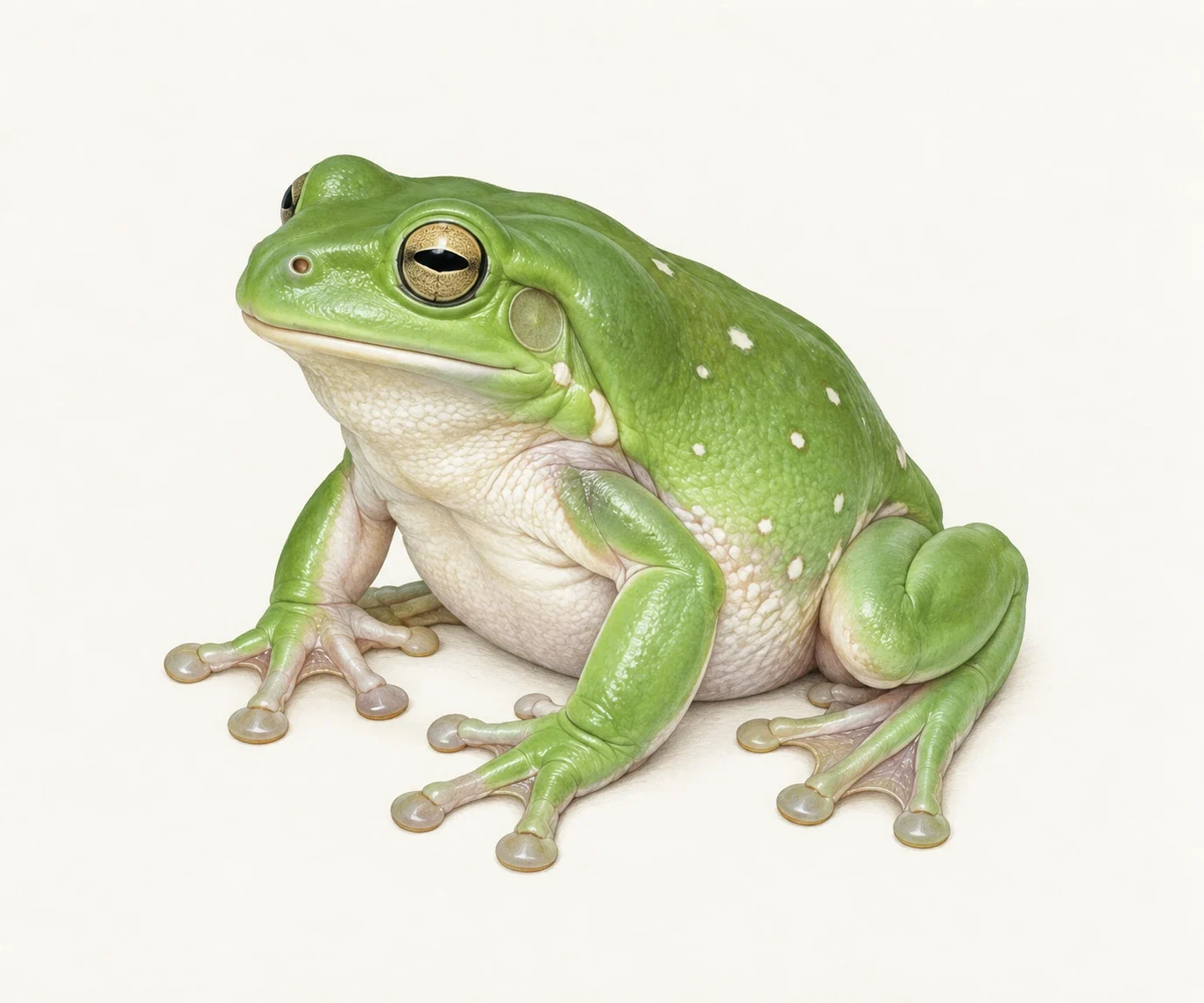
White’s tree frog - AI-generated scientific interpretation.
Modern AI-generated scientific illustration. Diagnostic features follow the selected zoological sources; pose, individual pattern and fine details are interpretive. Not specimen photography or independent evidence.
Overview
White’s tree frog has a robust body, a green back that may carry scattered white spots, and a pale underside. A golden iris surrounds a horizontal pupil. Large discs at the ends of the digits aid attachment, while partial webbing reflects a combination of climbing and aquatic stages rather than an exclusively aquatic adult.
The Australian Museum identifies variation in colour across the range, so one bright green illustration cannot stand for every individual. Its species account also documents a museum specimen used in a micro-CT scan. Such a scan reveals internal anatomy of a particular animal; it should not be treated as a measurement of every frog or as proof of all proposed climbing mechanisms.
The scientific name has changed as classifications have been revised. Amphibian Species of the World currently places the species in Pelodryas, following a 2025 revision, while the museum’s public account still uses Litoria caerulea. Older Ranoidea and Dryopsophus combinations also occur in the literature. These labels refer to a history of classification rather than several new species to count.
The current database restricts the accepted distribution and records comparisons with recently recognized relatives, including the New Guinea frog P. mira. Older broad geographic statements cannot automatically be assigned to the same modern species boundary. This researched profile should link to an existing matching bulk taxon rather than create a second taxonomic occurrence.
Origins & earliest records
White named the species as Rana caerulea in 1790 from New South Wales. The current combination is Pelodryas caerulea (White, 1790); original type specimens are presumed lost according to the museum taxonomy database.
Evidence & interpretation
The Australian Museum species page and specimen scan document external form and a collection reference. Amphibian Species of the World supplies nomenclatural history, current placement and a bibliography for distribution and revised boundaries.
Selected bibliography
Documented works and useful reading. This is not a list of every appearance.
- 01
Pelodryas caerulea
Selected bibliography; bounded source account, not exhaustive coverage.
- 02
Green Tree Frog
Selected bibliography; bounded source account, not exhaustive coverage.
Family, evolution & connections
Taxonomic classification
A hierarchy of classified groups, not a chain of direct ancestors.
Source note: The current AMNH database uses Pelodryas; Litoria caerulea remains a recognizable historical combination. Bulk-image-audit already mentions this taxon: preserve the existing taxon link rather than doublecount it.
- kingdomAnimalia
- phylumChordata
- classAmphibia
- orderAnura
- familyPelodryadidae
- genusPelodryas
- speciesPelodryas caerulea
References
Sources supporting this profile. Linked pages have their own scope and editorial standards.
- InstitutionalPelodryas caeruleaResearch access: 2026-10-10
- InstitutionalGreen Tree FrogResearch access: 2026-10-10
Image credits
AI-generated scientific interpretationWhite’s tree frog - AI-generated scientific interpretation.
Modern AI-generated scientific illustration. Diagnostic features follow the selected zoological sources; pose, individual pattern and fine details are interpretive. Not specimen photography or independent evidence.