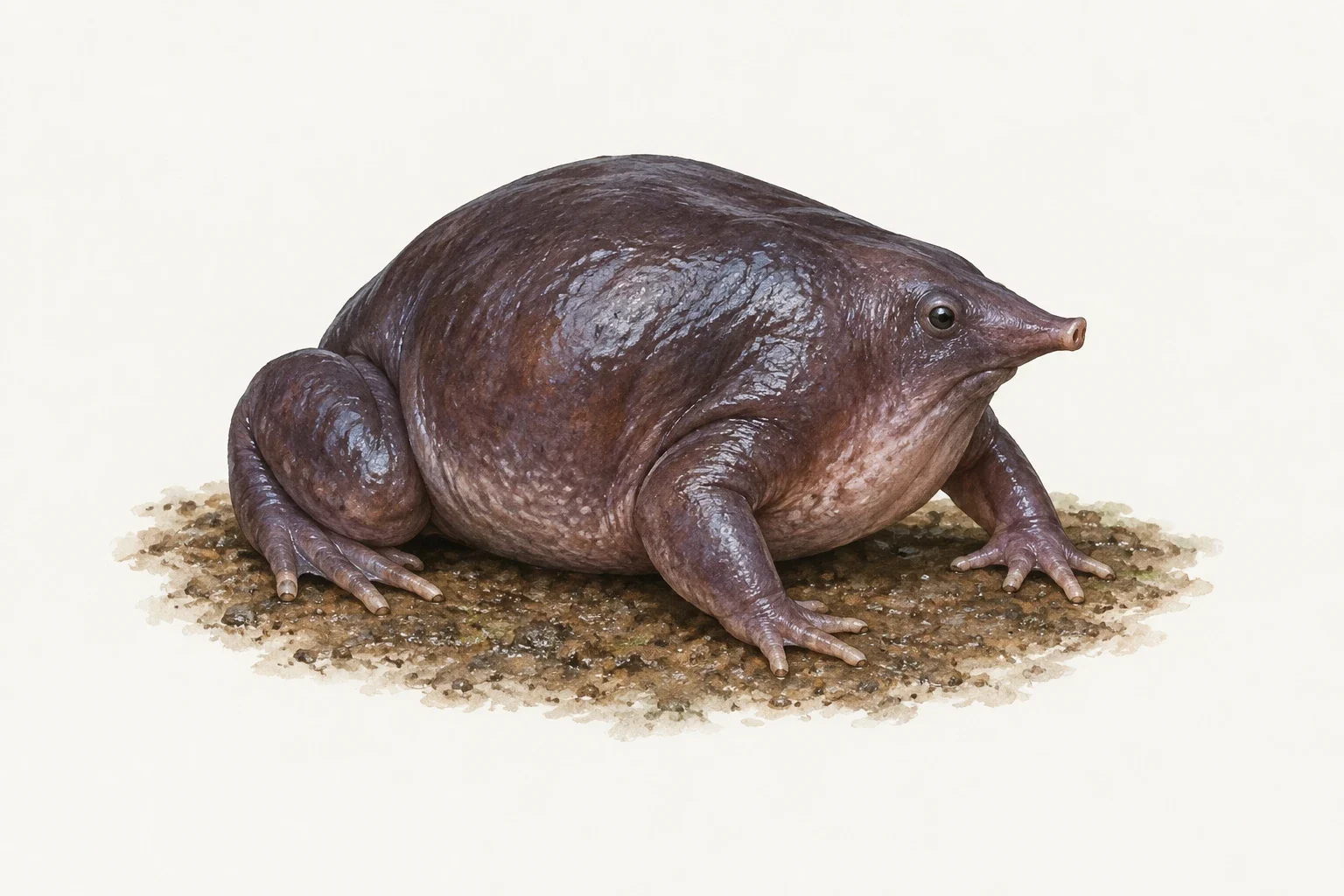
Purple frog - AI-generated scientific interpretation.
Modern AI-generated scientific illustration. Diagnostic external features follow the selected sources; pose, individual pattern and fine details are interpretive. Not photography or independent anatomical evidence.
Overview
The purple frog has a dark plump body, small head and distinctive pointed snout. Its fossorial adult life makes it difficult to observe, and external form differs markedly from a long-legged tree frog. The 2014 primary vocal study notes the absence of an external tympanum, while leaving aspects of internal sound reception unresolved.
Thomas and colleagues analysed 208 calls from ten males recorded in Kerala in 2012. Calls occurred in short pulsatile groups, and the study compared variation within and among individuals. Males called near tunnel openings beneath a thin layer of soil, connecting communication with a largely subterranean life rather than requiring an exposed waterside display.
The small sample and limited temperature range constrain conclusions about environmental effects. Antiphonal calling and overlap were observed, but an acoustic description is not the same as a playback experiment establishing what a receiver hears or prefers. Suggested roles for substrate vibrations remained questions for further study.
Modern museum taxonomy records a 2003 naming and discusses earlier publications on adults and larvae. Scientific description therefore should not be equated with the first human encounter. The family has deep relationships with Seychelles frogs, but those ancestral connections do not imply the living species remained unchanged since an ancient continental separation or that it is the sole species known in the family today.
Origins & earliest records
Nasikabatrachus sahyadrensis was named by Biju and Bossuyt in 2003 from Kattappana, Kerala. AMNH records holotype BNHM 4202 and earlier morphological literature; it also cites comparisons with N. bhupathi.
Evidence & interpretation
AMNH provides type and nomenclatural provenance. The openly accessible primary PLOS paper provides anatomy, field methods and bounded acoustic results. A direct 2003 Nature open returned Internal Error and was not retried; its full text is not claimed as read.
Selected bibliography
Documented works and useful reading. This is not a list of every appearance.
- 01
Nasikabatrachus sahyadrensis
Selected bibliography; bounded evidence and study-specific limitations retained.
- 02
Vocal Behavior of the Elusive Purple Frog of India, a Fossorial Species Endemic to the Western Ghats
Selected bibliography; bounded evidence and study-specific limitations retained.
Family, evolution & connections
Taxonomic classification
A hierarchy of classified groups, not a chain of direct ancestors.
Source note: The primary paper's 2014 sole-known-species statement is historical, not copied as current family coverage. Absence of an external eardrum does not prove absence of all hearing mechanisms.
- kingdomAnimalia
- phylumChordata
- classAmphibia
- orderAnura
- familyNasikabatrachidae
- genusNasikabatrachus
- speciesNasikabatrachus sahyadrensis
References
Sources supporting this profile. Linked pages have their own scope and editorial standards.
- InstitutionalNasikabatrachus sahyadrensisResearch access: 2026-10-10
- ResearchVocal Behavior of the Elusive Purple Frog of India, a Fossorial Species Endemic to the Western GhatsResearch access: 2026-10-10
Image credits
AI-generated scientific interpretationPurple frog - AI-generated scientific interpretation.
Modern AI-generated scientific illustration. Diagnostic external features follow the selected sources; pose, individual pattern and fine details are interpretive. Not photography or independent anatomical evidence.