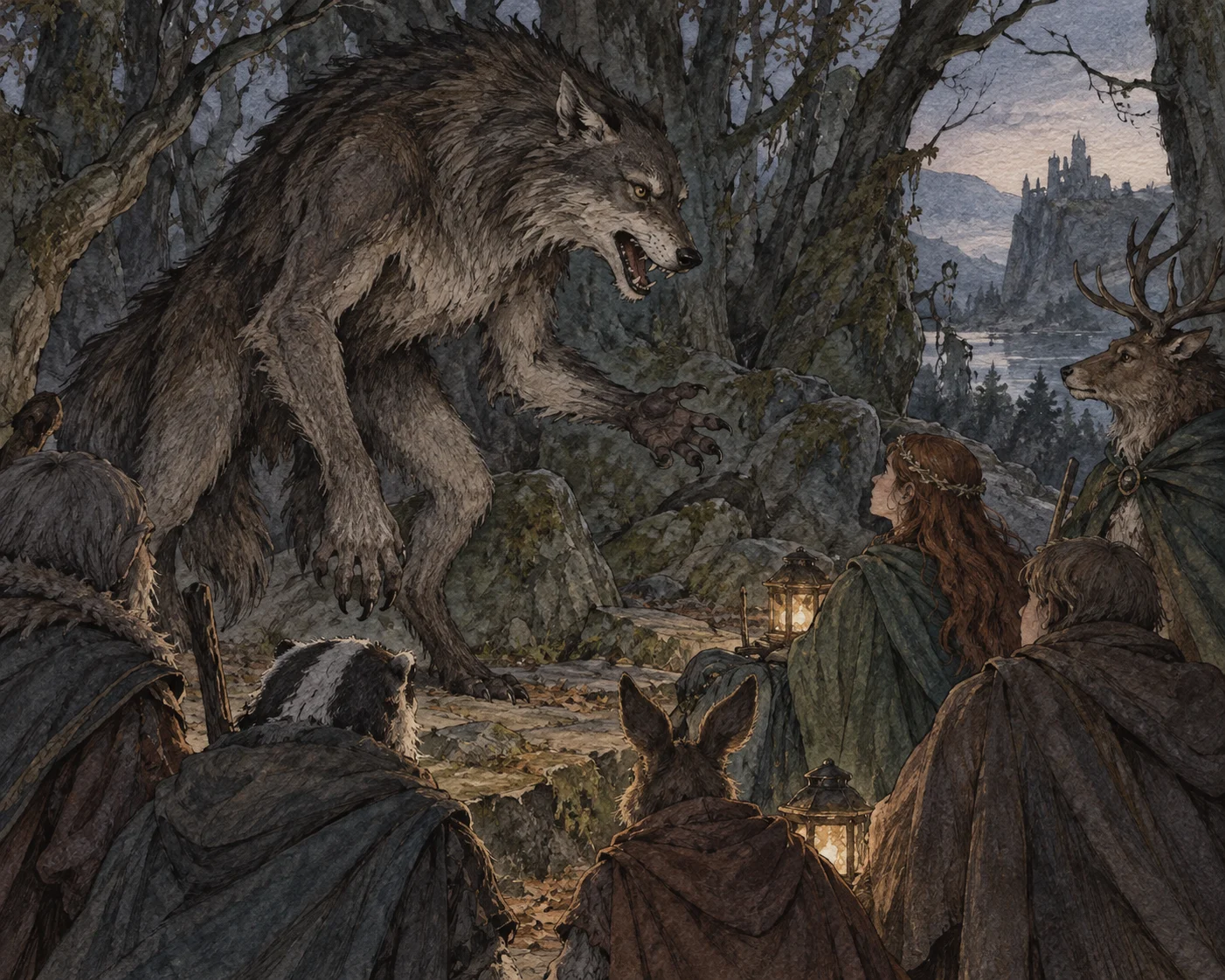
An imagined lupine Narnian werewolf at a dark meeting.
Original AI-generated interpretation; undescribed appearance, clothing and incidental setting are imagined, not official design evidence. Unofficial interpretation.
Overview
Narnian werewolves are speaking lupine monsters associated with the White Witch's followers, distinct from the world's ordinary wolves and Talking Wolves. Prince Caspian presents one alongside a hag in Nikabrik's proposed alliance. Its self-description boasts extraordinary hunger, resistance to cold and an enduring bite. Those statements communicate menace, but a threatening speech is not a controlled demonstration of every claimed capacity.
The confrontation around the attempted summoning makes the werewolf an immediate attacker rather than a remote legend. The novel does not establish a standard infectious lycanthropy system, a compulsory full-moon transformation timetable or a universal cure involving silver. The 2008 film supplies a separate visual treatment of the same plot role. This profile consequently preserves Lewis's specific monster and its claims without importing an entire modern werewolf rulebook or treating every Narnian wolf as the same creature type.
First appearances & development
Werewolves belong to the Witch's monstrous following in the 1950 Lion, the Witch and the Wardrobe, with a more substantial speaking and attacking role in 1951's Prince Caspian. The 2008 film provides another portrayal. This is a Narnian monster category, separate from ordinary wolves and from the mechanically defined lycanthropes of other franchises.
Canon & continuity
The inspected Prince Caspian dialogue establishes extraordinary endurance as the werewolf's own boasts. The book's confrontation and the independent species account supply its attacking role, while the adaptation is identified separately. Neither a bite nor borrowed folklore is used to invent a standard infection system. Priority 2 reflects a lupine monster type rather than a documented civilisation.
Selected bibliography
Documented works and useful reading. This is not a list of every appearance.
- 01
The Lion, the Witch and the Wardrobe
Fauns and Talking Beasts in published Narnia.
- 02
Prince Caspian
Old Narnian peoples under Telmarine rule.
- 03
The Chronicles of Narnia: Prince Caspian
Film adaptation: different minotaur allegiances and the White Witch summoning scene.
Family, evolution & connections
Werewolf
Baring-Gould’s northern chapter quotes Sigmund and Sinfjötli putting on wolf skins they cannot immediately remove. Their howled agreement, separate roaming and violent quarrel belong to that particular transmitted episode. This historical witness is compared with Werewolf (Narnia) through the shared creature-name; no common fictional history or documented creator-consulted source is established.
References
Sources supporting this profile. Linked pages have their own scope and editorial standards.
- ReferenceWerewolf (Narnia) — reference guideResearch access: 2026-10-05
- Primary workPrince Caspian — Canadian transcription, selected Glenstorm and summoning passagesResearch access: 2026-10-05
Image credits
Modern interpretationAn imagined lupine Narnian werewolf at a dark meeting.
Original AI-generated interpretation; undescribed appearance, clothing and incidental setting are imagined, not official design evidence. Unofficial interpretation.