A sourced illustration has not yet been added. This gap is included in the coverage record.
Overview
Spence’s account of old croft life describes a watermill driven by a horizontal wheel called a tirl. A small straw basket of grain kept nearby is the annual offering to the Water Neugle, intended to secure its good services. Neglecting the offering allows the being to grasp the tirl and stop the mill.
The account says that a firebrand dropped by the lightnin’ tree dislodges it. This selected passage identifies the being by its relationship with the watermill and reciprocal grain offering. It supplies neither horse anatomy nor a story of carrying a rider into water; those characteristics require other independently located witnesses.
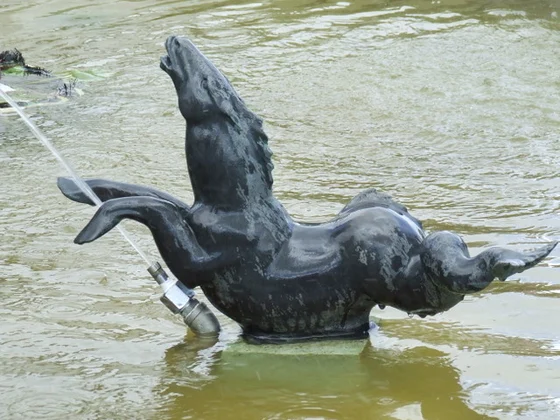
A separate passage in Spence’s Finn legends provides the missing form: the Neugle or nicker appears as a sleek horse with an upright mane and a tail compared to the rim of a large wheel. It frequents burns and lonely lakes, as well as stopping mills whose owners neglect offerings. An unwary night traveller who mounts it is carried swiftly into the middle of a lake or mill-dam and left struggling, while the being rushes toward the other shore like a streak of mareel. Spence explicitly says that the account does not report anyone actually drowned by it. Legendary Finns alone can ride it safely and may use it in their rapid journeys. The earlier mill passage and this fuller horse-and-rider notice are separate witnesses within the same book.
Black and Thomas’s printed extracts preserve several Shetland names, including Noggle, Neogle, Nuggle, Njuggle, Nygel and Nyugl. A New Statistical Account passage describes a beautiful saddled pony waiting near a stopped water-mill. A rider who mounts cannot control it and is thrown into the sea before the animal vanishes in flame. Karl Blind’s collected descriptions emphasize deception rather than direct attack: the pony frequents paths beside lochs and burns and offers an apparently convenient ride. One distinctive feature is a tail resembling a wheel rim, concealed between its hind legs when it seeks a rider.
Blind preserves disagreement about that tail. One correspondent does not know whether it serves for locomotion; another says it can be used as a propeller and gives Shoepultie as a local name. A Foula account printed from Reid describes a quadruped of varying size and colour, with glaring eyes, conspicuous teeth and the wheel-shaped tail turned above its back. It stops a mill wheel with its teeth and is also said to have expelled a household from a dwelling later left unoccupied for thirty years. These details belong to identified local reports rather than a fixed body assembled from all the extracts.
A Laurenson account supplied to Blind describes a man and his sister walking beside a burn with lights on a dark night. Sparks reach the water, a creature like a Shetland horse rises and rushes down to the sea, and the siblings identify it as Njuggle. Another anecdote follows an ancestor of George Henderson in Unst who mounts a white mare but dismounts when it persistently turns toward a loch; it moves over the water as blue flame. An old man’s Delting recitation describes grey horse appearance and riders receiving a dunking, while a Whalsay narrative gives a black horse’s uncontrolled ride ending in blue flame. Those endings show that being carried toward water need not be turned into a universally fatal encounter.
Origins & earliest records
John Spence, Shetland Folk-Lore (Lerwick: Johnson & Greig, 1899), Folk-Lore chapter, Social Life in Olden Times: watermill.
Records & interpretation
Historical local collection with named story participants, localities and explicitly attributed recollections.
Selected bibliography
Documented works and useful reading. This is not a list of every appearance.
- 01
Shetland Folk-Lore: Social Life in Olden Times: watermill
Title page and preface identify edition and nearly forty years of collecting; selected accounts, not a universal modern belief.
- 02
Shetland Folk-Lore: The Picts and Their Brochs, Neugle notice
Horse form, wheel-rim tail, watery ride, express no-reported-drowning qualification; Finn safe-rider exception.
- 03
County Folk-Lore III: Examples of Printed Folk-Lore concerning the Orkney & Shetland Islands, Noggle/Nuggle extracts
pp. 189–193. Blind Contemporary Review 1881, pp. 189–191; Gentleman’s Magazine 1882, pp. 369–370; Reid p. 31; New Statistical Account p. 142, quoted through compilation.
Family & connections
A source-supported family tree or inspiration record has not yet been compiled for this profile. Related reading below indicates a connection in subject matter, not a proven lineage or creative influence.
References
Sources supporting this profile. Linked pages have their own scope and editorial standards.
- Primary collected folklore accountsSpence 1899: Folk-Lore chapterResearch access: 2026-10-05
- Primary edition metadataSpence 1899: original title page and prefaceResearch access: 2026-10-05
- Primary collected folklore accountSpence 1899: Neugle in Finn legendsResearch access: 2026-10-05
- Primary printed compilationBlack and Thomas 1903, Nuggle local variants, pp. 189–193Research access: 2026-10-05
Image credits
A sourced illustration has not yet been added. This gap is included in the coverage record.