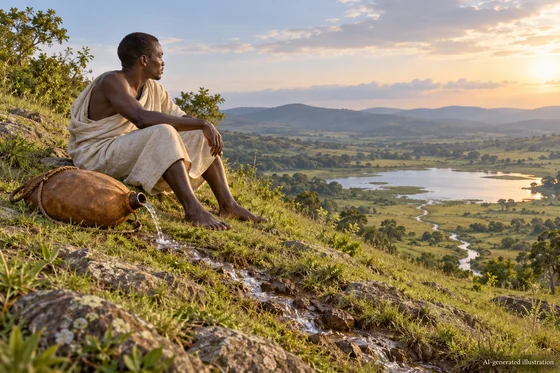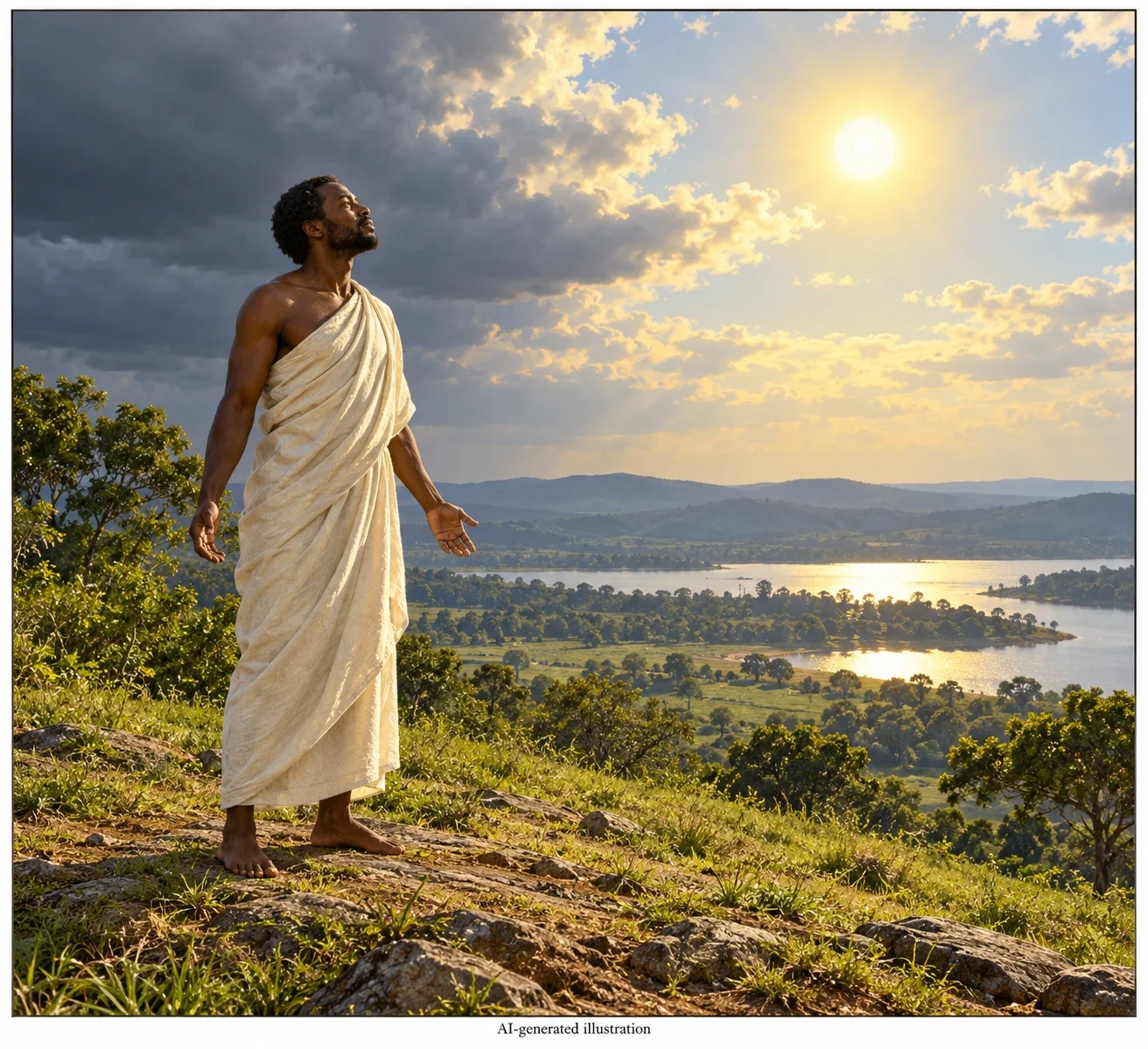
An imagined human representation of Wanga beneath returning sunlight.
Wanga restores the sun in Roscoe’s religion-chapter version of the Baganda account. Human appearance, garment and scenery are illustrative choices, not authenticated divine anatomy or historical costume.
Overview
Roscoe’s religion chapter places Wanga among the oldest gods known to his Baganda informants and gives a sequence of attributed divine kinship: Wanga is the father of Musisi, who is the father of Mukasa. Its central legend begins when the sun falls from the heavens and several days of darkness follow. King Juko appeals to Wanga, who comes from one of the Sese Islands and restores the sun. The king rewards him with an estate in Busiro. Wanga remains there, and a temple is subsequently built. The account gives a result rather than a description of how a divine body handles the sun.
Two other passages in the same volume preserve important differences. The clan account at Baka says the sun fails to shine for seven days and names Walusimbi as Juko’s messenger to Sese. In that telling Wanga raises both sun and moon to their places. The royal history instead supplies a human cause: a medicine-man, rebuked by Juko for giving an amulet to a young prince, commands the sun to fall. One of the king’s wives recommends summoning Wanga, who returns the sun to its place. These are separately located accounts, not three independently verified events or details that must be combined into a single definitive narrative.
The religion chapter also associates Wanga with sickness, disease and foretelling how shared misfortunes may be avoided. It compares his priests and medium with Mukasa’s, but does not describe a visible divine anatomy, clothing or implement. The Baka passage locates another remembered temple in a clan estate setting. Roscoe presents these accounts through a missionary collection shaped by Apolo Kagwa’s introductions to elders, priests, mediums and clan representatives. No individual narrator is named for these particular passages. Their publication documents attributed religious narrative and institutions; it does not date the beginning of the tradition or establish present-day agreement among Baganda communities.
Origins & earliest records
Roscoe, The Baganda (1911), religion chapter p. 313, compared with the complete selected Baka passage p. 146 and Juko subsection p. 219.
Records & interpretation
The complete Wanga religion subsection and the two separately located internal narrative witnesses were read continuously from retained original-edition OCR. Preface ix–xii read for collection method; chapter-length or modern community-consensus coverage is not claimed.
Selected bibliography
Documented works and useful reading. This is not a list of every appearance.
- 01
The Baganda: An Account of Their Native Customs and Beliefs
London: Macmillan. Wanga p. 313; Baka estate account p. 146; Juko subsection p. 219. Preface ix–xii explains mediation.
Family & connections
A source-supported family tree or inspiration record has not yet been compiled for this profile. Related reading below indicates a connection in subject matter, not a proven lineage or creative influence.
References
Sources supporting this profile. Linked pages have their own scope and editorial standards.
- Historical missionary-mediated ethnographic collectionRoscoe 1911 — Wanga in three separately located accountsResearch access: 2026-10-17
Image credits
Original narrative illustration; human appearance, costume and scenery are interpretive because the source supplies no physical description.An imagined human representation of Wanga beneath returning sunlight.
Wanga restores the sun in Roscoe’s religion-chapter version of the Baganda account. Human appearance, garment and scenery are illustrative choices, not authenticated divine anatomy or historical costume.