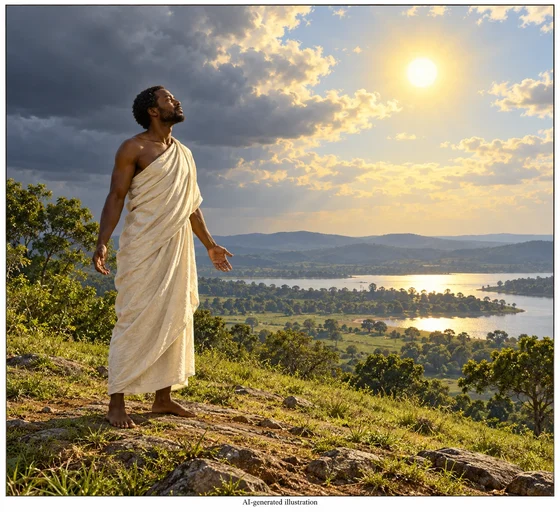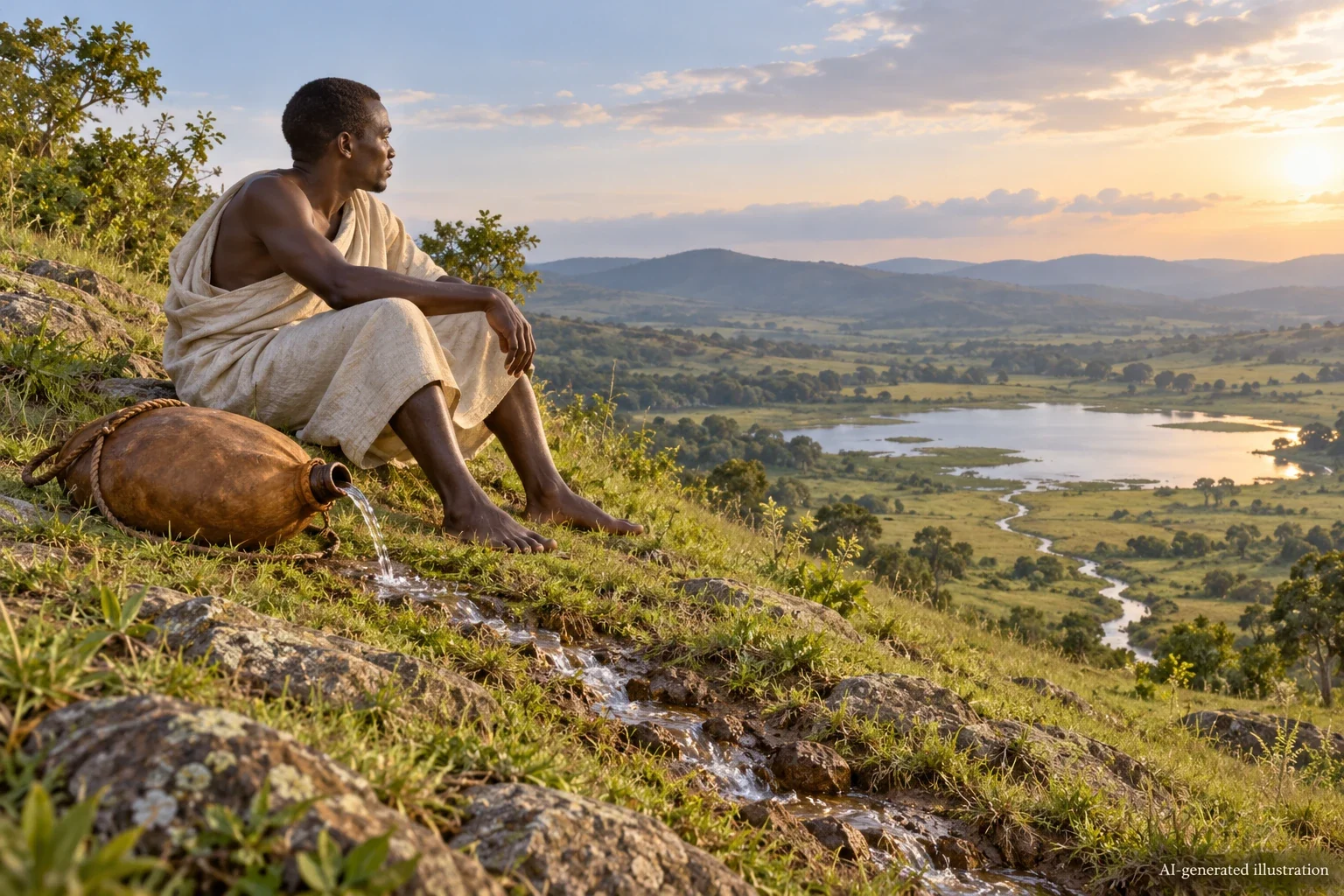
An imagined traveller rests on a hill beside a leaking hide water-skin.
Wamala rests beside a leaking water-skin in Roscoe’s lake-origin narrative. Human appearance, garment and scenery are illustrative choices, not authenticated divine anatomy or historical costume.
Overview
Roscoe’s Wamala subsection begins with a family living on one of the Sese Islands: Wamala, his father Musisi and his brother Wanema. A disagreement between the brothers becomes a wrestling match in which neither first gains the advantage. Wamala’s dog bites Wanema’s leg, allowing Wamala to throw him. Wanema responds by throwing ashes into Wamala’s eyes and temporarily blinding him. Wamala then gathers his possessions and leaves, intending to find a home where his brother cannot trouble him. The tale connects migration to a specific dispute rather than describing a separate species of water creature.
Carrying a skin of water, Wamala travels towards Singo. He rests on a hill and puts the skin beside him, where an accident releases its contents. The escaping water runs down the hill; a spring rises at that place, becomes a river and forms Lake Wamala in the valley. Wamala settles there, and a temple is later built in his honour. This is Roscoe’s attributed explanation of a named landscape. The passage supplies no mapped route, appearance of the deity, special container design or physical hydrological evidence that would authenticate the event.
The same subsection describes a female medium giving oracles at night, with priests and a petitioner sitting near a fire. Sheep are accepted as offerings and goats excluded. Access to the principal temple is reserved for the king’s messenger, while ordinary petitioners use lesser temples. Roscoe adds a rule against the building overseer cutting hair or nails while a temple is reconstructed, and reports human sacrifice at the lakeshore. These claims belong to his historical account and its collection context; they are neither recommendations nor statements about current practice. His preface credits Apolo Kagwa’s mediation, but does not identify an individual source for Wamala’s story.
Origins & earliest records
Roscoe, The Baganda (1911), Chapter IX, complete Wamala subsection pp. 314–315.
Records & interpretation
Complete continuous Wamala subsection read through the final sacrifice report to the separate Nagawonyi heading. Preface ix–xii read for mediation; no whole-book, field-observation or contemporary-practice claim.
Selected bibliography
Documented works and useful reading. This is not a list of every appearance.
- 01
The Baganda: An Account of Their Native Customs and Beliefs
London: Macmillan. Chapter IX, pp. 314–315, complete Wamala subsection; preface ix–xii.
Family & connections
A source-supported family tree or inspiration record has not yet been compiled for this profile. Related reading below indicates a connection in subject matter, not a proven lineage or creative influence.
References
Sources supporting this profile. Linked pages have their own scope and editorial standards.
- Historical missionary-mediated ethnographic collectionRoscoe 1911 — Wamala’s departure, lake origin and temple accountResearch access: 2026-10-17
Image credits
Original narrative illustration; human appearance, costume and scenery are interpretive because the source supplies no physical description.An imagined traveller rests on a hill beside a leaking hide water-skin.
Wamala rests beside a leaking water-skin in Roscoe’s lake-origin narrative. Human appearance, garment and scenery are illustrative choices, not authenticated divine anatomy or historical costume.