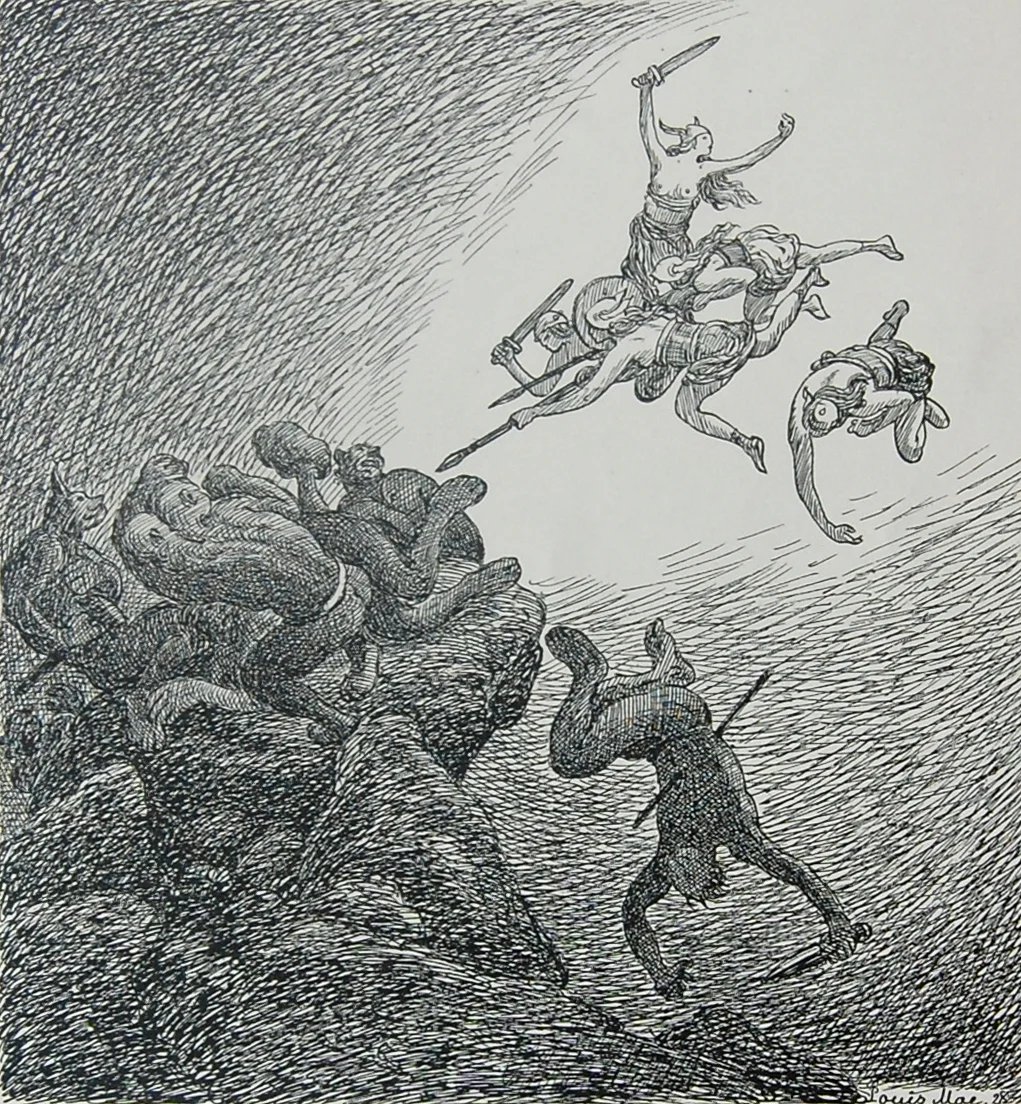
Valkyries ride and fight at Ragnarök, Louis Moe, 1929
Moe represents the valkyries as armed mounted women in the battle of Ragnarök. Their equipment, clothing and airborne arrangement belong to this later pictorial interpretation; the selected Eddic passages do not prescribe one uniform appearance for every valkyrie.
Overview
Blackwell’s Gylfaginning §37 describes Valkyrjor as women who serve drink and tend drinking horns and tables in Valhalla. Odin also sends them to battlefields to select those who will be slain and to influence victory. Gudur, Rota and the youngest Norn, Skuld, are specifically named as riders who choose the slain and turn the combat. Service within a hall and agency on a battlefield coexist in this prose account; neither is a complete description of every poetic character later called a valkyrie.
Thorpe’s introduction to The Lay of Volund identifies three women found spinning flax beside a lake as Valkyriur. Their swan plumages lie nearby. The brothers live with them, but they eventually fly away seeking conflicts, and two brothers leave in search of their partners. The prose gives seven years, whereas the verse stages seven winters, longing in the eighth and separation in the ninth. The women are named Hladgud-Svanhvit, Hervor-Alvit and Olrun; the prose supplies royal fathers and individual pairings. This is a particular swan-women episode, not proof that all valkyries are captured by stolen feathers.
The Lay of Sigrdrifa presents another relationship with battle authority. Its named valkyrie has defeated the warrior to whom Odin promised victory, provoking his punishment with a sleep-thorn and an end to her battle victories. After Sigurd wakes her, she becomes his teacher of runic knowledge and conduct. These located witnesses show variation in obedience, punishment, domestic partnership and supernatural knowledge; a single uniform armour, mount or physical size is not supplied by them.
Origins & earliest records
The selected witnesses are rendered by Benjamin Thorpe and I. A. Blackwell in the Norroena Society’s 1906 Elder and Younger Eddas. This edition brings several separately framed medieval accounts together; its publication date is not the beginning of the traditions.
Records & interpretation
Gylfaginning §37, p. 291, supplies Valhalla service and battle choice. The complete Lay of Volund, pp. 121–127, and Lay of Sigrdrifa, pp. 180–186, supply separate named poetic encounters.
Selected bibliography
Documented works and useful reading. This is not a list of every appearance.
- 01
Gylfaginning §37, p. 291
Complete selected passage on hall service, battlefield selection and named riders.
- 02
The Lay of Volund, pp. 121–127
Complete poem and introduction; swan-women identities supplied by the prose.
- 03
The Lay of Sigrdrifa, pp. 180–186
Complete selected poem through final vows.
Family & connections
A source-supported family tree or inspiration record has not yet been compiled for this profile. Related reading below indicates a connection in subject matter, not a proven lineage or creative influence.
References
Sources supporting this profile. Linked pages have their own scope and editorial standards.
- Primary poetic and prose translationsElder and Younger Eddas: selected 1906 Thorpe–Blackwell editionResearch access: 2026-10-05
Image credits
Historical illustrationValkyries ride and fight at Ragnarök, Louis Moe, 1929
Moe represents the valkyries as armed mounted women in the battle of Ragnarök. Their equipment, clothing and airborne arrangement belong to this later pictorial interpretation; the selected Eddic passages do not prescribe one uniform appearance for every valkyrie.