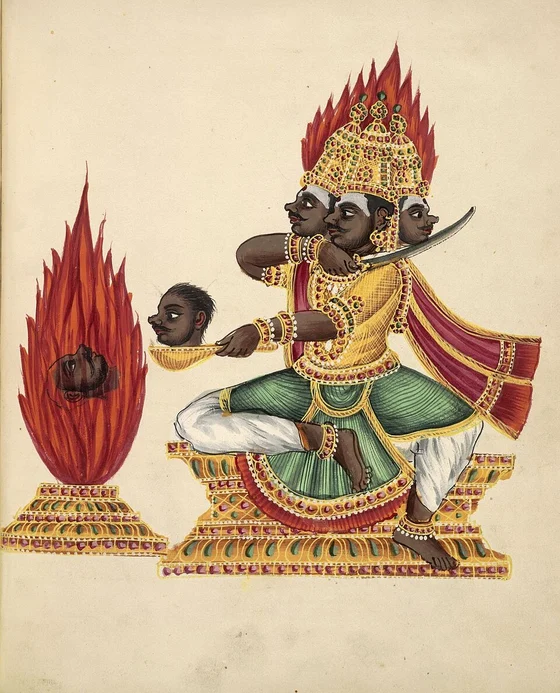
AI-generated interpretation of Vaka in Ganguli’s epic account. The huge build, red hair, beard and eyes, broad mouth, straight ears and forehead furrows follow the description. Skin colour, clothing detail, proportions and scenery are artistic choices.
This individual epic adversary does not define all rākṣasas or Dungeons & Dragons designs.
Overview
Vaka is the man-eating ruler who controls Ekachakra’s surrounding country in the Vaka-vadha episode of Ganguli’s Mahabharata translation. A Brahmana tells Kunti that the being protects the town against enemies but exacts a terrible fee: a cartload of rice, two buffaloes and the person who delivers them. Households take turns supplying it; avoiding the obligation brings death to an entire family. The speaker also blames the ineffective territorial king. Supernatural predation and failed human protection operate together in his account.
The Pandavas and Kunti are living in this household without revealing their identity. When its turn arrives, the father, mother and daughter each argue about who should die; their small son innocently offers to kill the Rakshasa with grass. Kunti promises to send Bhima instead, intending to repay their hosts’ kindness. The Brahmana initially refuses to endanger a guest, and Yudhishthira fears losing his brother. Kunti’s confidence in Bhima’s strength resolves their objections. The speeches reflect the episode’s particular social and religious arguments, not a universal modern code.
Bhima carries the food to the forest and deliberately eats it himself while calling Vaka. The approaching adversary has a huge body, red eyes, beard and hair, a wide mouth, straight ears and a forehead with three furrows. He strikes the still-eating Bhima, then tears up trees to use against him. After finishing the meal, Bhima catches a tree and fights back. Their contest strips the surroundings of trees before becoming a wrestling struggle. Bhima exhausts his opponent, forces him down and breaks his body; the following section confirms Vaka’s death.
The ending also concerns those who survive. Vaka’s frightened relatives and attendants appear, and Bhima requires them to promise never again to kill humans. The narrator says the region’s Rakshasas thereafter remain peaceful towards people. Bhima leaves Vaka’s body at a town gate and returns secretly. When the astonished townspeople question the household, the Brahmana conceals the Pandavas by crediting an unnamed mantra-skilled Brahmana. A commemorative festival follows. This named being’s tribute regime, confrontation and aftermath provide a complete epic account, not evidence that every Rakshasa has the same appearance or conduct, or that a modern game adopted this particular story.
Origins & earliest records
Mahabharata, Book 1, Adi Parva, Vaka-vadha Parva, sections CLIX–CLXVI in Kisari Mohan Ganguli’s historical English translation. Hosted title identifies the translation’s 1883–1896 publication period. Exact physical print exemplar and original Sanskrit recension were not independently collated.
Records & interpretation
All eight selected sections read completely, including the household’s deliberations, Kunti/Yudhishthira exchange, combat, surviving relatives and civic ending. Hosted title and complete translator’s preface read. Complete web-reader returns retained; no native HTML/original-page pixels acquired. No separate footnotes appear in these eight returned units.
Selected bibliography
Documented works and useful reading. This is not a list of every appearance.
- 01
The Mahabharata, Book 1: Adi Parva — Vaka-vadha Parva, CLIX–CLXVI
Complete selected episode, hosted page markers 327–337; section opens before marker 327; exact print exemplar unverified. No Sanskrit critical-edition collation.
Family, evolution & connections
Rakshasa
Ganguli’s Vaka is explicitly a Rakshasa in the Ekachakra episode. His tribute demands, appearance, defeat and surviving relatives’ pledge are particular to this epic account. The category includes diverse other witnesses; no tiger anatomy, game mechanics or designer consultation is inferred.
References
Sources supporting this profile. Linked pages have their own scope and editorial standards.
- Historical primary epic translationGanguli historical English translation, complete Vaka-vadha sections CLIX–CLXVIResearch access: 2026-10-26
- Primary bibliographic framingGanguli translation, hosted title and attribution noticeResearch access: 2026-10-26
Image credits
Modern interpretation of a historical literary accountAI-generated interpretation of Vaka in Ganguli’s epic account. The huge build, red hair, beard and eyes, broad mouth, straight ears and forehead furrows follow the description. Skin colour, clothing detail, proportions and scenery are artistic choices.
This individual epic adversary does not define all rākṣasas or Dungeons & Dragons designs.