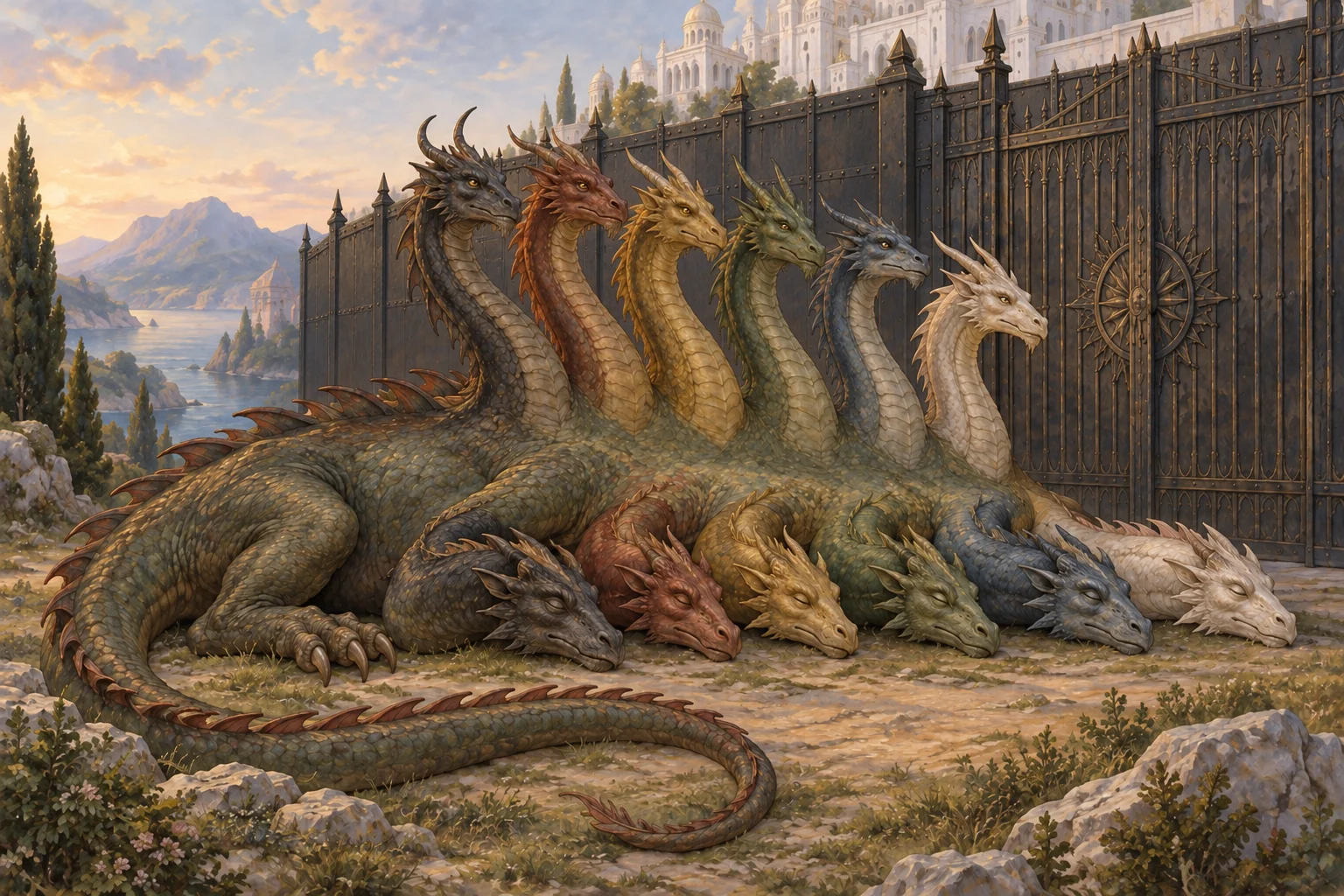
Twelve-headed dragon guards an iron gate, six heads awake and six resting.
AI-generated interpretation of gate guard before invisible mace attacks in Princess Miranda and Prince Hero, from Maude Ashurst Biggs’s 1920 translation of Glinski. Body proportions, neck layout, colour, exact eyes, limbs and claws are imagined; closed sleeping eyes are a visual reading. Prince outside frame is a choice; no wing anatomy specified. Original composition from historical prose; no source illustration copied. Horns, scales and palace landscape are imagined. Compressed for display.
Overview
Kosciey places this dragon at the sole entrance through the iron rampart surrounding Miranda’s palace. Six heads watch while six sleep, so its guard does not lapse. The narrator gives it twelve jaws and many claws. It cannot be killed by another’s direct act: death must come through its own action. No wings are described.
Hero sends an invisible, self-fighting mace against it. The weapon strikes every head despite the dragon’s efforts to locate its attacker. Its eyes become bloodshot, its wounds bleed and it hisses and shrieks; eventually it belches flame and in desperation drives its claws into its own flesh. That self-inflicted violence fulfils the stated condition of death, clearing the palace entrance. The mace is a magical object serving Hero, not an additional dragon, and this guardian’s conditional death is distinct from Kosciey’s external egg.
Origins & earliest records
Polish Fairy Tales, translated from A. J. Gliński by Maude Ashurst Biggs (1920), Princess Miranda and Prince Hero, pp. 15–28.
Records & interpretation
Complete selected English narrative through Kosciey’s death, the awakening and joint weddings. Biggs acknowledges shortening her source; no original Polish collation is claimed.
Selected bibliography
Documented works and useful reading. This is not a list of every appearance.
- 01
Polish Fairy Tales: Princess Miranda and Prince Hero, pp. 15–28
Complete selected English narrative; title, contents and translator’s preface read. No separately named oral contributor supplied.
Family & connections
A source-supported family tree or inspiration record has not yet been compiled for this profile. Related reading below indicates a connection in subject matter, not a proven lineage or creative influence.
References
Sources supporting this profile. Linked pages have their own scope and editorial standards.
- Primary historical shortened literary translationGliński/Biggs 1920: Miranda and HeroResearch access: 2026-10-05
Image credits
AI-generated interpretationTwelve-headed dragon guards an iron gate, six heads awake and six resting.
AI-generated interpretation of gate guard before invisible mace attacks in Princess Miranda and Prince Hero, from Maude Ashurst Biggs’s 1920 translation of Glinski. Body proportions, neck layout, colour, exact eyes, limbs and claws are imagined; closed sleeping eyes are a visual reading. Prince outside frame is a choice; no wing anatomy specified. Original composition from historical prose; no source illustration copied. Horns, scales and palace landscape are imagined. Compressed for display.