
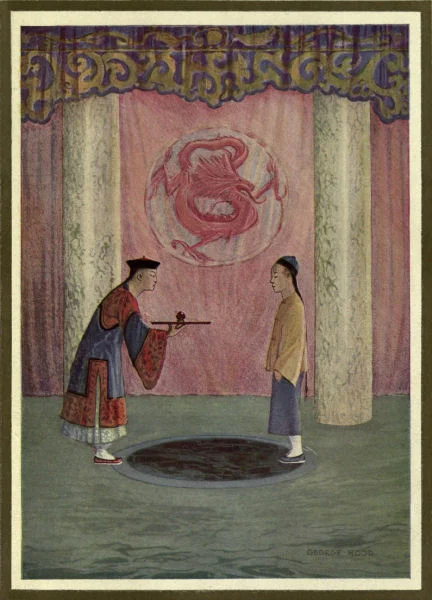
Tsian Tang in human guise presenting the red-amber platter to Liu I, George W. Hood, 1921
Hood shows Tsian Tang in his human guise presenting the red-amber platter and jewel to Liu I at the dragon palace. This is the gift scene in Wilhelm and Martens’s 1921 retelling. The dragon painted on the hanging screen is palace decoration, rather than a depiction of his earlier thousand-foot storm-dragon body; the rescued princess is not shown.
Overview
In Wilhelm and Martens’s account, Tsian Tang is the brother of the Dragon-King of the Sea of Dungting. His brother says that he formerly ruled the Tsian-Tang River but was deposed after his anger caused a great flood. A heavenly king entrusted him to his brother, who chained him to a palace column. The attached note explains that Tsian Tang is a place-name used for its local god.
When a letter reveals the mistreatment of his niece, he breaks out in the form of a thousand-foot red dragon, dragging the column and chain. The narrative gives him scarlet scales, flashing eyes, a blood-red tongue and a fiery beard, with thunder, lightning and wintry precipitation around him. He returns as a purple-robed young man carrying a sword, accompanied by the rescued princess. He reports killing six hundred thousand opponents, damaging fields for eight hundred miles and eating her husband alive; these enormous figures belong to his report within the story.
His brother rebukes the excess of his violence. At a later feast Tsian Tang pressures the messenger Liu I to marry the rescued princess. Liu I rejects the proposal as dishonourable, and Tsian Tang apologizes. The princess eventually marries Liu I through a separate human disguise, rather than as an immediate consequence of her uncle’s demand. The dragon’s fiery beard is a visual description; this episode does not explicitly say that he breathes fire.
Origins & earliest records
Chinese tales mediated by Richard Wilhelm and Frederick H. Martens
Records & interpretation
Complete tale and its attached source note read in the retained1921-edition transcription.
Selected bibliography
Documented works and useful reading. This is not a list of every appearance.
- 01
The Chinese Fairy Book
XLVII, The Disowned Princess, pp.151–161; New York, Frederick A. Stokes Company
Family, evolution & connections
The Dungting Dragon-Princess’s family — Wilhelm/Martens XLVII
Complete Dragon-Princess narrative and note, pp.151–161.
Scroll sideways to see all branches. With a keyboard, focus the tree and use the arrow keys.
- Two dragon brothers (sibling group, not a parent)
- Dungting Dragon-King, married to the unnamed Queen
- Her and Liu I’s unnamed son
Explicit king–brother relation, named uncle, king and queen’s daughter, later completed marriage and son. The root represents two brothers, not an invented parent. The princess’s older siblings are unstated individually. Her former Ging Dschou marriage is distinct from the later Liu I marriage; no son is assigned to the former husband. The separate princesses in XLV and XLVI are not merged.
Primary records and illustrations
Richard Wilhelm/Frederick H. Martens, The Chinese Fairy Book (Stokes1921)
Nature and Animal Tales. XLVII, The Disowned Princess, pp.151–161
Complete chapter and attached note read in wilhelm-XLVII.txt and29939.html. Source-specific identity, reported claims and complete ending preserved; earlier Chinese witness not independently collated.
References
Sources supporting this profile. Linked pages have their own scope and editorial standards.
- Historical translated taleWilhelm/Martens, The Chinese Fairy Book, The Disowned Princess, pp.151–161Research access: 2026-10-05
Image credits
Historical illustrationTsian Tang in human guise presenting the red-amber platter to Liu I, George W. Hood, 1921
Hood shows Tsian Tang in his human guise presenting the red-amber platter and jewel to Liu I at the dragon palace. This is the gift scene in Wilhelm and Martens’s 1921 retelling. The dragon painted on the hanging screen is palace decoration, rather than a depiction of his earlier thousand-foot storm-dragon body; the rescued princess is not shown.