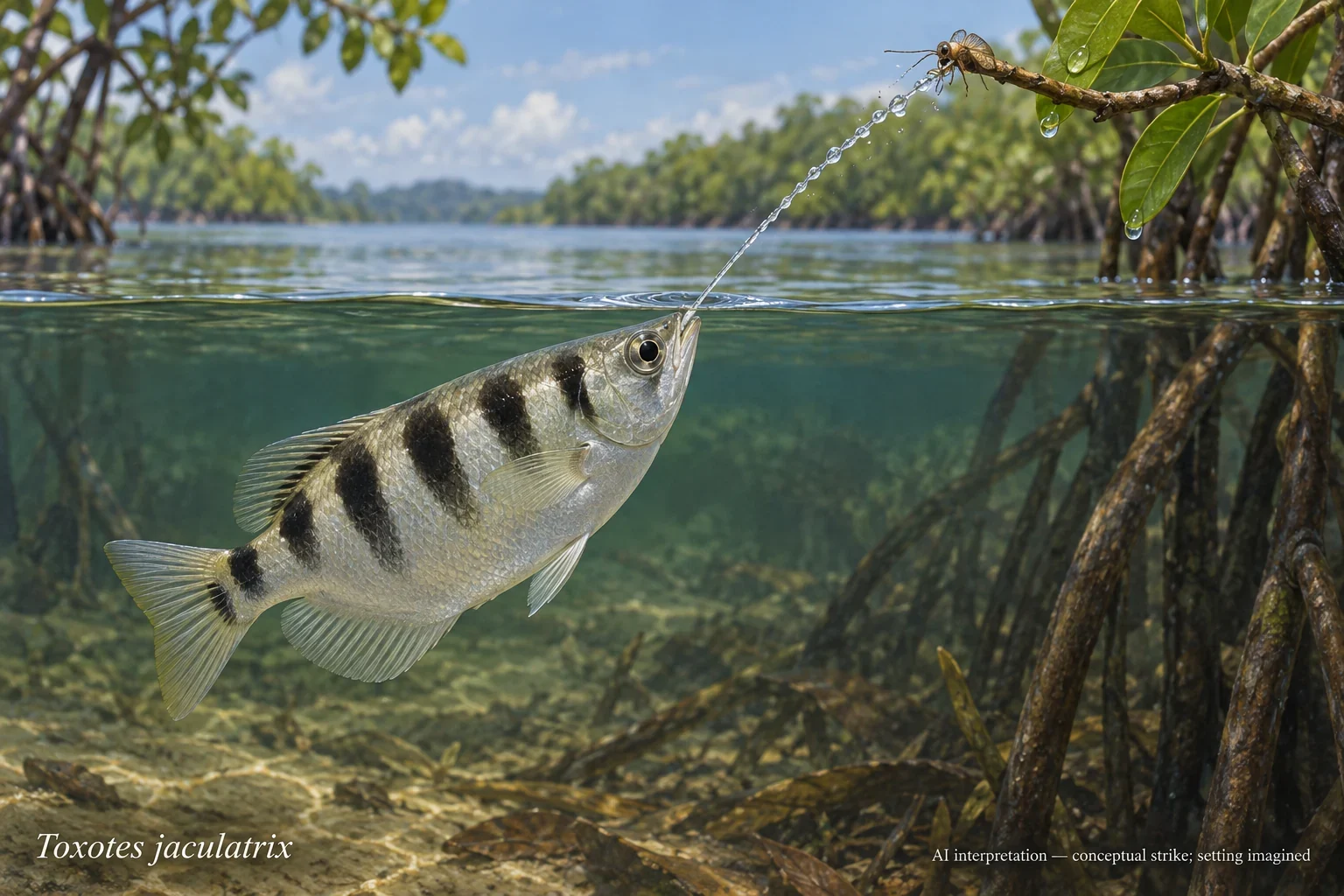
AI barred archerfish shooting above an imagined estuary.
AI interpretation of a conceptual archerfish strike; prey and setting imagined.
Overview
The museum describes four or five dark bars on the upper body. The fish usually occupies mangroves and estuaries, with Australian records from northwestern Western Australia to northern Queensland. Colour pattern and locality support identification; a hunting pose alone does not distinguish every archerfish.
To spit, the fish presses its tongue against the mouth roof, forming a channel. Rapid closure of the gill covers forces water through it. The illustrated jet explains the external hunting action rather than exposing invented internal anatomy.
The aquarium account places prey both at the surface and above the water, including overhanging mangrove branches. It describes coastal brackish habitat, while acknowledging freshwater occurrence. The imagined insect and perch illustrate this setting rather than a measured strike or guaranteed hunting range.
Origins & earliest records
Museum records and an aquarium species account describe identification, distribution and feeding.
Evidence & interpretation
The museum supplies the mouth mechanism; the aquarium account supplies the coastal feeding context.
Selected bibliography
Documented works and useful reading. This is not a list of every appearance.
- 01
- 02
Family, evolution & connections
Taxonomic classification
A hierarchy of classified groups, not a chain of direct ancestors.
Source note: Toxotidae placement follows the museum; hunting adaptations do not constitute a phylogenetic analysis.
References
Sources supporting this profile. Linked pages have their own scope and editorial standards.
- Institutional accountMuseum species accountResearch access: 2026-10-11
- Indexed institutional textAquarium species accountResearch access: 2026-10-11
Image credits
AI-generated interpretationAI barred archerfish shooting above an imagined estuary.
AI interpretation of a conceptual archerfish strike; prey and setting imagined.