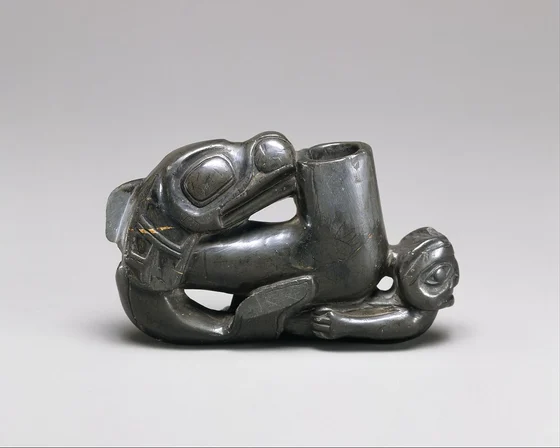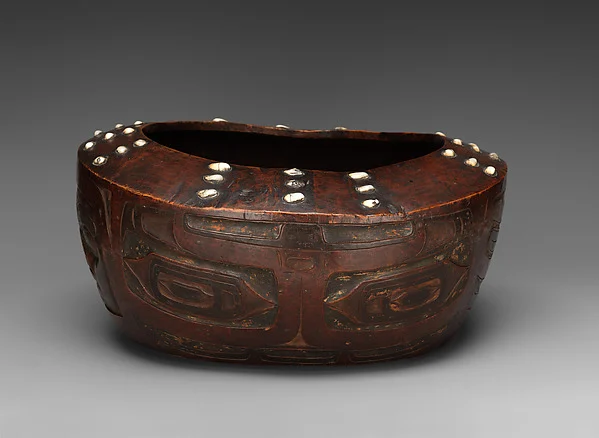
Historical Tlingit wooden bowl with shell inlays around its rim, Met accession 2021.434.5
This wooden bowl is catalogued as Tlingit, from Alaska, around 1750–1800. Shell inlays punctuate the rim, and carved designs occupy the outer surface. It offers one historical example of material culture, rather than a portrait of the living Tlingit people or a claim that all communities used identical objects.
Overview
Tlingit communities extend through southeastern Alaska and nearby islands, from Yakutat toward Ketchikan, and into Canada. The community-guided American Museum of Natural History presentation describes connections through marriage, clans and oral histories. Its account distinguishes matrilineal moieties, clans and houses: Raven stands opposite Eagle or Wolf, while marriage practices today do not invariably follow the older rule of marrying across moieties. Clan affiliation involves responsibilities and rights to crests, including permission to use them; these designs are not simply interchangeable decorative motifs.
Named contributors make this account concrete. Saantas’, Lani Hotch of Klukwan, explains how weavers adapt pattern templates using contemporary materials. Dax̱ootsu, Judith Ramos of Yakutat, connects identity with seasonal harvesting. The presentation describes ceremonial meals that combine locally gathered foods with other culinary influences. These examples concern living practices and particular speakers, rather than a requirement that every Tlingit person live or create in one prescribed way.
The Central Council of Tlingit and Haida Indian Tribes of Alaska tells a related political history while explicitly identifying Tlingit and Haida as distinct nations. Its timeline traces the Alaska Native Brotherhood’s formation in 1912, the 1929 decision to pursue land claims, and congressional recognition in 1935. The council describes its later work as serving enrolled citizens and preserving sovereignty, lands and cultural resources. This joint institution should not be mistaken for an assertion that Haida and Tlingit are one people. Its institutional history also does not define all Tlingit communities across the international border.
Sealaska Heritage Institute describes revitalization through fluent Elders, younger teachers, publications and classroom programs. The Tlingit Culture, Language and Literacy program began with the institute in 2000 and became supported by the Juneau school district; it incorporates language and culture into daily instruction and is open to all students. Educational participation therefore is not itself a statement of political citizenship. The institute’s resource catalogue identifies Beginning Tlingit by Nora Marks Dauenhauer and Richard Dauenhauer, first published in 1976, with a 2018 edition linking to audio. It also lists Lance X̱’unei Twitchell’s workbook as an extension of the Dauenhauers’ teaching approach. These are bibliographic descriptions, not claims that the complete books or recordings have been examined here.
History & identity
Regional and clan histories are distinct from the twentieth-century formation of a joint governmental institution.
Sources & representation
AMNH selected introduction, language, kinship, weaving and food sections; complete official governmental history body; SHI selected program descriptions and Tlingit resource catalogue. Linked recordings and books were not fully inspected.
Selected bibliography
Documented works and useful reading. This is not a list of every appearance.
- 01
Beginning Tlingit
SHI catalogue identifies this edition and the original 1976 publication; bibliography only.
- 02
Haa Shuká, Our Ancestors: Tlingit Oral Narratives
University of Washington Press/Sealaska Heritage Foundation; second printing 1988, copyright 1987.
- 03
[Signed statement dated 18 May 2022]
Untitled one-page statement hosted in the congressional meeting record; supplied descriptive title.
Language & cultural connections
These connections link languages or specific cultural works and institutions; they do not establish biological ancestry or ethnic identity.
Athabaskan–Eyak–Tlingit language family
The Alaska Native Language Archive groups Tlingit with an Athabaskan–Eyak branch and describes Eyak as a coordinate branch to Athabaskan, rather than an Athabaskan language itself. These are relationships between language systems, not a biological pedigree or a claim that their speakers form one people.
Located primary passages
Specific passages supporting details in this entry, grouped by their published witness.
Haa Shuká, Our Ancestors: Tlingit Oral Narratives
Second printing, 1988.
- The editors frame oral narratives as literature developed through community relationships. They acknowledge imperfect transfer into writing; this particular collaborative edition cannot represent every Tlingit tradition.
Complete Preface ix–xii (PDF 8–11); title/copyright PDF 4–5.
Narratives, Introduction, biographies and individual recording histories unread. Historical language-loss projections are not current demographic evidence; no independent Tlingit translation claimed.
[Signed statement dated 18 May 2022]
18 May 2022
- Hayes recalls being sent to residential homes as a teenager and interprets continuing family and cultural losses in relation to assimilationist policies. Her account challenges the idea that later individual achievements compensate for those losses. This is a named participant’s retrospective testimony, not an independently reconstructed history of every Tlingit family.
No live hearing, linked memoir or independent verification of each recollection claimed.
References
Sources supporting this profile. Linked pages have their own scope and editorial standards.
- Community-guided museumAMNH: Tlingit community presentationResearch access: 2026-10-05
- Tribal governmentTlingit & Haida: HistoryResearch access: 2026-10-05
- Indigenous cultural institutionSealaska Heritage Institute: Language resourcesResearch access: 2026-10-05
Image credits
Contextual cultural object photographHistorical Tlingit wooden bowl with shell inlays around its rim, Met accession 2021.434.5
This wooden bowl is catalogued as Tlingit, from Alaska, around 1750–1800. Shell inlays punctuate the rim, and carved designs occupy the outer surface. It offers one historical example of material culture, rather than a portrait of the living Tlingit people or a claim that all communities used identical objects.