
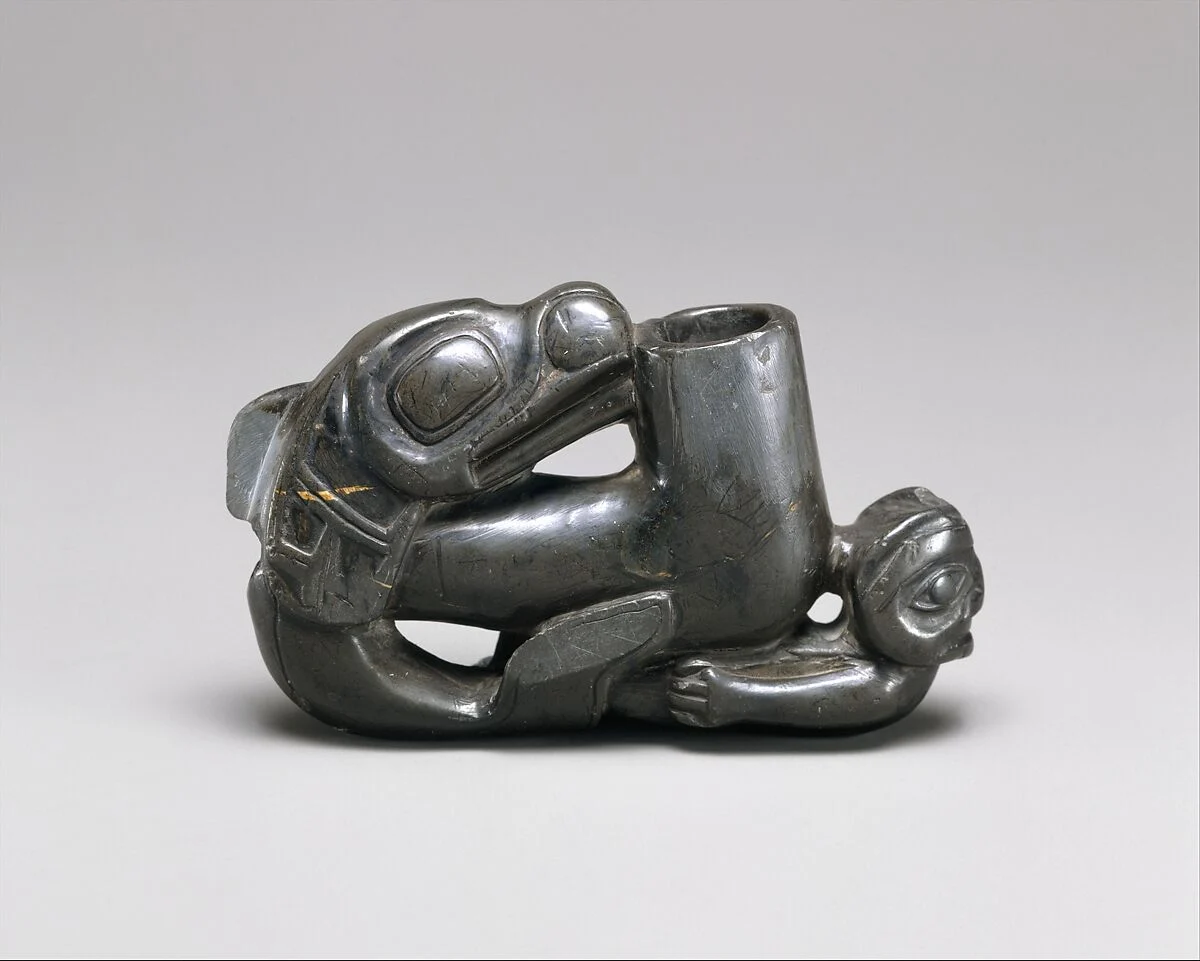
Haida argillite pipe bowl dated 1815–20, Met accession 2011.154.51
This argillite pipe bowl is catalogued as Haida and dated 1815–20, with British Columbia recorded as its place of origin. It is one historical material object, rather than a portrait of the living Nation or a representation of its present government. The catalogue does not identify its individual maker or name the carved figures.
Overview
The Haida Nation’s proclamation presents Haida Gwaii as its ancestral home and places responsibility for future generations in the living community. The Constitution expressly recognizes the separate jurisdiction of the Kaigani Haida. The Council of the Haida Nation therefore cannot silently be made the government of every Haida community across present-day international boundaries.
The Council was formed in 1974 to organize political action, including pursuit of a land settlement that retained Aboriginal title. Its institutional account distinguishes elected national representatives, the Hereditary Chiefs Council and the village governments of Old Massett and Skidegate. Representation also includes citizens in Prince Rupert and Vancouver. These structures serve different responsibilities; neither a village council nor a single hereditary title is an interchangeable name for the whole Nation. The creation of the Council dates a modern institution, not the origin of Haida identity.
The constitutional text adopted on 31 January 2026 identifies Haida society as matrilineal and recognizes hereditary matriarchs within governance. It distinguishes ancestry-based citizenship, a formal process for additional citizenship, family adoption and honorary recognition. Residence alone does not settle those different statuses. Haida and English are official languages. These provisions describe the Nation’s own dated governing framework, rather than an unchanging ethnic definition.
Language renewal takes place through particular communities and varieties. The Skidegate Haida Immersion Program describes its beginnings in 1998 and the work of fluent elders with adult learners. Its recordings support learning in the program, schools, homes and families living away from the islands. The public account emphasizes restoring everyday household use and intergenerational transmission. Its undated estimates of speakers and elders’ ages are not repeated here as present-day counts. The museum presentation distinguishes Alaska, Skidegate and Old Massett varieties, showing why one community’s learning program cannot represent every Haida speaker.
Contemporary expression includes the Nation’s Haida Laas publication, podcasts, public communications, language-learning books and storybooks. The communications program consults language authorities rather than treating spellings as arbitrary decoration. The AMNH Haida presentation, including Haida contributors, describes ceremony through respect and explains that songs and dances have holders of performance rights. Its accounts of repatriation and present-day cultural institutions also challenge the idea that museum objects represent a closed historical world. Public educational access to an image or recording does not establish permission to reproduce every associated song or cultural expression.
Mudalaaw Elizabeth Moore's 2019 recollections give language renewal a concrete social history. Following immersion gatherings, elders wanted regular opportunities to converse; Saturday dinners combined language use, shared food and volunteer fundraising. A 1994 visit to Maori language nests later helped inspire a nest at the Dii Tuulang Nee Family Centre in Old Massett. The community organization sustained that program there until 2012. This interview records one participant's experience of collective organizing, rather than a single history of every Haida language initiative.
History & identity
Haida self-description centres ancestral responsibility to Haida Gwaii. Modern institutional dates are documented separately from the history of the people.
Sources & representation
Council institutional account, selected constitutional provisions and adoption statement, Skidegate immersion-program account, communications description and selected AMNH Haida introduction/ceremony material. No whole exhibition-video or linked publication reading is claimed.
Selected bibliography
Documented works and useful reading. This is not a list of every appearance.
- 01
Constitution of the Haida Nation
Web text identifies adoption on31January2026; selected territorial, citizenship, language and governance provisions used.
- 02
Haida Laas
Ongoing official publication, identified through the communications account; no individual issue treated as fully read here.
- 03
Haida Laas: language edition
Complete interview, pp. 12–13.
- 04
The Shared Love for the Language Brings Everyone to the Table: An Interview with Mudalaaw Elizabeth Moore
Haida Laas, Haida Language Edition, 2019.
Language & cultural connections
These connections link languages or specific cultural works and institutions; they do not establish biological ancestry or ethnic identity.
Skidegate Haida Immersion Program and Xaad Kíl Née
The Council’s communications program consults these language authorities on appropriate language use and spelling.
Located primary passages
Specific passages supporting details in this entry, grouped by their published witness.
Primary source witness
2019
- Moore recalls community language revitalization and learning from Māori language nests.
Participant recollection; remaining issue unread.
References
Sources supporting this profile. Linked pages have their own scope and editorial standards.
- Community-authoredCouncil of the Haida NationResearch access: 2026-10-05
- Community-authoredHaida Constitution,2026web textResearch access: 2026-10-05
- Community-authoredSkidegate Haida Immersion ProgramResearch access: 2026-10-05
- Community-authoredCommunications and publicationsResearch access: 2026-10-05
- MuseumAMNH Haida presentationResearch access: 2026-10-05
- Community-authoredHaida Laas interviewResearch access: 2026-10-05
Image credits
Contextual cultural object photographHaida argillite pipe bowl dated 1815–20, Met accession 2011.154.51
This argillite pipe bowl is catalogued as Haida and dated 1815–20, with British Columbia recorded as its place of origin. It is one historical material object, rather than a portrait of the living Nation or a representation of its present government. The catalogue does not identify its individual maker or name the carved figures.