
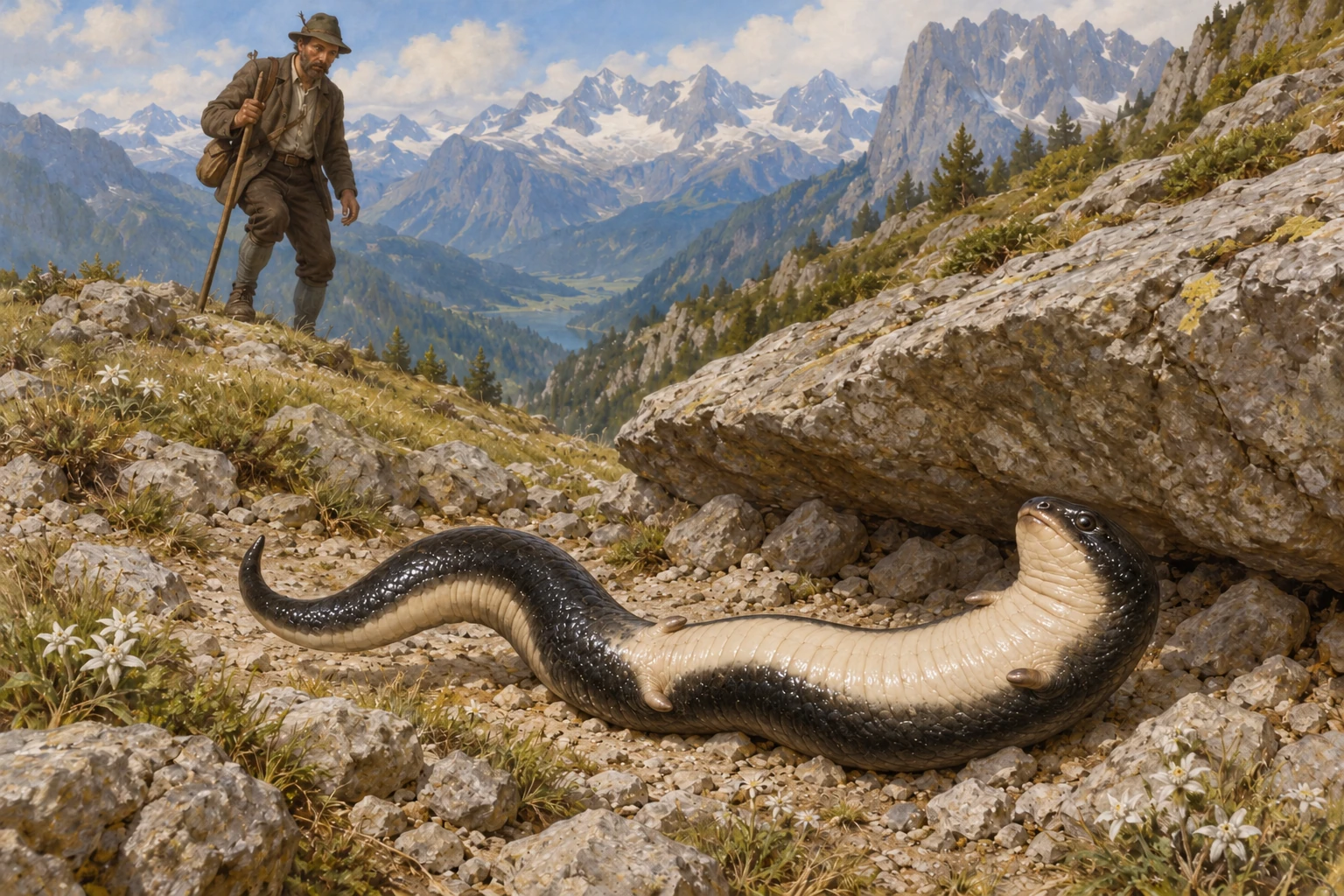
AI-generated interpretation of Bacher’s reported encounter in Anderl’s 1895 correspondence. The four tiny paws, dark back, pale belly, broad head and tumble follow this account. Exact surface texture, eyes, landscape and the herdsman’s appearance are imagined. This illustrates reported testimony, not a verified species or the God of War design.
Bacher’s four-pawed description is kept separate from Sandtner’s account, which does not count the feet. The cat-head comparison does not imply cat ears, fur or whiskers.
Overview
Josef von Doblhoff’s 1895 journal article prints a letter dated 4 June 1895 from Anderl, a royal Bavarian forestry official at Leogang. Anderl distinguishes the Bergstutz, which he thinks usually represents a copper-coloured snake, from the Tatzelwurm described as a snake-like animal with feet. He explicitly says he has not seen the alleged Tatzelwurm himself. His letter therefore supplies a named channel of testimony and local interpretation, rather than a naturalist’s verified specimen or direct personal observation.
The first report reaches Anderl after his transfer to Ruhpolding in November 1850. His predecessor Engelbert Sandtner is said to have seen a lizard-like animal several months earlier at Sulzemoos. It clings to the side of a tree stump with short feet, has a dark back resembling the bark and a lighter underside, and is described as two to three historical Schuh long. The letter does not count Sandtner’s animal’s feet. Anderl sees ordinary snakes and salamanders at the locality in 1850–51 but never sees the creature Sandtner described, so his later visit does not independently corroborate it.
The second narrative concerns Mathias Bacher, a herdsman who reportedly climbs the Spielberghorn from the Reichenspielberg Alp to gather edelweiss. About nine years before the letter, he hears a hissing whistle and sees a black, arm-thick creature coming downhill. He thinks it is pursuing him and jumps aside. The animal overturns on a slanting stone slab and wriggles on its back, giving him an opportunity to inspect it from approximately ten paces. When it rights itself and looks at him, he escapes sideways across the steep slope. The sequence makes mistaken or frightened perception part of the evidentiary question; pursuit is Bacher’s interpretation of its movement.
Bacher’s reported anatomy is unusually specific: a pale belly, four tiny paws compared in size and shape to an index fingernail, and a broad round head compared to a fist and a cat’s head. The head joins the body almost without a neck. The belly between the forepaws and hindpaws spans two to three historical Spannen; a broad flat tail tapers to a point, with the source glossing its length as approximately 20 centimetres. These are this report’s proportions, not a standard body for every Alpine worm. The cat comparison does not supply cat ears, fur or whiskers, and the tiny paws do not establish a toe count.
The letter adds that Bacher knew the local copper-coloured snakes but never saw the alleged animal either before or after this event. He particularly associates the following day with the beginning of prolonged severe weather. The report records that association without proving that the creature predicts or causes storms. Doblhoff’s publication documents a late nineteenth-century attempt to collect named reports and compare interpretations. It does not establish an ancient Alpine species, a verified zoological discovery, or a Norse setting for this historical tradition. In his framing of the newer correspondence, Doblhoff calls the material superstition and attributes its persistence to the strength of tradition despite educated criticism. That is the collector’s assessment, rather than an independently demonstrated explanation of what Bacher perceived.
Origins & earliest records
Source-specific Alpine reported encounters transmitted in Anderl’s correspondence and published by Doblhoff. The 1850 recollection is not the publication date. No earliest attestation or complete history of the name is claimed.
Records & interpretation
Complete printed p.149 and dated footnote inspected in the original German page image; English is original paraphrase with a retained private working translation. Named observers are mediated through Anderl and the collector. No specimen or contemporary independent sighting verification supplied.
Selected bibliography
Documented works and useful reading. This is not a list of every appearance.
- 01
Altes und Neues vom Tatzelwurm
Complete Anderl correspondence unit, printed p.149, with footnote dated 4 June 1895. Selected collector framing on pp.148 and 151 also read.
Family, evolution & connections
Tatzelwurm (God of War)
God of War uses the Tatzelwurm name for its separately documented fictional enemy. Anderl’s 1895 correspondence gives specific Alpine reports with variable detail, including Bacher’s four tiny paws and a cat-compared head. The game’s Norse setting and mechanics are separate from the Alpine testimony; the shared name does not establish creator consultation, shared biology or direct adaptation of this letter.
References
Sources supporting this profile. Linked pages have their own scope and editorial standards.
- Historical collected correspondence in original GermanDoblhoff, complete Anderl correspondence, p.149 and note 1; selected collector framing, pp.148 and 151Research access: 2026-10-26
Image credits
Modern interpretation of a historical literary accountAI-generated interpretation of Bacher’s reported encounter in Anderl’s 1895 correspondence. The four tiny paws, dark back, pale belly, broad head and tumble follow this account. Exact surface texture, eyes, landscape and the herdsman’s appearance are imagined. This illustrates reported testimony, not a verified species or the God of War design.
Bacher’s four-pawed description is kept separate from Sandtner’s account, which does not count the feet. The cat-head comparison does not imply cat ears, fur or whiskers.