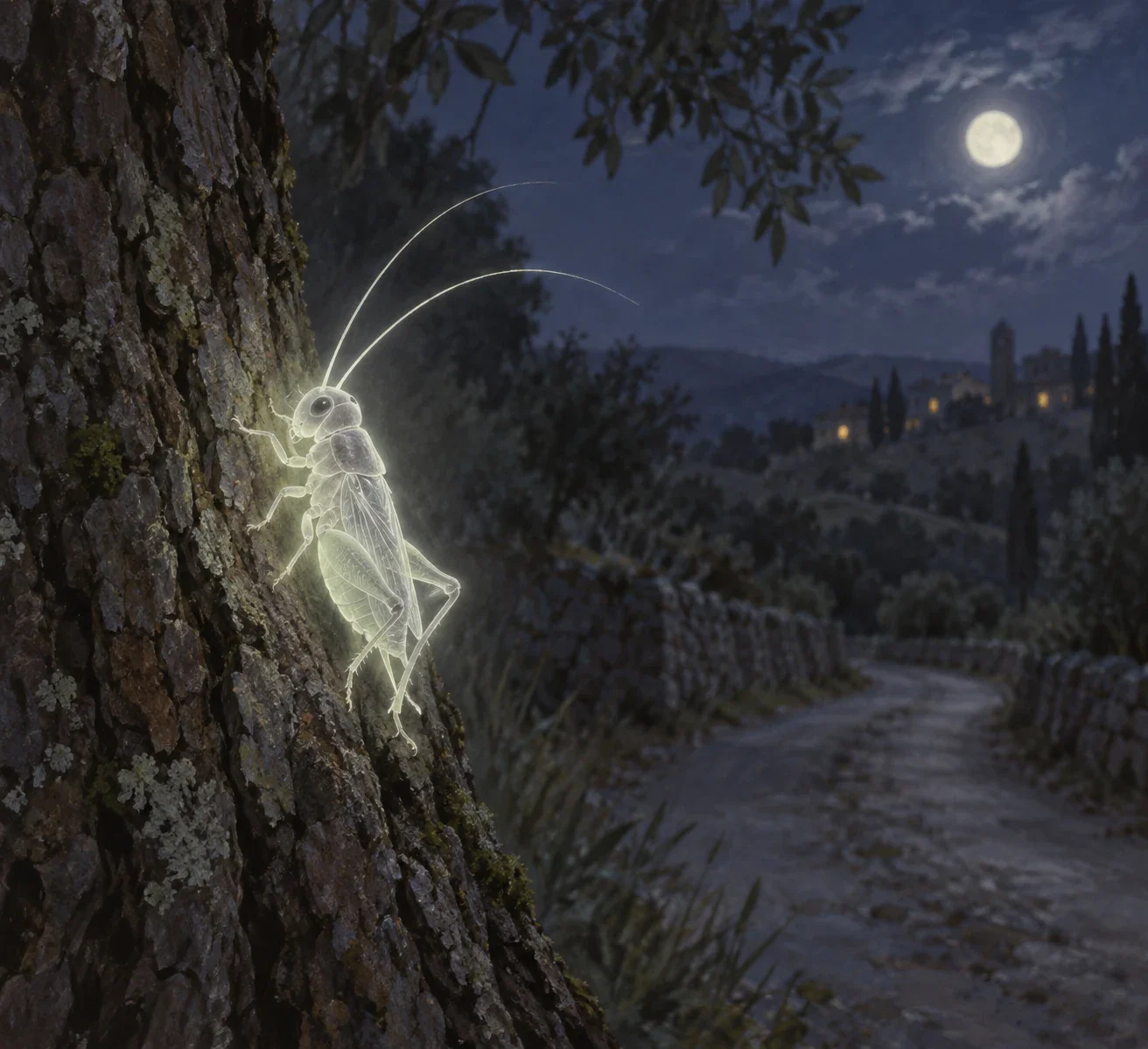
Unofficial AI interpretation of the Talking Cricket’s pale-lit ghost on a tree trunk. This follows the selected night-road episode; precise insect anatomy, colour, scale, bark and distant setting are imagined. No adaptation costume or general glowing living-cricket claim is intended.
Unofficial AI interpretation of the Talking Cricket’s pale-lit ghost on a tree trunk. This follows the selected night-road episode; precise insect anatomy, colour, scale, bark and distant setting are imagined. No adaptation costume or general glowing living-cricket claim is intended. Full-frame display derivative; no upscaling.
Overview
Pinocchio first encounters the Cricket in Geppetto’s room after the carpenter has been taken to prison. A large cricket crawls up the wall and says that he has lived in the room for more than a hundred years. This age is the character’s own statement. He refuses to leave before advising the marionette against disobedience and aimless idleness, urging school or a trade. The narrator calls him a wise old philosopher, while Pinocchio treats correction as an intrusion. The passage identifies an insect but supplies no exact colour, measurements or complete diagnostic anatomy.
Pinocchio throws a hammer at him, and the narrator explicitly describes his death. On the later night journey, a tiny insect glimmers on a tree trunk with pale, soft light and identifies himself as the Cricket’s ghost. He warns against promises of sudden wealth and urges Pinocchio to return home with the remaining coins. The marionette ignores him and continues towards danger. This selected ghost presentation is a later episode; its glow should not be silently applied to every living appearance or expanded into additional spectral powers.
At the Fairy’s house, a Talking Cricket joins the Crow and Owl among the summoned doctors. Rather than adding another uncertain diagnosis, he criticises a doctor who speaks without knowing and recognises Pinocchio’s behaviour. His comments cause the marionette to react beneath the sheets. The story thus returns the familiar adviser to a new role, but does not provide a systematic explanation of resurrection or a fixed taxonomy of ghosts. These appearances remain part of the original narrative’s continuity rather than evidence for an adaptation’s separate named conscience character.
After escaping the Shark, Pinocchio and Geppetto find a straw cottage whose owner speaks from a ceiling beam. The Cricket recalls the hammer but spares both father and son, explaining that kindness should be shown to others before one needs it oneself. He says a blue-haired goat gave him the cottage and directs Pinocchio to a nearby farmer for milk. Pinocchio interprets the goat as his Fairy; that recognition is attributed to him. The Cricket’s final assistance turns moral correction into shelter and practical help, without claiming that he controls Pinocchio’s choices.
First appearances & development
This profile follows Collodi’s original literary sequence as represented in Carol Della Chiesa’s English translation. The living wall-dweller, self-identified ghost, doctor and cottage host are distinguished by episode. No screen costume, separate adaptation name or invented account of how death is reversed is imported.
Canon & continuity
Complete primary translated text supports the selected episodes and attributed dialogue. Catalogue metadata establishes the translation and public-domain witness; its automated plot summary was not used.
Selected bibliography
Documented works and useful reading. This is not a list of every appearance.
- 01
The Adventures of Pinocchio
Original literary narrative in the identified translation. Electronic credits and later adaptations are distinguished; no source artwork was used.
Family & connections
A source-supported family tree or inspiration record has not yet been compiled for this profile. Related reading below indicates a connection in subject matter, not a proven lineage or creative influence.
References
Sources supporting this profile. Linked pages have their own scope and editorial standards.
- Primary fictionThe Adventures of Pinocchio — primary translated textResearch access: 2026-10-11
- Bibliographic and rights recordProject Gutenberg catalogue: The Adventures of PinocchioResearch access: 2026-10-11
Image credits
Unofficial modern AI interpretationUnofficial AI interpretation of the Talking Cricket’s pale-lit ghost on a tree trunk. This follows the selected night-road episode; precise insect anatomy, colour, scale, bark and distant setting are imagined. No adaptation costume or general glowing living-cricket claim is intended.
Unofficial AI interpretation of the Talking Cricket’s pale-lit ghost on a tree trunk. This follows the selected night-road episode; precise insect anatomy, colour, scale, bark and distant setting are imagined. No adaptation costume or general glowing living-cricket claim is intended. Full-frame display derivative; no upscaling.