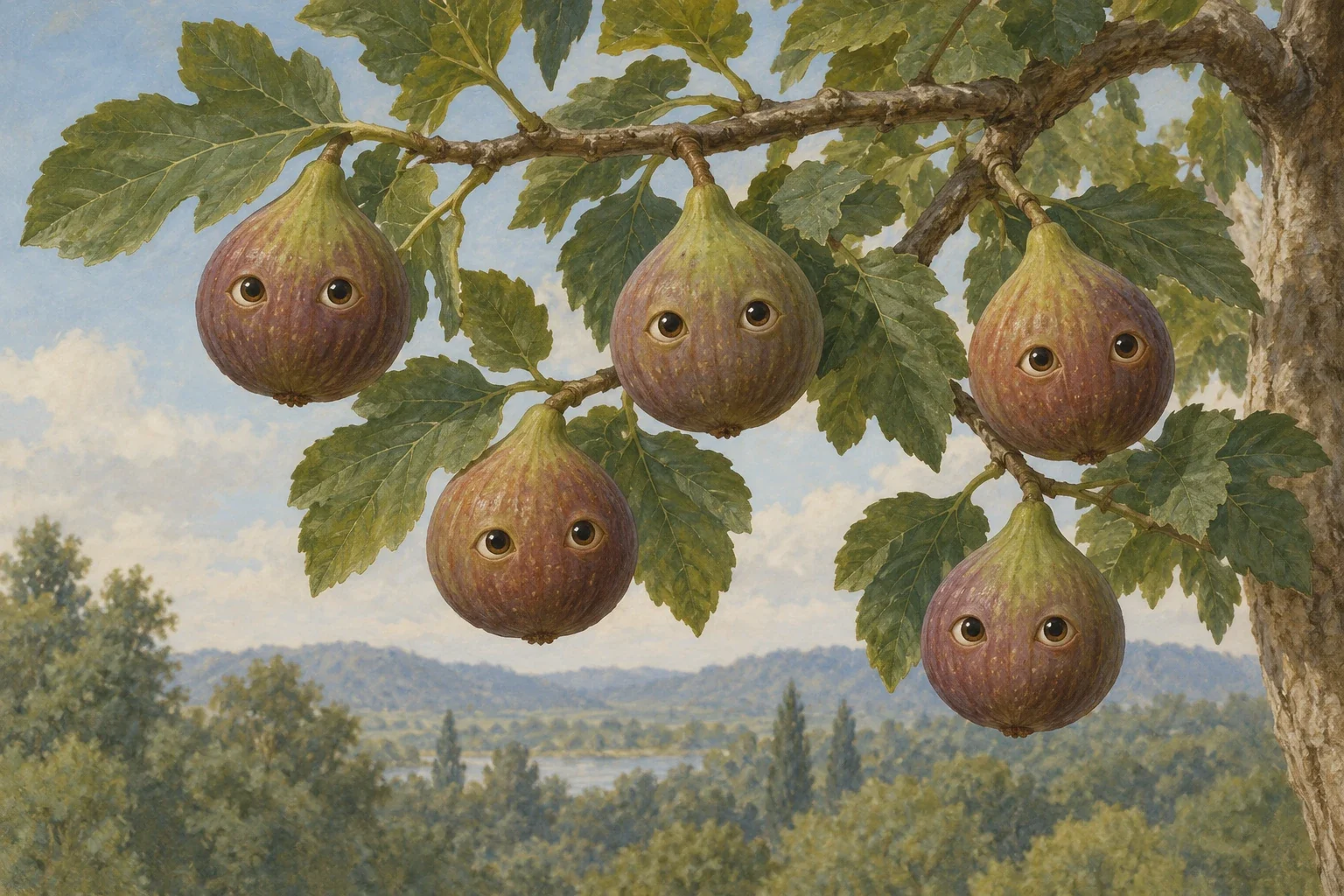
AI-generated narrative interpretation of the fruits putting forth eyes in Hollis’s collected tale. Fruit count, shape, colour, tree details and landscape are artistic choices; no scientific species or authenticated place is asserted.
Historical bilingual collected narrative; source mediation preserved, no taxonomic or ethnographic authentication.
Overview
An old woman without husband or children seeks help because she is unhappy. When the medicine-man asks which she wants, she chooses children. His instructions concern cooking pots and a fruit-bearing sycamore: she should take three pots, or as many as she can carry, fill them with fruit, leave them in her hut and go for a walk. The story supplies no fixed number of children and does not present this episode as evidence that a real treatment works.
Returning in the evening, the woman hears voices near the kraal. Her hut is full of children and the work has been done. Boys tend cattle, girls have swept the hut, warriors sing and dance on the common, and little children wait to greet her. The household therefore includes several age groups, rather than only infants. She becomes rich and lives happily with them for many days. The narrative moves directly from gathered fruit to the populated household without describing a visible transformation.
The relationship breaks after she scolds them and reproaches them with being children of the tree. They say nothing. While she visits friends in other kraals, they return to the sycamore and become fruit again. She finds the home empty, weeps and accuses the medicine-man of having spirited them away. He says that he does not know what she should do now. When she proposes looking at the tree, he recommends that she try; the text does not establish that he deliberately recalled the children.
She carries her pots back and climbs into the tree. All the fruits put forth eyes and stare at her. Frightened, she cannot climb down until her friends help her. She never returns to search for children. The ending establishes eyed fruit but supplies no mouths, limbs, human faces or separate monster species. The profile follows this particular household’s loss and failed recovery, without making every sycamore sacred or treating the story as a general rule about families.
Origins & earliest records
Hollis’s 1905 volume prints a Maa text with interlinear glosses and an English narrative. His complete preface credits Justin Ol-omeni, described there as Oikop or Lumbwa Masai and educated through the Church Missionary Society, with a large share of the book’s material. That collective acknowledgment does not identify him as this tale’s individual narrator. The preface’s racial, colonial and conversion assumptions belong to its historical editor, not to the profile’s explanation of Maasai identity.
Records & interpretation
Complete Maa/interlinear narrative pp.161–164 and complete English version pp.164–165; complete preface iii–v. Printed pages checked against the preserved scan.
Selected bibliography
Documented works and useful reading. This is not a list of every appearance.
- 01
The Masai: Their Language and Folklore
Oxford, Clarendon Press. Selected narratives and complete preface inspected in the original scan; Eliot’s separate introduction and the customs sections are not used.
Family & connections
A source-supported family tree or inspiration record has not yet been compiled for this profile. Related reading below indicates a connection in subject matter, not a proven lineage or creative influence.
References
Sources supporting this profile. Linked pages have their own scope and editorial standards.
- Historical collected Maa narrative with interlinear gloss and English versionHollis, The Masai: Their Language and Folklore (1905), pp.161–165; complete preface iii–vResearch access: 2026-10-23
Image credits
AI-generated narrative illustrationAI-generated narrative interpretation of the fruits putting forth eyes in Hollis’s collected tale. Fruit count, shape, colour, tree details and landscape are artistic choices; no scientific species or authenticated place is asserted.
Historical bilingual collected narrative; source mediation preserved, no taxonomic or ethnographic authentication.