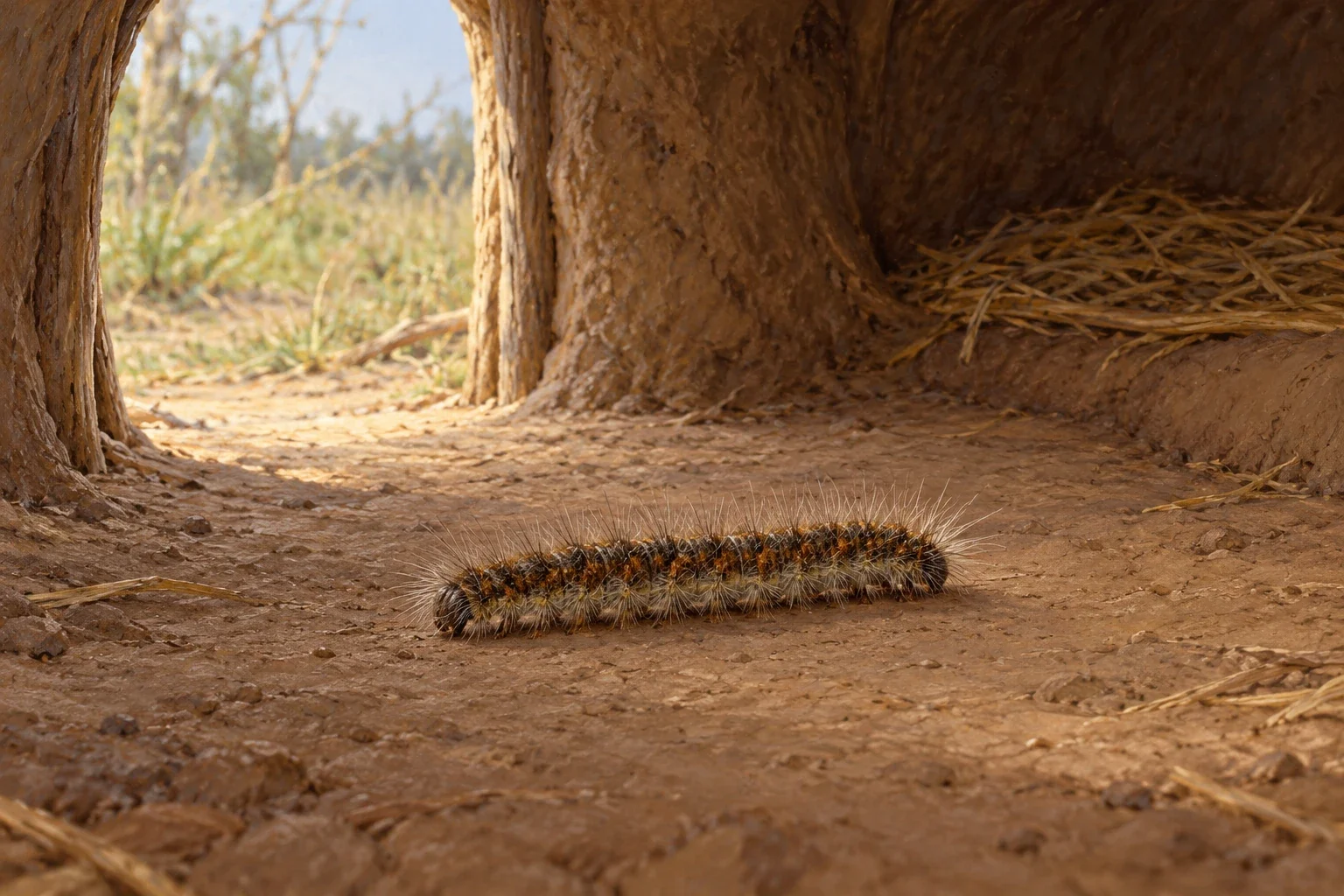
AI-generated narrative interpretation of the caterpillar at the hare’s doorway in Hollis’s collected Maa tale. Its warrior threats are empty boasts. Colour, exact species and dwelling details are artistic choices, not an ethnographic reconstruction.
Historical bilingual collected narrative; source mediation preserved, no taxonomic or ethnographic authentication.
Overview
A caterpillar enters a hare’s house while the owner is absent. The returning hare notices marks on the ground and asks who is inside. Speaking loudly, the intruder declares itself the warrior-son of the long one, with anklets unfastened during a fight in Kurtiale country. It boasts that it crushes a rhinoceros and tramples an elephant into dung. These declarations frighten its listeners; the narrative never shows the caterpillar performing those feats or taking a warrior’s bodily form.
The hare leaves to seek help. A jackal comes back with it and asks who occupies his friend’s house, but the same answer makes him abandon the attempt. A leopard likewise hears the claim and reasons that a creature able to crush an elephant and rhinoceros could destroy him too. The hare next obtains assistance from the rhinoceros itself, and then the elephant. Each hears the boast, accepts the danger it announces and retreats. Their reactions enlarge the caterpillar’s reputation without testing its strength.
A passing frog agrees to help. It receives the same answer at the door, but goes nearer instead of leaving. It answers with its own declaration of strength and leaping ability. As the frog approaches, the caterpillar trembles and admits that it is only a caterpillar. The assembled animals seize it and drag it out, laughing at the trouble it has caused. The ending exposes the gap between the unseen speaker’s threats and its actual identity, rather than awarding the frog an unexplained magical weapon.
The Maa heading calls this caterpillar Kunju. A footnote explains that ol-kurto is a caterpillar term, especially for geometer caterpillars, while ol-kurto oji kunju names hairy caterpillars. Kunju is therefore retained as source wording with that lexical qualification, not confidently promoted to a unique personal name or a scientific species. The English narrative supplies no colour, measured length or detailed insect anatomy. Its small speaker remains distinct from caterpillar heroes, ancestors and monsters recorded in other collections.
Origins & earliest records
Hollis’s 1905 volume prints a Maa text with interlinear glosses and an English narrative. His complete preface credits Justin Ol-omeni, described there as Oikop or Lumbwa Masai and educated through the Church Missionary Society, with a large share of the book’s material. That collective acknowledgment does not identify him as this tale’s individual narrator. The preface’s racial, colonial and conversion assumptions belong to its historical editor, not to the profile’s explanation of Maasai identity.
Records & interpretation
Complete Maa/interlinear narrative pp.179–183 and English narrative pp.184–185; lexical footnote p.179 and complete preface iii–v. Printed pages checked against preserved scan.
Selected bibliography
Documented works and useful reading. This is not a list of every appearance.
- 01
The Masai: Their Language and Folklore
Oxford, Clarendon Press. Selected narratives and complete preface inspected in the original scan; Eliot’s separate introduction and the customs sections are not used.
Family & connections
A source-supported family tree or inspiration record has not yet been compiled for this profile. Related reading below indicates a connection in subject matter, not a proven lineage or creative influence.
References
Sources supporting this profile. Linked pages have their own scope and editorial standards.
- Historical collected Maa narrative with interlinear gloss and English versionHollis, The Masai: Their Language and Folklore (1905), pp.179–185; complete preface iii–vResearch access: 2026-10-23
Image credits
AI-generated narrative illustrationAI-generated narrative interpretation of the caterpillar at the hare’s doorway in Hollis’s collected Maa tale. Its warrior threats are empty boasts. Colour, exact species and dwelling details are artistic choices, not an ethnographic reconstruction.
Historical bilingual collected narrative; source mediation preserved, no taxonomic or ethnographic authentication.