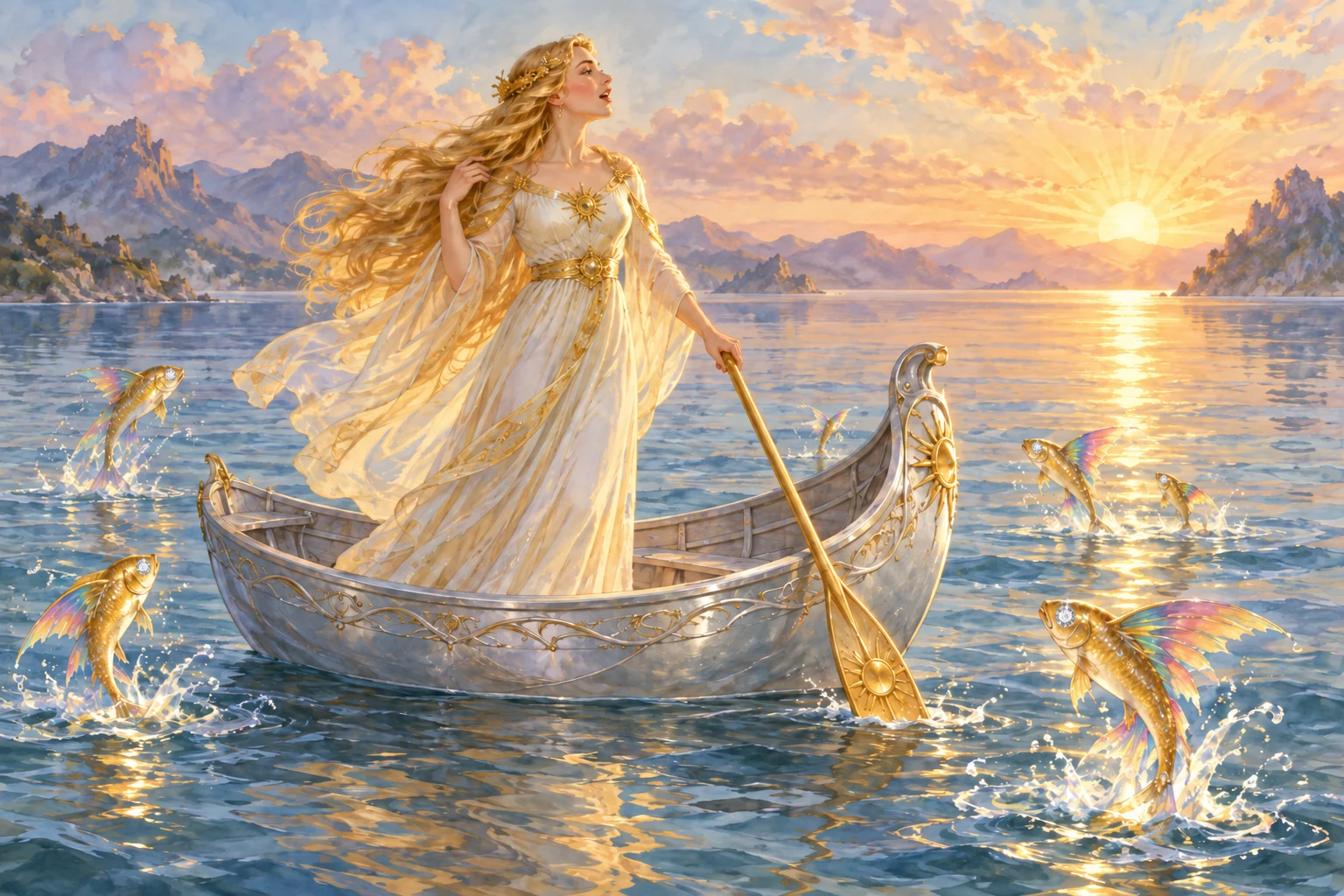
Golden-haired woman holds an oar among winged golden fish.
AI-generated interpretation of the Sun-beloved sea-maiden singing at sunrise on smooth waters. Silver boat, golden oar, gathered golden hair and rainbow-winged golden fish with diamond eyes are textual. She is called a mermaid, but tail anatomy is undescribed; human presentation, clothing, boat form and sunrise palette are choices. Based on The Good Ferryman and the Water Nymphs in Maude Ashurst Biggs’s 1920 translation of Glinski. Original composition from historical prose; no existing illustration copied. Compressed for display.
Overview
The Sun tells his mother that a mermaid distracted an attacking dragon with her song and beauty, allowing him to burn it to ashes and end an eclipse. The ferryman later seeks this maiden under the king’s threat. She travels in a silver boat with a golden oar, gathering her long golden hair. Her song can send the listener into reverie and sleep. Golden fishes with rainbow wings and diamond eyes play around her; these are companions, not parts of her body.
Rich dresses and ornaments lure her towards shore. The ferryman summons the Storm-wind to capsize her boat and Frost to freeze the water, then hooks her hair and carries her away despite her tears. At his home she recognizes his wife as her sister, and their reunion changes her grief to joy. Asked to marry the king, she first requires the self-playing guitar. Its performance reveals the king’s murdered brother, who kills him. The following day she returns to her own sea, boat and fishes, still described as beloved of the Sun. Neither a completed royal marriage nor a permanent land transformation is narrated.
Origins & earliest records
Polish Fairy Tales, translated from A. J. Gliński by Maude Ashurst Biggs (1920), The Good Ferryman and the Water Nymphs, pp. 53–68.
Records & interpretation
The selected English tale supplies the transformation, actions and ending. Biggs’s preface explicitly acknowledges considerable shortening of her source.
3D model
An original procedural model made for the Mythscribe World Builder. It is an interpretation based on this entry, not a historical source or a depiction from the records cited here.
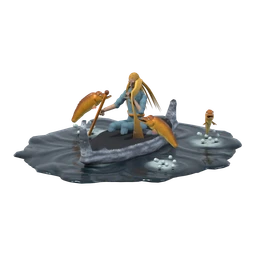
Procedural folklore creature kit · 36,825 triangles · 2.4 MB
Opens mythscribe.cloud in a new tab. Sign-in is required.
Selected bibliography
Documented works and useful reading. This is not a list of every appearance.
- 01
Polish Fairy Tales: The Good Ferryman and the Water Nymphs, pp. 53–68
Complete selected English narrative and translator’s preface. No individually named oral contributor provided; original Polish text not collated.
Family, evolution & connections
Two water nymphs and Goldmore — Biggs
Complete pp. 53–68 narrative; explicit kinship pp. 63, 65–66.
Scroll sideways to see all branches. With a keyboard, focus the tree and use the arrow keys.
- Three siblings, parents unspecified
- Goldmore, brother
Sister recognition and Goldmore’s own-sister identification. Parents and sibling order unspecified. The sea maiden’s proposed royal marriage is not completed. No children or relationship to the Sun’s mother is supplied.
References
Sources supporting this profile. Linked pages have their own scope and editorial standards.
- Primary historical shortened literary translationGliński/Biggs 1920: The Good Ferryman and the Water NymphsResearch access: 2026-10-05
Image credits
AI-generated interpretationGolden-haired woman holds an oar among winged golden fish.
AI-generated interpretation of the Sun-beloved sea-maiden singing at sunrise on smooth waters. Silver boat, golden oar, gathered golden hair and rainbow-winged golden fish with diamond eyes are textual. She is called a mermaid, but tail anatomy is undescribed; human presentation, clothing, boat form and sunrise palette are choices. Based on The Good Ferryman and the Water Nymphs in Maude Ashurst Biggs’s 1920 translation of Glinski. Original composition from historical prose; no existing illustration copied. Compressed for display.