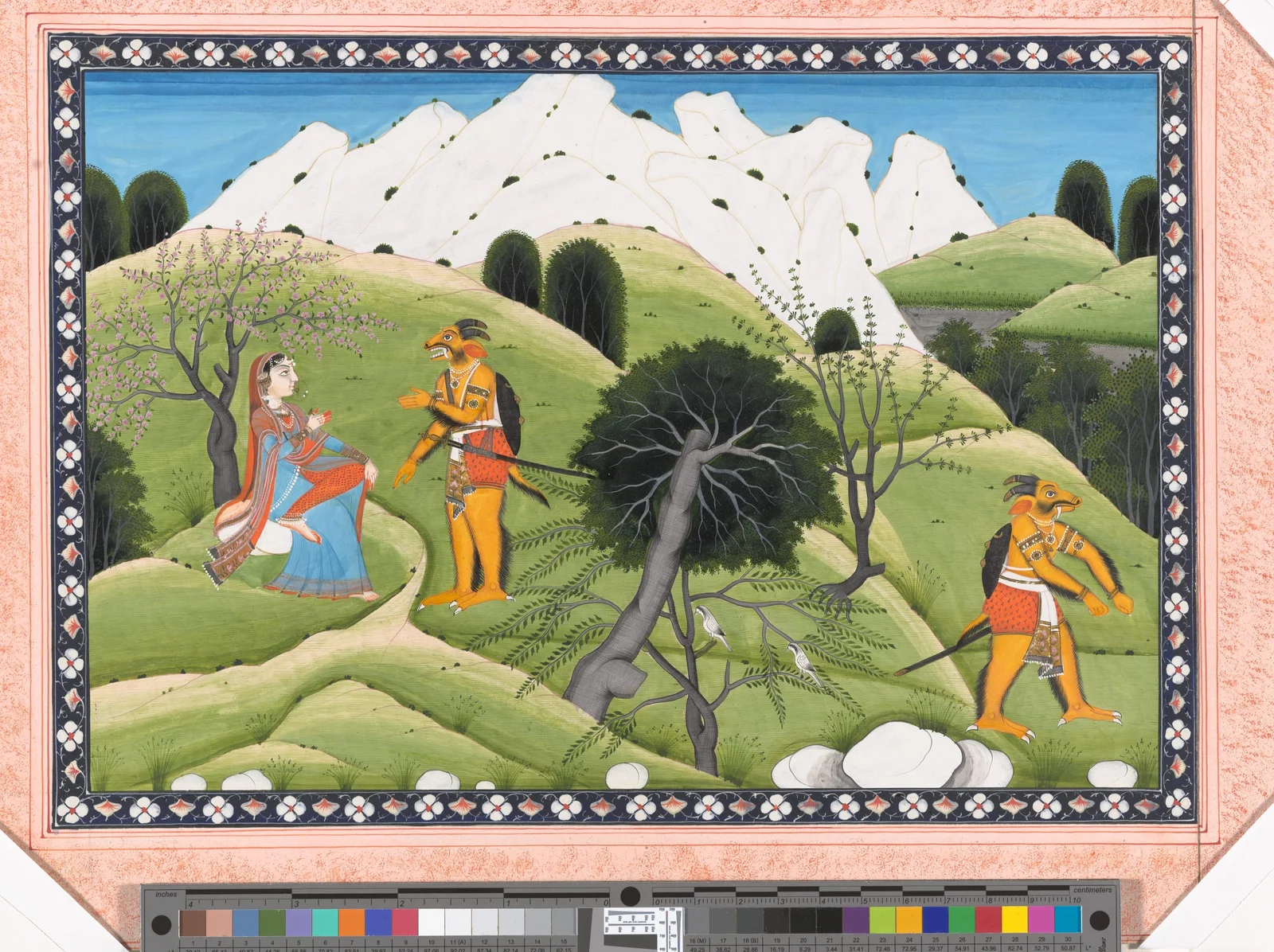
Sugriva appears twice as an orange horned, tailed messenger with a sword and shield: speaking to seated Parvati at left, then departing at right, in a green mountain landscape with a flowered border.
Kangra, ca.1820–1830. The museum identifies both appearances as the asura messenger Sugriva, first addressing Parvati and then leaving to report to Shumbha. His horned animal-headed form belongs to this painting; he is distinct from the Ramayana’s monkey king.
Overview
The Markandeya Purana names Sugriva as the great asura whom Shumbha sends to invite the goddess to marry him. He first speaks gently, describing his master’s authority and treasures. When she requires her prospective husband to defeat her in battle, he calls her proud and threatens forcible capture. She sends him back to report her answer. This court messenger is a figure of the Devi-Mahatmya episode, not the vanara king of the Ramayana who bears the same name.
Origins & earliest records
South Asian Hindu sacred narrative
Records & interpretation
Full relevant hosted Pargiter passages directly read; Medhas’s narration within the Markandeya Purana.
Selected bibliography
Documented works and useful reading. This is not a list of every appearance.
- 01
The Mārkaṇḍeya Purāṇa
Canto 85; historical English edition date, not Sanskrit composition date.
Family & connections
A source-supported family tree or inspiration record has not yet been compiled for this profile. Related reading below indicates a connection in subject matter, not a proven lineage or creative influence.
Primary records and illustrations
The Mārkaṇḍeya Purāṇa, Pargiter translation
Devī-Māhātmya; hosted 1904 translation. Canto 85
Full relevant chapter narrative directly read on Wisdomlib; source-specific translation and narrator retained; no illustration claimed.
References
Sources supporting this profile. Linked pages have their own scope and editorial standards.
- Historical primary religious-text translationPargiter, Markandeya Purana — canto 85Research access: 2026-10-05
Image credits
Historical narrative paintingSugriva appears twice as an orange horned, tailed messenger with a sword and shield: speaking to seated Parvati at left, then departing at right, in a green mountain landscape with a flowered border.
Kangra, ca.1820–1830. The museum identifies both appearances as the asura messenger Sugriva, first addressing Parvati and then leaving to report to Shumbha. His horned animal-headed form belongs to this painting; he is distinct from the Ramayana’s monkey king.