A sourced illustration has not yet been added. This gap is included in the coverage record.
Overview
A two-headed Girringa brings the unnamed woman home from Kano. Along the road, encounters with beings bearing three, four and five heads make her cry, and each tells her that the king will be more alarming still. The ruler has ten heads. She refuses to enter her husband’s house, but eventually yields to persuasion. Three goats are killed in welcome, and the household keeps feeding her until she becomes fat. Their hospitality conceals a plan to kill and eat her.
On the intended day of her death, the household sends her to the river with a pot to fetch water for washing. She does not know the stated purpose, but suspects danger because this is the first time they have permitted her outside. She changes herself into a tree stump. A pursuing Girringa follows her tracks, fails to find her and reports that she has escaped. At night she resumes her human shape and runs back to her own city. The transformation belongs to this woman’s escape, while the cannibals’ failed search shows that following footprints does not reveal her altered form.
Origins & earliest records
The contents attribute tale 98 to Sa(r)rikin Samari (S.S.). Tremearne collected, translated and edited the English witness. His introduction dates most collection work to 1908–1909 at Jemaan Daroro, without giving an exact performance date for this tale.
Records & interpretation
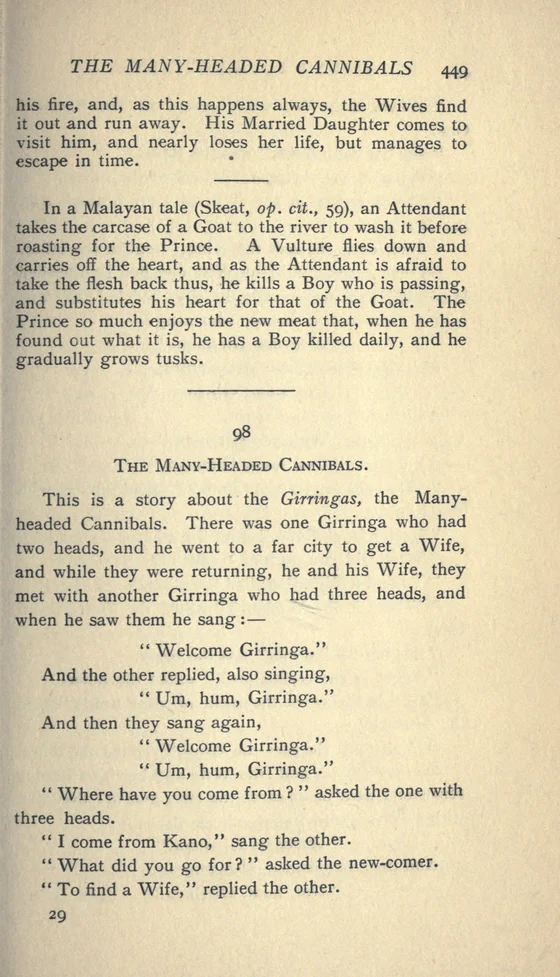
Complete tale 98, printed pp. 449–452, independently read; main sequence and appended comparison distinguished.
Selected bibliography
Documented works and useful reading. This is not a list of every appearance.
- 01
Hausa Superstitions and Customs, second edition
Tale 98, printed pp. 449–452; narrator key pp. 5–8 and preliminary correction.
Family & connections
A source-supported family tree or inspiration record has not yet been compiled for this profile. Related reading below indicates a connection in subject matter, not a proven lineage or creative influence.
References
Sources supporting this profile. Linked pages have their own scope and editorial standards.
- Collected primary narrative in translationTremearne 1913 — tale 98Research access: 2026-10-05
Image credits
A sourced illustration has not yet been added. This gap is included in the coverage record.