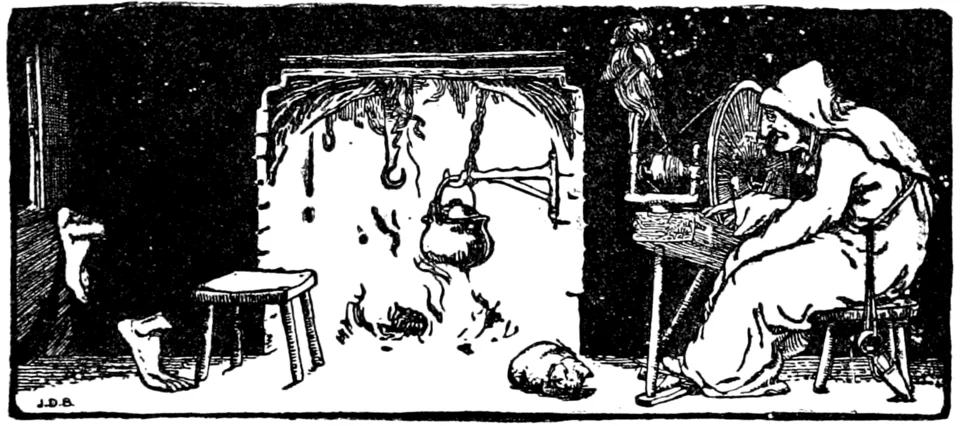
Strange Visitor assembles beside the fireside, Batten
Actual detached legs and upper body arrive beside old woman at fireplace; printed page186 is the exact Strange Visitor chapter opening. Segmented body motif preserved.
Overview
The woman continues reeling and wishing for company as broad feet enter and sit at the fire. Legs, knees, thighs, hips, a waist, shoulders, arms, hands, a neck and finally a head follow, each resting upon the accumulating body. Their alternating thin and enormous proportions make the assembled figure deliberately irregular. There is no personal name, creature ancestry or explanation of whether the pieces belonged to a previously complete being.
The woman questions the body’s different proportions. Some replies refer to walking, praying, sitting, carrying or threshing, while others use a refrain whose meaning Jacobs candidly says he does not know. He proposes an alternative for readers but does not establish a reliable translation of the inherited sounds. The final question asks why the visitor came; its reply threatens the woman, with instructions to shout, stamp and gesture. These performance directions are significant evidence for a startling nursery recitation, rather than a detailed witnessed attack. Jacobs compares the motif to other instalment-like body tales, yet a shared technique does not establish that their figures are one supernatural individual.
Origins & earliest records
Jacobs’s 1890 English Fairy Tales names Chambers’s Scottish collection as its source and acknowledges substantial Anglicisation. The retained uncertain refrain and explicit performance directions preserve traces of a telling tradition. The published version provides no secure date for that tradition’s beginning.
Records & interpretation
The assembled body is literary and performative evidence: printed instructions show how the climax was to be delivered aloud. The tale offers no independently observed anatomy, and its unexplained refrain should not be converted into a fabricated linguistic claim.
Selected bibliography
Documented works and useful reading. This is not a list of every appearance.
- 01
English Fairy Tales
Inspected complete selected episode “The Strange Visitor” and compiler’s editorial source note.
- 02
English Fairy Tales — The Strange Visitor
Joseph Jacobs, English Fairy Tales; first collection1890 context, selected PG7439 print date unresolved. Preface explicitly acknowledges rewriting and changed incidents. Named tale and observed anchor used, no invented print pagination.
Family & connections
A source-supported family tree or inspiration record has not yet been compiled for this profile. Related reading below indicates a connection in subject matter, not a proven lineage or creative influence.
Located primary passages
Specific passages supporting details in this entry, grouped by their published witness.
English Fairy Tales — The Strange Visitor
Joseph Jacobs, English Fairy Tales; first collection1890 context, selected PG7439 print date unresolved. Preface explicitly acknowledges rewriting and changed incidents. Named tale and observed anchor used, no invented print pagination.
- A lone woman reels while wishing for company. Body parts successively enter and stack into a complete visitor with mismatched proportions. Her questions receive answers tied to activities or a repeated obscure phrase; asked its purpose, it threatens her, with instructions for a loud delivery and physical gesture. No actual seizure is narrated.
Complete selected tale and source note read; earlier cited works remain indirect. No song or ritual-formula excerpts. Strange Visitor evidence limited to six words from its narrative presentation; no separate quotation added.
Primary source witness
Joseph Jacobs, English Fairy Tales; first collection1890 context, selected PG7439 print date unresolved. Preface explicitly acknowledges rewriting and changed incidents. Named tale and observed anchor used, no invented print pagination.
- Jacobs attributes the tale to Chambers p64 and says he Anglicised it. He retains a repeated Scots phrase while admitting he does not understand it and offers a substitute; that uncertainty is preserved instead of supplying a confident translation.
NOTES AND REFERENCES, XXXII THE STRANGE VISITOR; Jacobs’s Anglicising and confessed uncertainty
Verifies Jacobs’s stated editorial practice; comparative interpretation is not treated as historical proof.
References
Sources supporting this profile. Linked pages have their own scope and editorial standards.
- Primary textJacobs, English Fairy Tales: The Strange VisitorResearch access: 2026-10-05
Image credits
Historical illustrationStrange Visitor assembles beside the fireside, Batten
Actual detached legs and upper body arrive beside old woman at fireplace; printed page186 is the exact Strange Visitor chapter opening. Segmented body motif preserved.