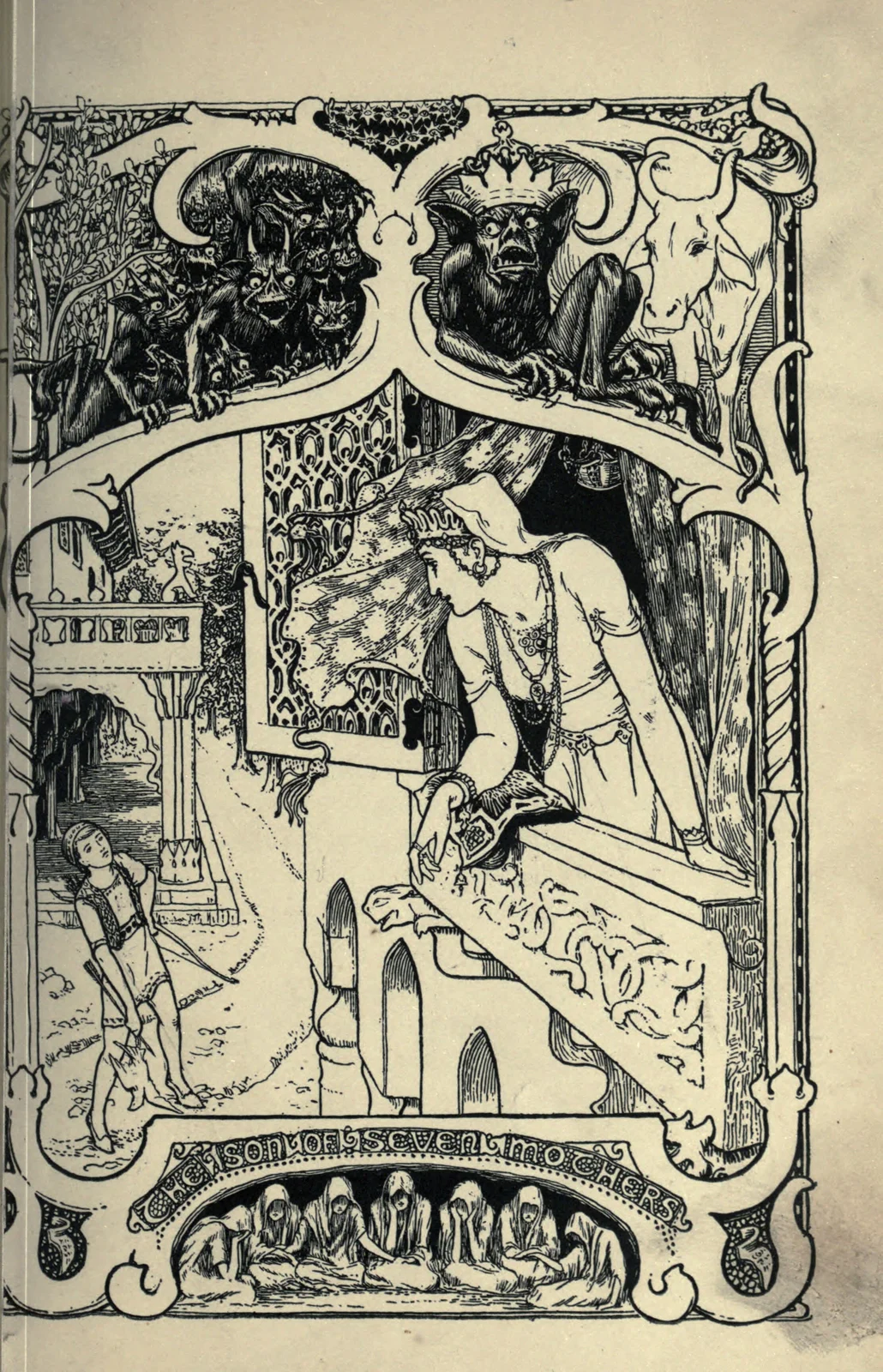
Batten: the Jogi’s white cow in The Son of Seven Queens
The white cow appears beside its crowned keeper at upper right. This composite illustration belongs to Jacobs’s adaptation of Steel and Temple’s named episode; the surrounding demons and other scenes do not form one simultaneous encounter.
Overview
Guarded by eighteen thousand demons, the tall white cow is milked continuously by their Jôgi king. Its stream fills a milk-white tank; the witch’s promise describes a pond as large as a kingdom. The hero obtains the animal by pretending that Indra demands its owner’s skin, then takes it to his seven mothers. Even making curds and whey and selling milk all day cannot use half its yield, and the household prospers. Temple compares this tale’s cow with Kâmdhain and classical Kâmdhenu, but the episode itself demonstrates inexhaustible milk rather than granting every imaginable wish.
Origins & earliest records
Punjabi storytelling collected and adapted in colonial British India
Records & interpretation
Complete named tale and Temple’s corresponding notes read; university-hosted 1894 text compared in full.
Selected bibliography
Documented works and useful reading. This is not a list of every appearance.
- 01
Tales of the Punjab, Told by the People
The Son of Seven Mothers and corresponding Temple notes; illustrations J. Lockwood Kipling
Family & connections
A source-supported family tree or inspiration record has not yet been compiled for this profile. Related reading below indicates a connection in subject matter, not a proven lineage or creative influence.
Primary records and illustrations
Flora Annie Steel, Tales of the Punjab, Told by the People (Macmillan, 1894); R. C. Temple notes
The Son of Seven Mothers. Complete tale and titled notes; Gutenberg id00496/id01684; UPenn punjab-10
Complete tale and all corresponding Temple notes read. Full 1894 UPenn comparison exceeds 98% token overlap; every remaining difference inspected. Narrated events, family relationships and landscape personification distinguished from comparative commentary.
References
Sources supporting this profile. Linked pages have their own scope and editorial standards.
- Historical collected folktaleSteel, The Son of Seven Mothers, complete narrativeResearch access: 2026-10-05
- Collector’s linguistic and comparative notesTemple, Notes to The Son of Seven MothersResearch access: 2026-10-05
- University-hosted historical primary textUniversity of Pennsylvania, 1894 edition transcriptionResearch access: 2026-10-05
Image credits
Historical illustrationBatten: the Jogi’s white cow in The Son of Seven Queens
The white cow appears beside its crowned keeper at upper right. This composite illustration belongs to Jacobs’s adaptation of Steel and Temple’s named episode; the surrounding demons and other scenes do not form one simultaneous encounter.