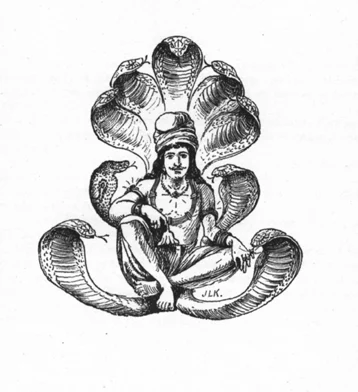
Kipling’s seated snake king surrounded by hooded cobras, 1894
A human figure sits among hooded cobras in the chapter-end illustration identified as “The snake king” in the parallel text transcription. Steel describes his nocturnal dancing court and authority; the surrounding cobras and seated pose belong to Kipling’s representation and do not establish the king’s own bodily transformation.
Overview
A sweeper, water-carrier and carpet-bearers prepare a clearing at night before a jewelled procession emerges from a snake-hole. Its king watches the young men dance, including the sorrowful Ruby Prince with a red star on his forehead. The prince’s wife learns to dance and performs so beautifully that the Snake-king promises her any reward. When she asks for her husband, he threatens that only his promise prevents him killing her, then releases the prince. His court and authority are explicit; his own bodily transformation and biological relationship to the prince are not described.
Origins & earliest records
Punjabi storytelling collected and adapted in colonial British India
Records & interpretation
Complete named tale and Temple’s corresponding notes read; university-hosted 1894 text compared in full.
Selected bibliography
Documented works and useful reading. This is not a list of every appearance.
- 01
Tales of the Punjab, Told by the People
The Ruby Prince and corresponding Temple notes; illustrations J. Lockwood Kipling
Family & connections
A source-supported family tree or inspiration record has not yet been compiled for this profile. Related reading below indicates a connection in subject matter, not a proven lineage or creative influence.
Primary records and illustrations
Flora Annie Steel, Tales of the Punjab, Told by the People (Macmillan, 1894); R. C. Temple notes
The Ruby Prince. Complete tale and titled notes; Gutenberg id01558/id01915; UPenn punjab-43
Full narrative and corresponding short notes directly read; Gutenberg footer excluded from final note section. Whole 1894 UPenn narrative compared, over 98% token overlap, all residual differences inspected. No biological Snake-king parentage or bodily restoration inferred.
References
Sources supporting this profile. Linked pages have their own scope and editorial standards.
- Historical collected folktaleSteel, The Ruby Prince, complete narrativeResearch access: 2026-10-05
- Collector’s linguistic and comparative notesTemple, Notes to The Ruby PrinceResearch access: 2026-10-05
- University-hosted historical primary textUniversity of Pennsylvania, 1894 edition transcriptionResearch access: 2026-10-05
Image credits
Historical illustrationKipling’s seated snake king surrounded by hooded cobras, 1894
A human figure sits among hooded cobras in the chapter-end illustration identified as “The snake king” in the parallel text transcription. Steel describes his nocturnal dancing court and authority; the surrounding cobras and seated pose belong to Kipling’s representation and do not establish the king’s own bodily transformation.