A sourced illustration has not yet been added. This gap is included in the coverage record.
Overview
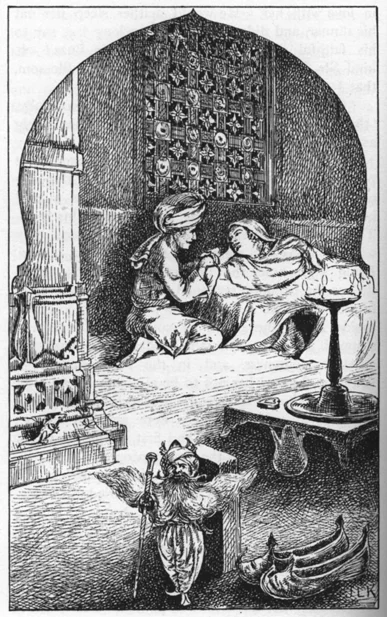
A Brahman finds a red stone and sells it to a king, who keeps it locked in a chest. Twelve years later the queen opens the chest and finds a handsome youth in its place. He calls himself Ruby Prince but withholds his origin. Driven from the palace, he kills an ogre that demands a young man daily and wins the king’s daughter and half the kingdom.
His wife repeatedly asks his ancestry despite his pleas. As she persists beside a river, he moves deeper into the water until a jewelled snake with a golden crown and ruby star appears and vanishes beneath the surface. Later she discovers him among young men dancing before a Snake-king at a nocturnal court emerging from a snake-hole. She learns to dance, wins a promised reward and asks for her husband. The king reluctantly releases him, and the reunited couple lives happily without another demand to reveal his origin.
Temple gives La’ljî, meaning Mr Ruby and also a cherished son, and identifies the opening snake-stone with the fabulous maṇi of cobra lore. The tale moves between jewel, youth and crowned snake rather than explaining a fixed species anatomy. It does not explicitly make the Snake-king the prince’s biological father.
Origins & earliest records
Punjabi storytelling collected and adapted in colonial British India
Records & interpretation
Complete named tale and Temple’s corresponding notes read; university-hosted 1894 text compared in full.
Selected bibliography
Documented works and useful reading. This is not a list of every appearance.
- 01
Tales of the Punjab, Told by the People
The Ruby Prince and corresponding Temple notes; illustrations J. Lockwood Kipling
Family & connections
A source-supported family tree or inspiration record has not yet been compiled for this profile. Related reading below indicates a connection in subject matter, not a proven lineage or creative influence.
Primary records and illustrations
Flora Annie Steel, Tales of the Punjab, Told by the People (Macmillan, 1894); R. C. Temple notes
The Ruby Prince. Complete tale and titled notes; Gutenberg id01558/id01915; UPenn punjab-43
Full narrative and corresponding short notes directly read; Gutenberg footer excluded from final note section. Whole 1894 UPenn narrative compared, over 98% token overlap, all residual differences inspected. No biological Snake-king parentage or bodily restoration inferred.
References
Sources supporting this profile. Linked pages have their own scope and editorial standards.
- Historical collected folktaleSteel, The Ruby Prince, complete narrativeResearch access: 2026-10-05
- Collector’s linguistic and comparative notesTemple, Notes to The Ruby PrinceResearch access: 2026-10-05
- University-hosted historical primary textUniversity of Pennsylvania, 1894 edition transcriptionResearch access: 2026-10-05
Image credits
A sourced illustration has not yet been added. This gap is included in the coverage record.