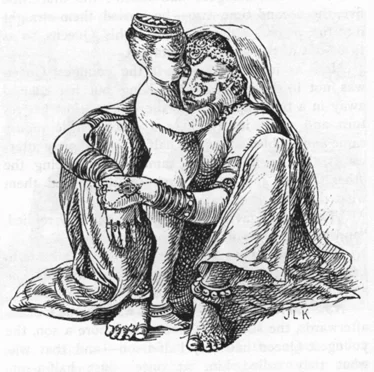
Kipling’s Prince Half-a-son with his mother, 1894
The half-bodied child embraces his mother with his one arm while standing on one leg. Kipling’s picture accompanies Steel’s description of the prince born after his mother eats half the magical barleycorn; it does not depict the later episode in which he becomes whole.
Overview
A holy faqîr provides mangoes through which a king’s seven queens may conceive. A mouse eats half the youngest queen’s fruit, and her son is correspondingly half-bodied, with one eye, ear, arm and leg. The narrator nevertheless makes him strong and resourceful. Temple records Adhiâ and the title Sat Bachiân diân Mâwân, the Mothers of Seven Sons; this should not be confused with the collection’s separate Son of Seven Mothers tale.
His small width and weight let him reach fruit that his six brothers cannot. They betray him to the fruit owners and eventually push him into a well, but he has the magical power to command ropes: bindings break and a well rope pulls him out at his request. Hidden below, he hears a serpent disclose buried treasure, a one-eyed demon boast of possessing a princess, and a pigeon describe its miraculous droppings.
He uses the pigeon’s substance to cure the princess in the story and wins her hand. After his brothers falsely identify him as a sweeper’s son, he proves his story with the serpent’s treasure. The jealous brothers enter the well seeking the same fortune and are eaten by the demon. He succeeds without a narrated change to a full body; the tale’s ridicule of disability and caste prejudice are not adopted as judgments, and its remedy is a fictional cure.
Origins & earliest records
Punjabi storytelling collected and adapted in colonial British India
Records & interpretation
Complete named tale and Temple’s corresponding notes read; university-hosted 1894 text compared in full.
Selected bibliography
Documented works and useful reading. This is not a list of every appearance.
- 01
Tales of the Punjab, Told by the People
Prince Half-a-son and corresponding Temple notes; illustrations J. Lockwood Kipling
Family & connections
A source-supported family tree or inspiration record has not yet been compiled for this profile. Related reading below indicates a connection in subject matter, not a proven lineage or creative influence.
Primary records and illustrations
Flora Annie Steel, Tales of the Punjab, Told by the People (Macmillan, 1894); R. C. Temple notes
Prince Half-a-son. Complete tale and titled notes; Gutenberg id01482/id01911; UPenn punjab-41
Full narrative and corresponding short notes directly read; Gutenberg footer excluded from final note section. Whole 1894 UPenn narrative compared, over 98% token overlap, all residual differences inspected. No biological Snake-king parentage or bodily restoration inferred.
References
Sources supporting this profile. Linked pages have their own scope and editorial standards.
- Historical collected folktaleSteel, Prince Half-a-son, complete narrativeResearch access: 2026-10-05
- Collector’s linguistic and comparative notesTemple, Notes to Prince Half-a-sonResearch access: 2026-10-05
- University-hosted historical primary textUniversity of Pennsylvania, 1894 edition transcriptionResearch access: 2026-10-05
Image credits
Historical illustrationKipling’s Prince Half-a-son with his mother, 1894
The half-bodied child embraces his mother with his one arm while standing on one leg. Kipling’s picture accompanies Steel’s description of the prince born after his mother eats half the magical barleycorn; it does not depict the later episode in which he becomes whole.