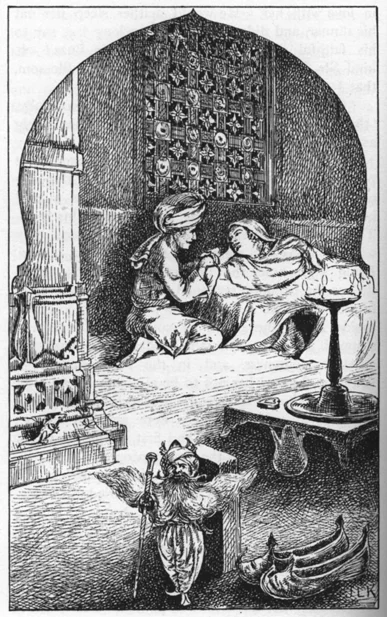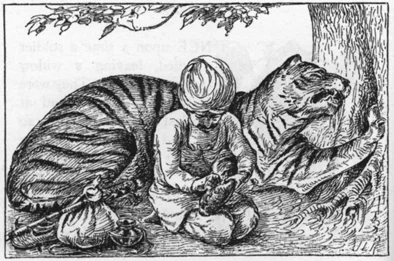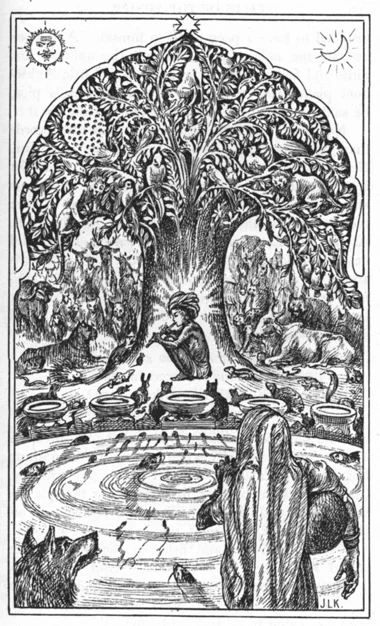
Kipling’s Little Anklebone piping beside the milk pond, 1894
The illustrator shows the supernatural piper as a boy beneath a tree, with listening animals, birds and fish around the milk pond. In the narrative the piper is the dead shepherd’s animated anklebone; the human figure is Kipling’s representation of that later scene.
Overview
A little orphan herds his maternal aunt’s sheep. When a wolf asks whether to eat him or the flock, she chooses the boy. Before being eaten he asks the wolf to hang his anklebone from a tree beside a pond. The bone later drops on a robber’s head, frightening away the thieves and leaving their treasure; its movement then becomes purposeful as it gathers the riches and plays a shepherd’s pipe.
Animals, birds and fish assemble to listen. Does, tigresses and she-wolves allow the tiny piper to milk them, and their surplus milk fills the pond. A king tries to capture him; thunder, the animals’ cries and the piper’s song persuade the king to release what he recognizes as only a bone. The narrative ends with the piping still sometimes heard across the plain.
Temple locates the story among cattle-drovers’ children in the Bâr of Gujrânwâlâ District and records Gîrî as a diminutive of gittâ, with Gitetâ Râm in the song. His suggestion of an invisible shepherd or Spirit of the Bâr is an interpretation, distinguished here from the tale’s explicit animated anklebone. No complete returning skeleton or restored human body is described.
Origins & earliest records
Punjabi storytelling collected and adapted in colonial British India
Records & interpretation
Complete named tale and Temple’s corresponding notes read; university-hosted 1894 text compared in full.
Selected bibliography
Documented works and useful reading. This is not a list of every appearance.
- 01
Tales of the Punjab, Told by the People
Little Anklebone and corresponding Temple notes; illustrations J. Lockwood Kipling
Family & connections
A source-supported family tree or inspiration record has not yet been compiled for this profile. Related reading below indicates a connection in subject matter, not a proven lineage or creative influence.
Primary records and illustrations
Flora Annie Steel, Tales of the Punjab, Told by the People (Macmillan, 1894); R. C. Temple notes
Little Anklebone. Complete tale and titled notes; Gutenberg id00632/id01705; UPenn punjab-14
Full tale and corresponding notes read. Entire UPenn 1894 narrative compared with Gutenberg: over 98% token overlap; all remaining punctuation, OCR and illustration-caption differences inspected. Story action distinguished from characters’ inferences and Temple’s comparative interpretations.
References
Sources supporting this profile. Linked pages have their own scope and editorial standards.
- Historical collected folktaleSteel, Little Anklebone, complete narrativeResearch access: 2026-10-05
- Collector’s linguistic and comparative notesTemple, Notes to Little AnkleboneResearch access: 2026-10-05
- University-hosted historical primary textUniversity of Pennsylvania, 1894 edition transcriptionResearch access: 2026-10-05
Image credits
Historical illustrationKipling’s Little Anklebone piping beside the milk pond, 1894
The illustrator shows the supernatural piper as a boy beneath a tree, with listening animals, birds and fish around the milk pond. In the narrative the piper is the dead shepherd’s animated anklebone; the human figure is Kipling’s representation of that later scene.