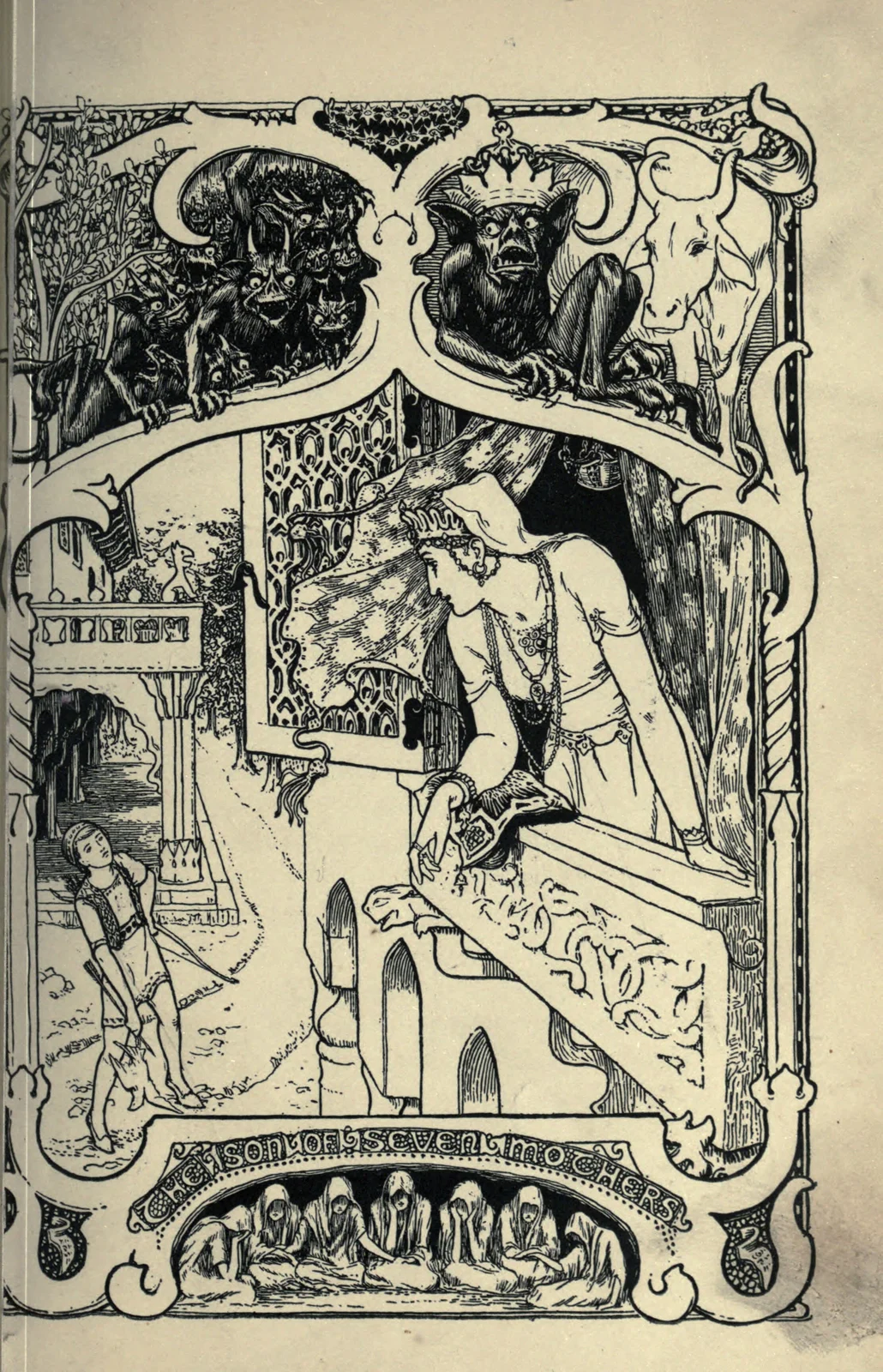
Batten: crowned Jogi demon king beside his miraculous cow
The crowned, horned demon king and cow occupy the upper-right part of Batten’s composite illustration. The artist’s monstrous face and horns are pictorial choices; the story identifies a Jogi ruling the demon guards without prescribing this whole body.
Overview
The son of seven mothers passes eighteen thousand demonic guards and finds a Jôgi milking a tall white cow into a milk-white tank day and night. The narrator calls him king of the demons. Following instructions, the boy falsely claims that Indra needs the Jôgi’s tough skin for a kettledrum. Terrified of disobeying Indra, the Jôgi offers his possessions and yields the cow. Temple notes that jôgi can be used broadly for holy persons in such tales; this supernatural antagonist is not a description of ascetics generally. His suggestion connecting the guards with ancient Maruts is comparative commentary, not an identity established by the narrative.
Origins & earliest records
Punjabi storytelling collected and adapted in colonial British India
Records & interpretation
Complete named tale and Temple’s corresponding notes read; university-hosted 1894 text compared in full.
Selected bibliography
Documented works and useful reading. This is not a list of every appearance.
- 01
Tales of the Punjab, Told by the People
The Son of Seven Mothers and corresponding Temple notes; illustrations J. Lockwood Kipling
Family & connections
A source-supported family tree or inspiration record has not yet been compiled for this profile. Related reading below indicates a connection in subject matter, not a proven lineage or creative influence.
Primary records and illustrations
Flora Annie Steel, Tales of the Punjab, Told by the People (Macmillan, 1894); R. C. Temple notes
The Son of Seven Mothers. Complete tale and titled notes; Gutenberg id00496/id01684; UPenn punjab-10
Complete tale and all corresponding Temple notes read. Full 1894 UPenn comparison exceeds 98% token overlap; every remaining difference inspected. Narrated events, family relationships and landscape personification distinguished from comparative commentary.
References
Sources supporting this profile. Linked pages have their own scope and editorial standards.
- Historical collected folktaleSteel, The Son of Seven Mothers, complete narrativeResearch access: 2026-10-05
- Collector’s linguistic and comparative notesTemple, Notes to The Son of Seven MothersResearch access: 2026-10-05
- University-hosted historical primary textUniversity of Pennsylvania, 1894 edition transcriptionResearch access: 2026-10-05
Image credits
Historical illustrationBatten: crowned Jogi demon king beside his miraculous cow
The crowned, horned demon king and cow occupy the upper-right part of Batten’s composite illustration. The artist’s monstrous face and horns are pictorial choices; the story identifies a Jogi ruling the demon guards without prescribing this whole body.