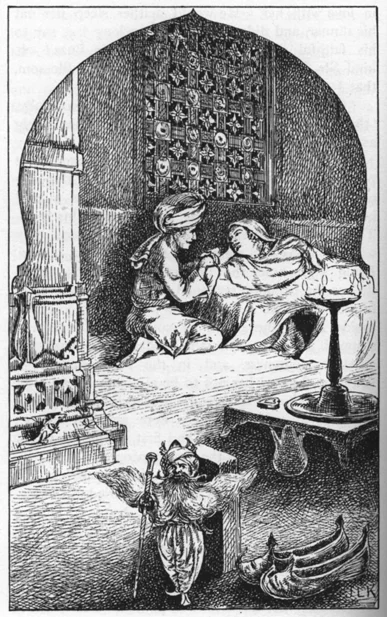
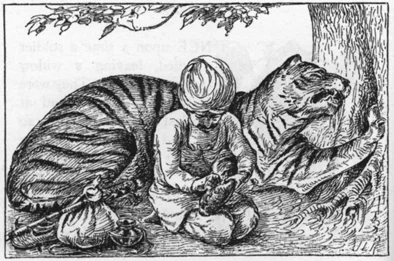
A sourced illustration has not yet been added. This gap is included in the coverage record.
Overview
Crocodiles occupying a farmer’s wheat demand his daughter in marriage and threaten him when he tries to drive them away. Attempts to arrange another match are followed by illness, death and injury, which the family attributes to the crocodiles. A richly dressed crocodile wedding party finally takes the unwilling bride into the river, whose waters divide to admit them to an underwater kingdom.
There the crocodile king is a handsome young prince: the narrative explicitly says that he assumes crocodile form when on shore. A brick he gives the bride’s father can divide the river again, revealing a path to his splendid palace. The daughter is described as happy in her new home, but she must obtain her husband’s permission to admit visitors, and he refuses to let her leave for a visit. Instead, her parents eventually settle in his kingdom.
Temple gives the original title Bâdshâh Ghariâl and observes that the word translated as demon in the mother’s complaint was jinn. The English narrative’s crocodiles are therefore not simply a zoological report, nor does the title establish the exact modern crocodilian species. The coerced marriage and restrictions remain part of the tale despite its prosperous ending.
Origins & earliest records
Punjabi storytelling collected and adapted in colonial British India
Records & interpretation
Complete named tale and Temple’s corresponding notes read; university-hosted 1894 text compared in full.
Selected bibliography
Documented works and useful reading. This is not a list of every appearance.
- 01
Tales of the Punjab, Told by the People
The King of the Crocodiles and corresponding Temple notes; illustrations J. Lockwood Kipling
Family & connections
A source-supported family tree or inspiration record has not yet been compiled for this profile. Related reading below indicates a connection in subject matter, not a proven lineage or creative influence.
Primary records and illustrations
Flora Annie Steel, Tales of the Punjab, Told by the People (Macmillan, 1894); R. C. Temple notes
The King of the Crocodiles. Complete tale and titled notes; Gutenberg id00602/id01700; UPenn punjab-13
Full tale and corresponding notes read. Entire UPenn 1894 narrative compared with Gutenberg: over 98% token overlap; all remaining punctuation, OCR and illustration-caption differences inspected. Story action distinguished from characters’ inferences and Temple’s comparative interpretations.
References
Sources supporting this profile. Linked pages have their own scope and editorial standards.
- Historical collected folktaleSteel, The King of the Crocodiles, complete narrativeResearch access: 2026-10-05
- Collector’s linguistic and comparative notesTemple, Notes to The King of the CrocodilesResearch access: 2026-10-05
- University-hosted historical primary textUniversity of Pennsylvania, 1894 edition transcriptionResearch access: 2026-10-05
Image credits
A sourced illustration has not yet been added. This gap is included in the coverage record.