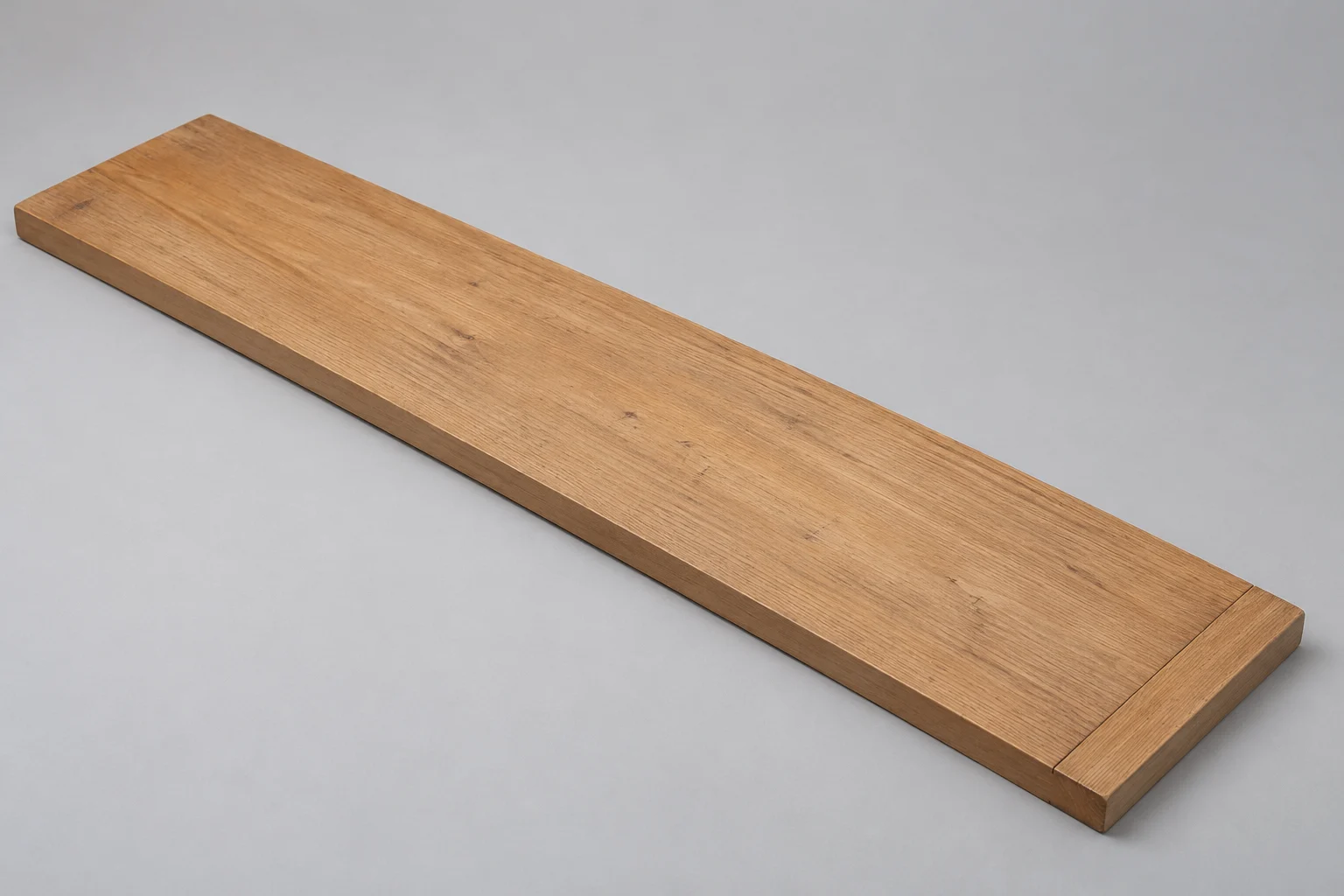
Generated interpretation of a published historical form; not an authenticated specimen or exact replica. Concealed details in the source scene are not reconstructed.
Overview
Inouye describes certain lined, wadded or better unlined garments being taken apart for washing. After the cloth pieces are cleaned, they are spread on a smooth plank made for the purpose, set out to dry and then starched. He says that the dry cloth still adheres to the plank, helping it remain free of creases and shrinkage. The captioned illustration shows a long broad board leaning at an angle while a worker smooths cloth against it. Its outline and near end are visible, but the hands and cloth obscure part of the working surface. A contextual object study can show the plain support without pretending to recover details concealed in that scene.
The board is one element in the clothing cycle described in the Daily Life chapter. Inouye distinguishes cloth spread on planks from other washed garments hung on long poles, and notes that silks needing special treatment or stain removal are sent to a dyer. He connects laundering with taking clothes apart, remaking them for another wearer, turning or redyeing worn cloth, and replacing bedding wadding. His account places this work within gendered household expectations and acknowledges both servants’ assistance and the mistress’s supervision. Those statements are retained as his description of Tokyo homes in 1910, rather than as a rule for every Japanese household or instructions for present-day textile care.
History & identity
Jukichi Inouye’s Home Life in Tokyo was printed in Tokyo in 1910, with a preface dated September 1910. He presents it as an account by a Japanese writer and explicitly confines his observations to Tokyo, while disclaiming completeness. This is the retained transcribed title, imprint and preface evidence, not an independent modern survey.
Sources & representation
Complete Daily Life chapter, particularly the laundry and needlework sequence, and the whole native Starching-board illustration. The visible plain board is supported by the prose; hands and cloth conceal part of its surface. Hidden construction and exact dimensions are not reconstructed.
Selected bibliography
Documented works and useful reading. This is not a list of every appearance.
- 01
Home Life in Tokyo
Printed by the Tokyo Printing Company Ltd. Complete Chapters X, Outdoor Gear, and XI, Daily Life; original captioned illustrations.
Language & cultural connections
Source-supported language and cultural connections have not yet been compiled for this profile.
References
Sources supporting this profile. Linked pages have their own scope and editorial standards.
- Historical first-person domestic accountHome Life in Tokyo, original dated domestic accountResearch access: 2026-10-18
Image credits
AI-generatedGenerated interpretation of a published historical form; not an authenticated specimen or exact replica. Concealed details in the source scene are not reconstructed.