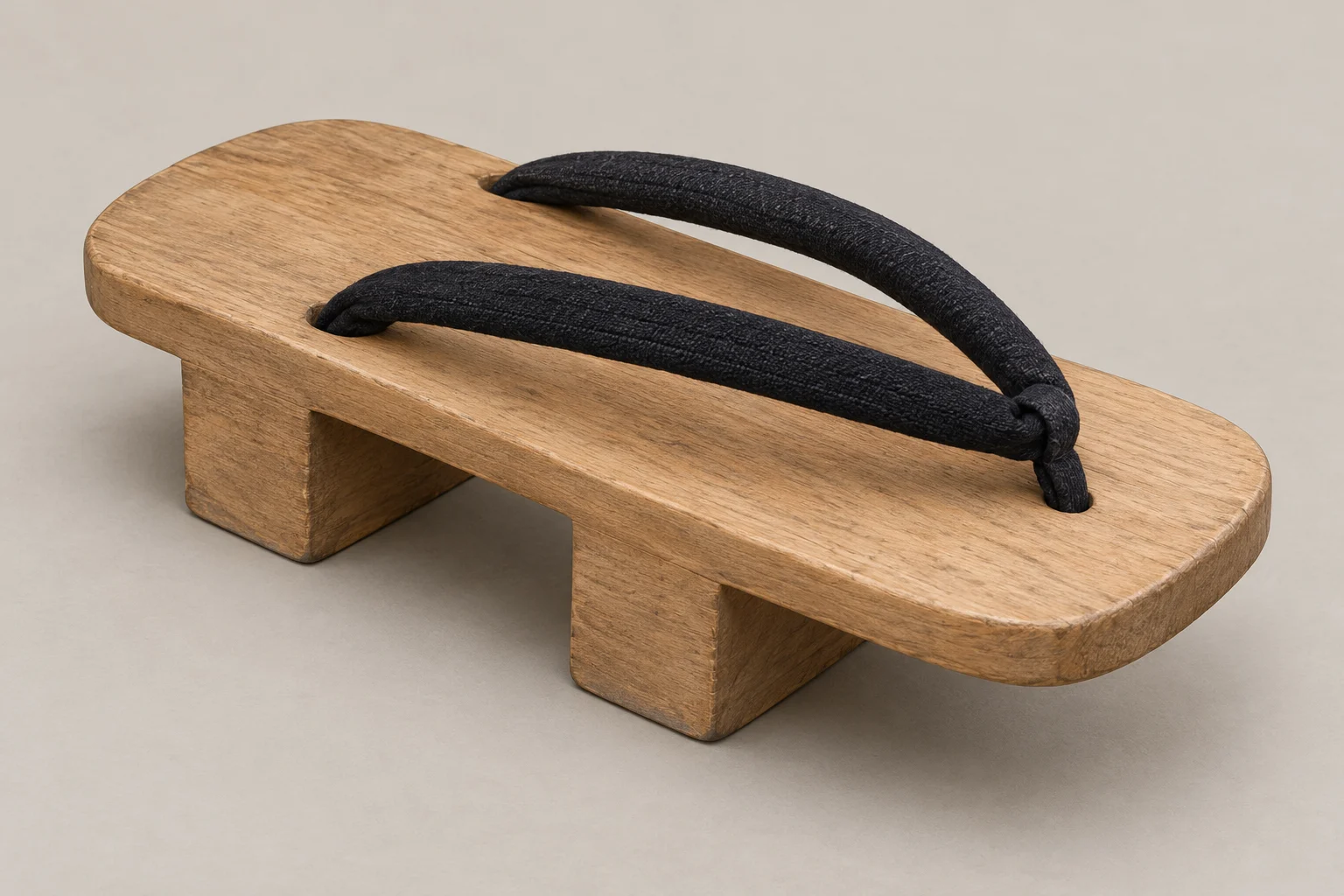
Generated interpretation of a published historical form; not an authenticated specimen or exact replica.
Overview
Inouye distinguishes plain wooden clogs from matted clogs and sandals. The plain form has an oblong sole-piece, sometimes with rounded ends, raised on two transverse supports placed one behind the other. Its three holes receive the covered hemp thongs: two side holes hold the longer thong, while a shorter front connection draws it down at the toe position. The wood can be cut as one piece or the supports can be fitted separately. The upper clog in the published drawing has broad block-like supports beneath a plain sole, while the lower example has thinner separate-looking supports. They are two examples, not different views of a single object.
The surrounding chapter treats footwear as part of changing urban dress and habits of entering buildings. Inouye contrasts the convenience of slipping off clogs or sandals at a private house with the complications of removing laced boots, and describes people changing footwear at schools and offices. These are his observations and judgments in 1910, including his prediction that household arrangements would help preserve the use of clogs. He also distinguishes taller rain forms with toe-caps from shorter fine-weather forms and says a one-piece type was then favoured by men. The contextual study selects that plain one-piece form without a toe-cap; it does not merge it with matted footwear or claim one design served every wearer.
History & identity
Jukichi Inouye’s Home Life in Tokyo was printed in Tokyo in 1910, with a preface dated September 1910. He presents it as an account by a Japanese writer and explicitly confines his observations to Tokyo, while disclaiming completeness. This is the retained transcribed title, imprint and preface evidence, not an independent modern survey.
Sources & representation
Complete Outdoor Gear chapter, especially the construction and variant paragraphs, plus the full native Plain Clogs drawing. The upper example informs the selected form. Exact wood species, colour, dimensions and the manufacture of an individual illustrated specimen are not established.
Selected bibliography
Documented works and useful reading. This is not a list of every appearance.
- 01
Home Life in Tokyo
Printed by the Tokyo Printing Company Ltd. Complete Chapters X, Outdoor Gear, and XI, Daily Life; original captioned illustrations.
Language & cultural connections
Source-supported language and cultural connections have not yet been compiled for this profile.
References
Sources supporting this profile. Linked pages have their own scope and editorial standards.
- Historical first-person domestic accountHome Life in Tokyo, original dated domestic accountResearch access: 2026-10-18
Image credits
AI-generatedGenerated interpretation of a published historical form; not an authenticated specimen or exact replica.