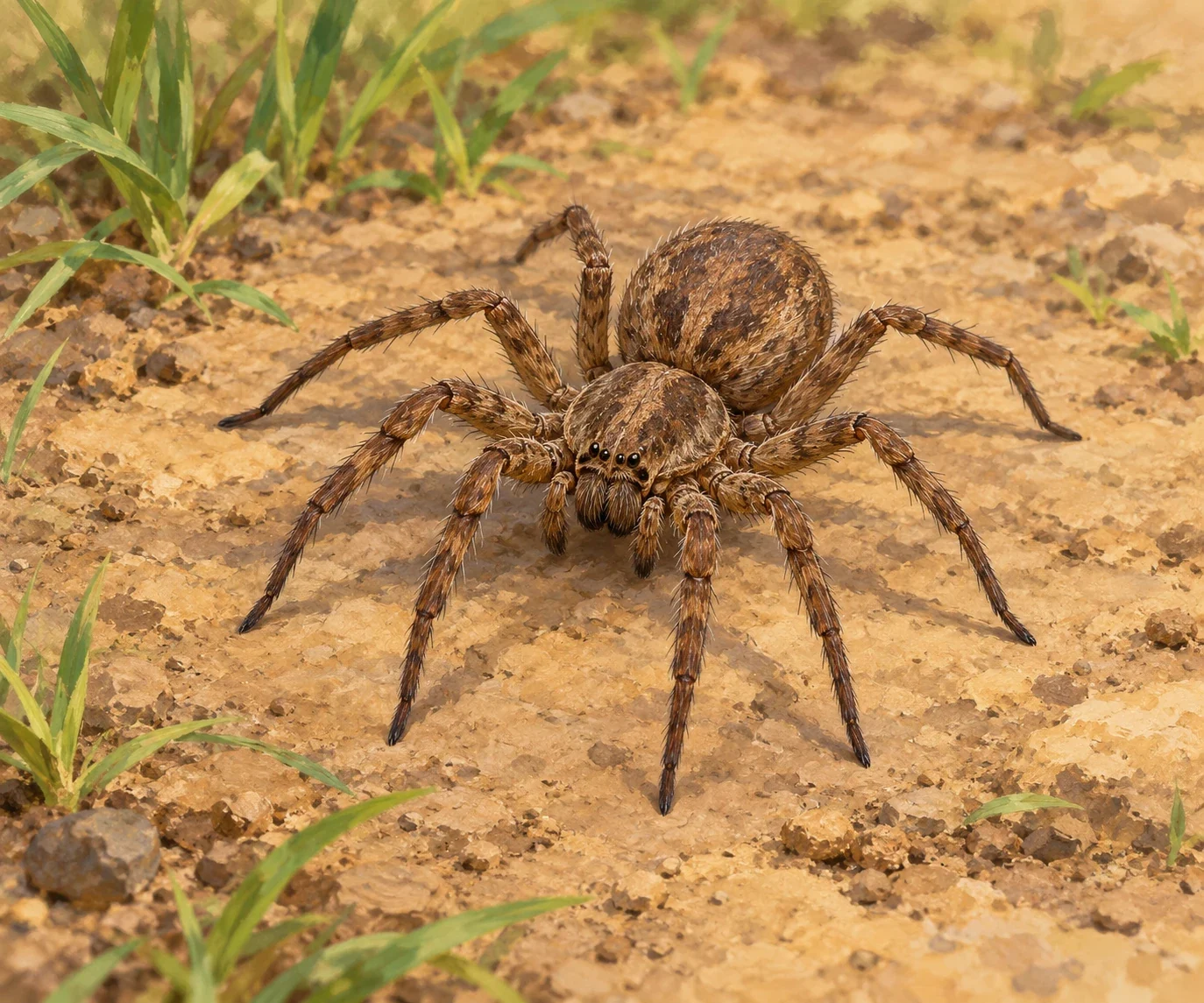
AI narrative interpretation of The Spider in Schlenker’s Near-Death Lesson in Schlenker’s A Collection of Temne Traditions, Fables and Proverbs (1861).
AI interpretation of the speaking Spider in Schlenker’s sixth Temne fable. Brown color, exact anatomy, species-like form, scale and quiet pose are invented; no scientific species or established traditional icon is identified.
Overview
After surviving punishment for theft, the Spider repeatedly says that he almost died. The Bushgoat asks what that means, and the Spider promises to demonstrate it. He secretly puts his children with knives in a hole containing one of the king’s sheep. When the unsuspecting Bushgoat holds the animal’s head, the children kill it below ground, leaving him apparently responsible. The Spider both reports him to the king and tells him where to hide.
The Spider supplies salt to the hidden Bushgoat and arranges for the Ant-Eater to dig him out. The Bushgoat blows salt into the digger’s eyes. When an attendant tastes the resulting eye discharge, the Spider redirects the king’s interest toward eating the Ant-Eater himself. The Ant-Eater is killed, the Bushgoat escapes to the Spider’s farm, and the Spider receives a share of the meat while concealing his part in the deception.
The Bushgoat now understands danger, but the Spider insists that the lesson is incomplete. Pretending to seek medicine for a headache, he takes the Bushgoat to two young leopards. Both companions take and kill them. Their father follows the scent to the Bushgoat, while the Spider hides, cooks the dead animals and falsely tells the Leopard that the Bushgoat has previously killed his own children too.
The Spider shelters and feeds the fugitive while continuing to collaborate with the king and Leopard. Finally he tells the Bushgoat that the dispute is settled, directs him behind the king’s place and arranges an ambush there. The Bushgoat is caught, killed and divided as food; the Spider again receives a reward. The ending explains the Leopard’s pursuit of bushgoats and the Cat’s pursuit of spiders as consequences of the betrayal.
This is the Spider’s role in Fable VI of one Temne collection, rather than a composite biography assembled from all African spider traditions. The story does not identify a biological species, prescribe a body shape or equate this figure with Anansi. Its speaking animals, farms and royal court belong to the fable; its account of predator relationships is a narrated explanation rather than zoological evidence.
Origins & earliest records
Part I, chapter IV, Fable VI, The Spider, and the Bushgoat, and the Ant-Eater, and the Leopard, printed pp. 73–87, with the printed Temne text on facing pages.
Records & interpretation
Schlenker’s original 1861 Temne text and his avowedly free English translation of Part I. The preface attributes Part I to one unnamed elderly Temne man living at Port-Loko, heard about twelve years before the preface dated 15 October 1861. No independent translation of the Temne, exact recording date, authenticated portrait or present community authorization is claimed.
Selected bibliography
Documented works and useful reading. This is not a list of every appearance.
- 01
A Collection of Temne Traditions, Fables and Proverbs
Schlenker’s original 1861 Temne text and his avowedly free English translation of Part I. The preface attributes Part I to one unnamed elderly Temne man living at Port-Loko, heard about twelve years before the preface dated 15 October 1861. No independent translation of the Temne, exact recording date, authenticated portrait or present community authorization is claimed.
Family & connections
A source-supported family tree or inspiration record has not yet been compiled for this profile. Related reading below indicates a connection in subject matter, not a proven lineage or creative influence.
References
Sources supporting this profile. Linked pages have their own scope and editorial standards.
- primarySchlenker 1861 — original bilingual collectionResearch access: 2026-10-21
Image credits
AI-generatedAI narrative interpretation of The Spider in Schlenker’s Near-Death Lesson in Schlenker’s A Collection of Temne Traditions, Fables and Proverbs (1861).
AI interpretation of the speaking Spider in Schlenker’s sixth Temne fable. Brown color, exact anatomy, species-like form, scale and quiet pose are invented; no scientific species or established traditional icon is identified.