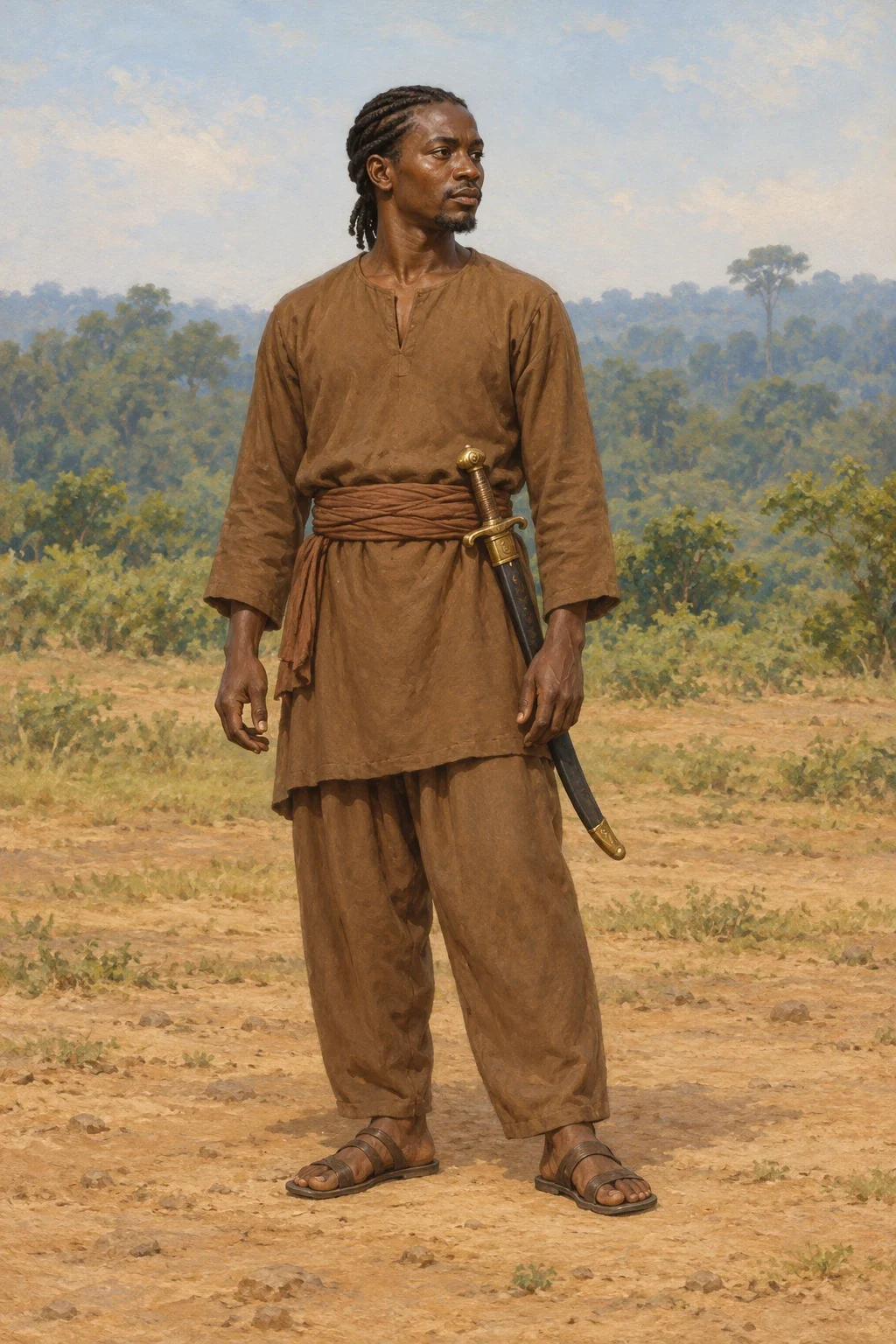
AI narrative interpretation of Korombo in Schlenker’s Temne Hero Tradition in Schlenker’s A Collection of Temne Traditions, Fables and Proverbs (1861).
AI interpretation of Korombo in Schlenker’s collected Temne narrative. Face, skin tone, costume, precise braid and weapon design and quiet pose are invented; no authenticated historical portrait or traditional costume is claimed.
Overview
Korombo rises after the earlier conqueror Bey Farma in the chapter’s legendary sequence. He devastates the Temne country but trades with Europeans rather than fighting at Port-Loko. His power includes the seizure and sale of people, including children; the narrative does not present his conquests as harmless adventure. Cutlasses cannot enter his body, gunfire fails to hit him, and he can fly. His sword is called a Turkish sabre.
His officer Ya Fura disregards a warning against another campaign and becomes trapped by enemies. Korombo comes to his aid, drives the opposing forces away and insists that they return after the loss of so many young men. Ya Fura subsequently settles and dies without being killed. Korombo places young men in depleted towns and remains the dominant warrior; the story’s claim that he conquered the whole world is part of its sweeping narrative language.
A conspiracy gathers his hair, nail clippings and water wrung from his pillow, with the pillow water taken to Mori-men. The text describes these preparations before the betrayal but does not explain a precise mechanism by which they defeat his protection. His own army joins the conspiracy. Kings invite him to a meeting in a wood, sit with him on a log and embrace him while weeping; one king then wounds his neck with a dagger.
Despite the wound, Korombo rises and kills ten captains. He puts his blade back into its sheath before falling dead at noon. The sun is then unseen for six days and reappears at noon on the seventh; his eyes continue to move until burial. No one can unsheathe his sword except his son. His death is followed by renewed competition among captains and finally an agreement limiting armies, with his earlier devastation given as the reason for restraint.
This profile follows the named figure in one collected Temne account, including its condemnation of destructive warfare. The narrative’s powers, vast conquests and solar disappearance are not independently verified history. Bey Farma’s separate traditions and Ya Fura’s actions remain distinct; Port-Loko identifies the collection context and an episode location, not an exclusive modern national origin.
Origins & earliest records
Part I, chapter I, Traditions about the ancient Heroes of the Temnes, printed pp. 3–13; Korombo’s account begins on p. 5. An unnamed elderly narrator at Port-Loko supplied the collection.
Records & interpretation
Schlenker’s original 1861 Temne text and his avowedly free English translation of Part I. The preface attributes Part I to one unnamed elderly Temne man living at Port-Loko, heard about twelve years before the preface dated 15 October 1861. No independent translation of the Temne, exact recording date, authenticated portrait or present community authorization is claimed.
Selected bibliography
Documented works and useful reading. This is not a list of every appearance.
- 01
A Collection of Temne Traditions, Fables and Proverbs
Schlenker’s original 1861 Temne text and his avowedly free English translation of Part I. The preface attributes Part I to one unnamed elderly Temne man living at Port-Loko, heard about twelve years before the preface dated 15 October 1861. No independent translation of the Temne, exact recording date, authenticated portrait or present community authorization is claimed.
Family & connections
A source-supported family tree or inspiration record has not yet been compiled for this profile. Related reading below indicates a connection in subject matter, not a proven lineage or creative influence.
References
Sources supporting this profile. Linked pages have their own scope and editorial standards.
- primarySchlenker 1861 — original bilingual collectionResearch access: 2026-10-21
Image credits
AI-generatedAI narrative interpretation of Korombo in Schlenker’s Temne Hero Tradition in Schlenker’s A Collection of Temne Traditions, Fables and Proverbs (1861).
AI interpretation of Korombo in Schlenker’s collected Temne narrative. Face, skin tone, costume, precise braid and weapon design and quiet pose are invented; no authenticated historical portrait or traditional costume is claimed.