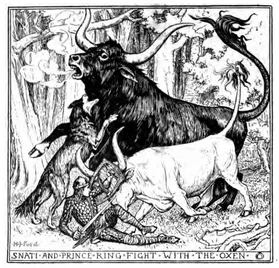
Snati-Snati attacks the larger wild ox while Prince Ring fights the smaller one, Henry Justice Ford, 1894
Ford places Snati-Snati on the larger ox and Ring beside the smaller white ox. The scene illustrates the dog-prince’s strength and assistance in this named tale; its dog shape is not a zoological identification.
Overview
Prince Ring first encounters Snati-Snati inside the island giant’s forbidden parlour. The large dog speaks and repeatedly asks him to choose it. When the giant offers a parting gift, Ring follows that request despite his fear; the giant reluctantly honours his promise because the dog is his wife’s indispensable helper. Once on the mainland, Snati asks why Ring has not asked his name and directs him to seek winter lodging at a royal court. The narrator gradually turns the prince’s fear of the animal into reliance upon its advice.
The jealous counsellor Red imposes contests intended to discredit or destroy Ring. Snati uses a second axe to help him cut more than twice Red’s heap of timber. It defeats the larger of two dangerous wild oxen, helps Ring overcome the smaller, completes its own skinning first, and carries most of the hides and horns. On the treasure expedition it carries a great load of salt and pulls Ring up three cliff shelves by its tail. Its knowledge of the cave household enables recovery of the stolen gold cloak, chessboard and shining gold piece.
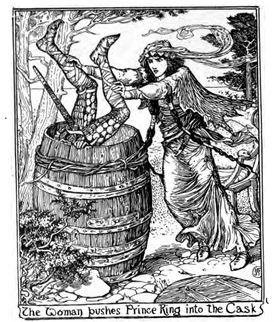
After the return, Snati exchanges sleeping places with Ring and intercepts Red’s attempt to stab the supposed sleeper over the partition. The severed armed hand exposes the plot. On Ring’s wedding night the dog asks to lie at the couple’s feet; a cry reveals a dog skin and a beautiful unconscious prince. Ring burns the skin and wakes him. The freed man is also named Ring: his witch stepmother had made release conditional upon a prince of his own name allowing precisely this wedding-night resting place. The two namesakes finally divide marriage and royal responsibilities, with the former dog marrying the rescuer’s sister Ingiborg.
Origins & earliest records
The Yellow Fairy Book (London: Longmans, Green, and Co., 1894), edited by Andrew Lang, prints Prince Ring with footnote 30 identifying the source as from the Icelandic. The edition gives no individual narrator for this tale.
Records & interpretation
The complete narrative ends by explaining Snati’s human identity and identifying the hind, barrel woman and cave witch as one actor. These are explicit retrospective disclosures, rather than likeness-based identifications.
Selected bibliography
Documented works and useful reading. This is not a list of every appearance.
- 01
The Yellow Fairy Book: Prince Ring
Complete story through the two princes’ marriage and kingdom arrangements. The helper and hero are namesakes, not the same person.
Family & connections
A source-supported family tree or inspiration record has not yet been compiled for this profile. Related reading below indicates a connection in subject matter, not a proven lineage or creative influence.
References
Sources supporting this profile. Linked pages have their own scope and editorial standards.
- Primary literary retellingLang 1894: complete Prince RingResearch access: 2026-10-05
Image credits
Historical illustrationSnati-Snati attacks the larger wild ox while Prince Ring fights the smaller one, Henry Justice Ford, 1894
Ford places Snati-Snati on the larger ox and Ring beside the smaller white ox. The scene illustrates the dog-prince’s strength and assistance in this named tale; its dog shape is not a zoological identification.