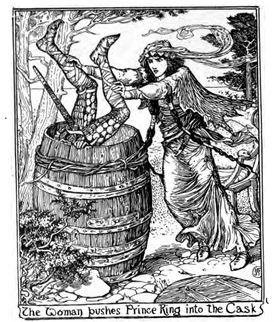
Ring’s stepmother in her human disguise pushes Prince Ring into a barrel, Henry Justice Ford, 1894
The barrel keeper pushes Ring head first into the cask. The story’s final disclosure identifies this woman with the hind and the cave witch who enchanted Snati-Snati; this illustration shows her human disguise.
Overview
The tale begins with a hind wearing a gold ring on its horns. Its pursuit exhausts the royal hunting party’s horses, and darkness leaves the travellers scattered. The young Prince Ring later meets a courteous woman beside a barrel containing a beautiful gold ring. As he reaches for it, the barrel seems to deepen. She suddenly pushes him inside, closes the top and casts it into the sea. These episodes initially appear separate; the ending expressly identifies both figures with the witch who had enchanted another prince of the same name into Snati-Snati.
In her cave the witch lives with a husband, daughter and son and keeps the king’s stolen gold treasures. She says that she obtained porridge milk through witchcraft from four kingdoms. After Ring and Snati salt the porridge, her thirst sends the family members to fetch water, each demanding a valuable object as the price of the errand. They are intercepted at the river and the treasures recovered. The husband returns as a ghost and must be subdued again, a detail that distinguishes death from the immediate end of danger in this episode.
Snati warns that the witch is especially dangerous outside and cannot be cut by iron. Their final attack uses heat and scalding rather than a cutting blade, after which her remains and those of her husband are burned. The freed dog-prince explains her motive: as his stepmother, she knew that a namesake’s marriage could release him and therefore tried to destroy his rescuer. The final disclosure supports a single profile across three guises. It does not establish that the hospitable island giant was another disguise or member of her household.
Origins & earliest records
The Yellow Fairy Book (London: Longmans, Green, and Co., 1894), edited by Andrew Lang, prints Prince Ring with footnote 30 identifying the source as from the Icelandic. The edition gives no individual narrator for this tale.
Records & interpretation
The complete narrative ends by explaining Snati’s human identity and identifying the hind, barrel woman and cave witch as one actor. These are explicit retrospective disclosures, rather than likeness-based identifications.
Selected bibliography
Documented works and useful reading. This is not a list of every appearance.
- 01
The Yellow Fairy Book: Prince Ring
Complete story through the two princes’ marriage and kingdom arrangements. The helper and hero are namesakes, not the same person.
Family & connections
A source-supported family tree or inspiration record has not yet been compiled for this profile. Related reading below indicates a connection in subject matter, not a proven lineage or creative influence.
References
Sources supporting this profile. Linked pages have their own scope and editorial standards.
- Primary literary retellingLang 1894: complete Prince RingResearch access: 2026-10-05
Image credits
Historical illustrationRing’s stepmother in her human disguise pushes Prince Ring into a barrel, Henry Justice Ford, 1894
The barrel keeper pushes Ring head first into the cask. The story’s final disclosure identifies this woman with the hind and the cave witch who enchanted Snati-Snati; this illustration shows her human disguise.