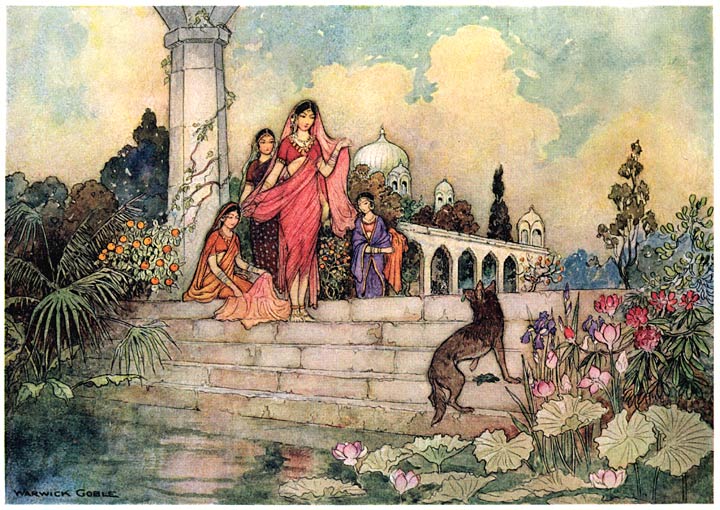
Sivalu chews betel-leaves before the princess at the bathing tank, Warwick Goble, 1912
The speaking jackal chews betel-leaves at the palace bathing tank to convince the princess that he comes from a wealthy country. Goble illustrates this particular trick in Day’s tale; the scene is not a zoological portrait of a jackal.
Overview
A jackal living beside an impoverished weaver remembers the former wealth of the man’s family and decides to secure him a royal bride. He chews betel-leaves at the palace bathing tank, prompting the princess and queen to imagine that he comes from an exceptionally prosperous country. Calling his friend a magnificent king, he negotiates the match. Day’s footnote explains Sivalu as a name for a jackal comparable to Reynard, rather than a separately defined supernatural species.
The jackal recruits a thousand jackals, a thousand crows and a thousand paddy-birds through their respective kings. Their combined noise persuades the bride’s father that the wedding company is too large to accommodate, allowing the supposed king to arrive alone in borrowed clothes. The jackal also explains away the weaver’s revealing talk about looms. His promises finally become true through the princess’s own gold-making power, not a transformation or wealth spell performed by the jackal.
Origins & earliest records
Bengali oral storytelling translated by Lal Behari Day
Records & interpretation
Complete relevant tale, attached notes,1883 preface and1912 edition credits directly read.
Selected bibliography
Documented works and useful reading. This is not a list of every appearance.
- 01
Folk-Tales of Bengal
XVIII, The Match-making Jackal, pp. 217–227 and two notes
Family & connections
A source-supported family tree or inspiration record has not yet been compiled for this profile. Related reading below indicates a connection in subject matter, not a proven lineage or creative influence.
Primary records and illustrations
Lal Behari Day, Folk-Tales of Bengal (Macmillan,1912; first edition1883)
XVIII. XVIII, The Match-making Jackal, pp. 217–227 and two notes
Whole XVIII through closing formula and both notes directly read. Jackal’s deception separated from the princess’s actual gold-making. Original paraphrase; no image inspection claimed.
References
Sources supporting this profile. Linked pages have their own scope and editorial standards.
- Historical translated oral narrative and collector notesDay, Folk-Tales of Bengal (1912), XVIII, The Match-making Jackal, pp. 217–227 and two notesResearch access: 2026-10-05
Image credits
Historical illustrationSivalu chews betel-leaves before the princess at the bathing tank, Warwick Goble, 1912
The speaking jackal chews betel-leaves at the palace bathing tank to convince the princess that he comes from a wealthy country. Goble illustrates this particular trick in Day’s tale; the scene is not a zoological portrait of a jackal.