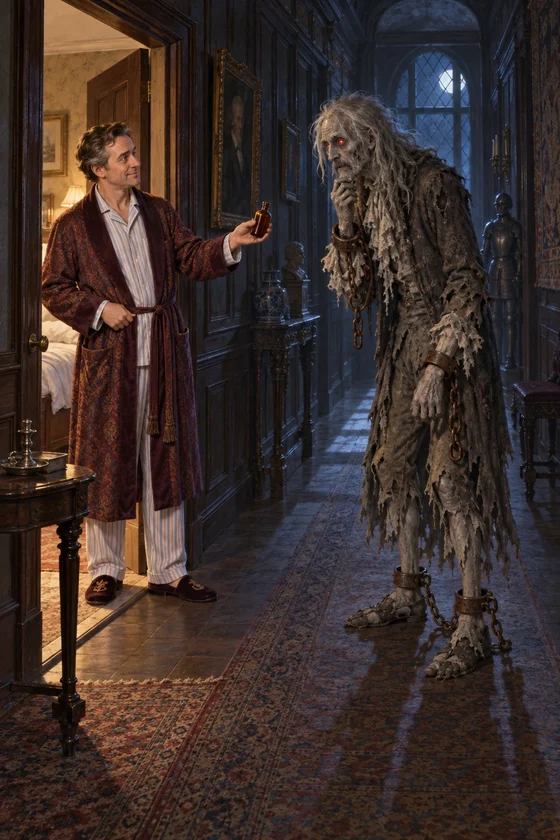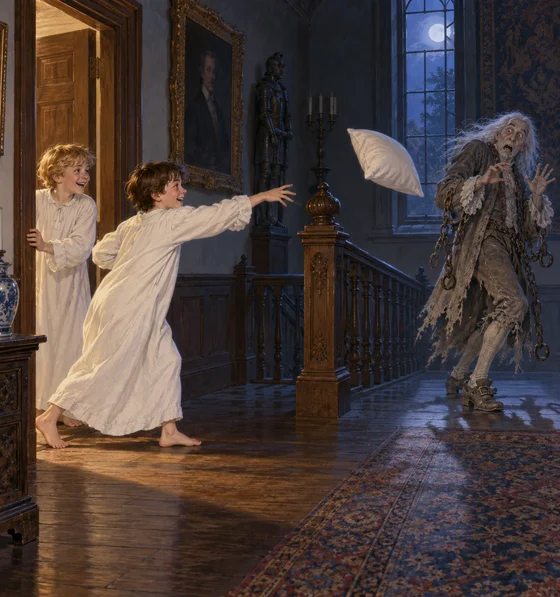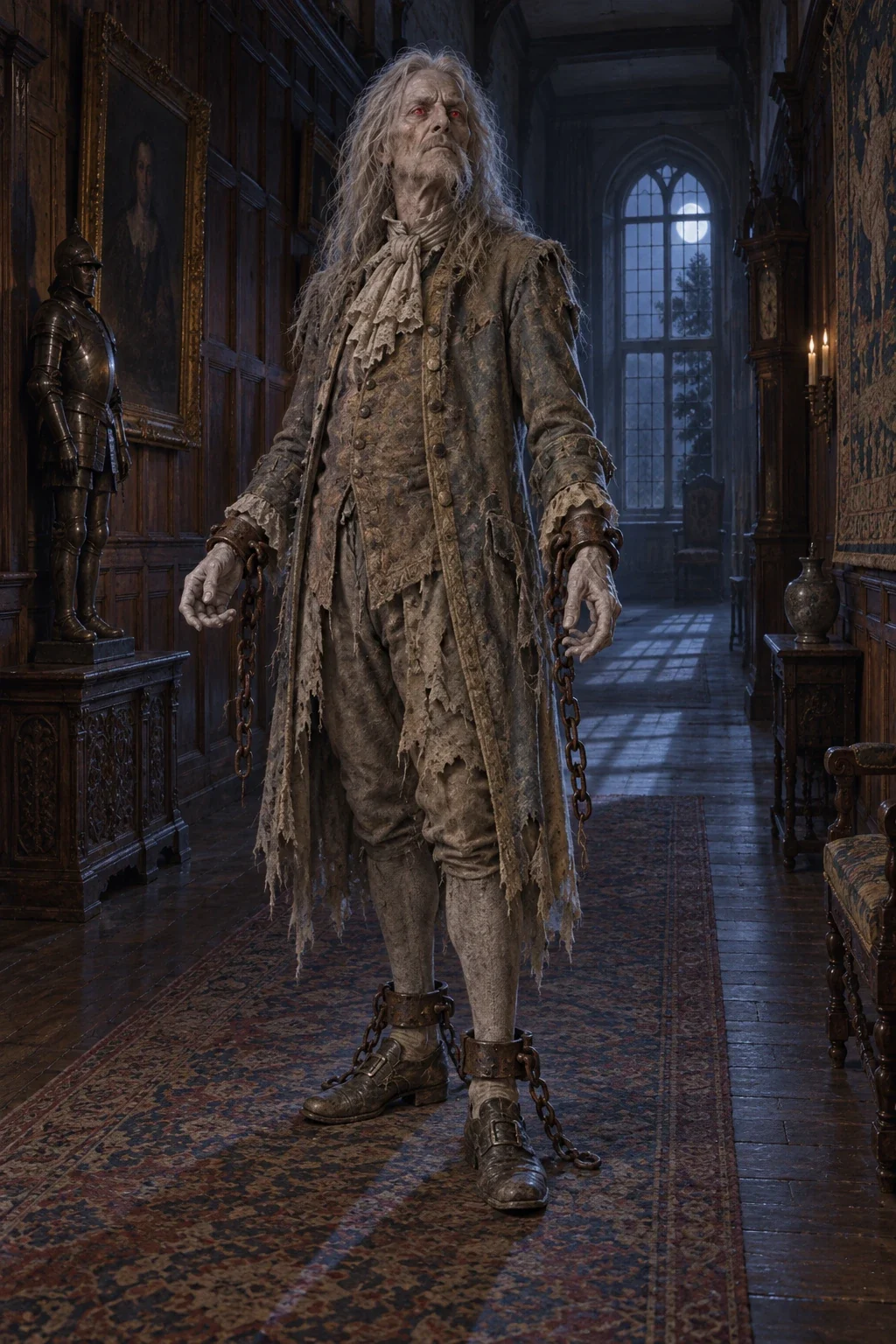
AI interpretation of Sir Simon's first corridor appearance, with grey hair, red eyes and rusty restraints.
Original tale phase; casting, garment detail and corridor layout imagined. Full-frame derivative; no upscaling.
Overview
Sir Simon de Canterville is the resident ghost of Canterville Chase in Oscar Wilde's authored tale. The housekeeper identifies him as the husband who murdered Lady Eleanore in the library in 1575 and disappeared nine years later. Lord Canterville presents the haunting as an ancestral warning before family deaths. These statements belong to the story's characters and setting, rather than evidence of a historical English haunting. Sir Simon initially regards frightening the living as both an artistic achievement and a duty attached to his position.
His first appearance to the American owner, Hiram Otis, is an old man with fiery red eyes, long matted grey hair, ragged antique clothing and heavy restraints at wrists and ankles. Otis responds to the noisy chains by offering lubricant. The family's practical remedies and the twins' tricks overturn the ghost's expected authority. He renews the library stain using Virginia's stolen paints, fails to carry the weight of his own armour, and is terrified by an artificial ghost assembled from household objects. His named theatrical disguises are performances by the same spirit, not separate supernatural species.
Defeat changes his behaviour without immediately erasing his vanity. He eventually oils his chains and tries to avoid discovery. Virginia finds him despondent in the Tapestry Chamber. He admits murdering his wife and says her brothers subsequently starved him to death. She rejects his excuses while showing compassion for his exhaustion: he has been unable to sleep for three centuries. He asks her to pray and weep for him because he lacks faith and tears, explaining the prophecy painted on the library window.
After Virginia accompanies him through the disappearing wall, she returns with jewels and reports that he was repentant. She leads her family to a hidden chamber containing his chained skeleton and unreachable vessels. The almond tree blossoms, and she declares him forgiven. His funeral and burial provide the rest he sought. The narrative leaves Virginia's intervening experience undisclosed, so a profile cannot supply a detailed journey through the afterlife. Sir Simon's ending combines acknowledgment of his wrongdoing with the possibility of mercy, rather than turning the murderer into an innocent victim.
First appearances & development
Oscar Wilde's authored tale supplies these characters; its ghost narrative is fiction rather than an independently documented haunting.
Canon & continuity
Original narrative passages support character claims. Project Gutenberg records ebook14522 as public domain in the USA; generated catalogue summaries are excluded.
Selected bibliography
Documented works and useful reading. This is not a list of every appearance.
- 01
The Canterville Ghost
Original narrative, distinguished from electronic custody and rights metadata.
Family & connections
A source-supported family tree or inspiration record has not yet been compiled for this profile. Related reading below indicates a connection in subject matter, not a proven lineage or creative influence.
References
Sources supporting this profile. Linked pages have their own scope and editorial standards.
- PrimaryThe Canterville Ghost: original narrativeResearch access: 2026-10-11
- CustodialProject Gutenberg ebook14522: custody and USA rightsResearch access: 2026-10-11
Image credits
AI literary interpretationAI interpretation of Sir Simon's first corridor appearance, with grey hair, red eyes and rusty restraints.
Original tale phase; casting, garment detail and corridor layout imagined. Full-frame derivative; no upscaling.