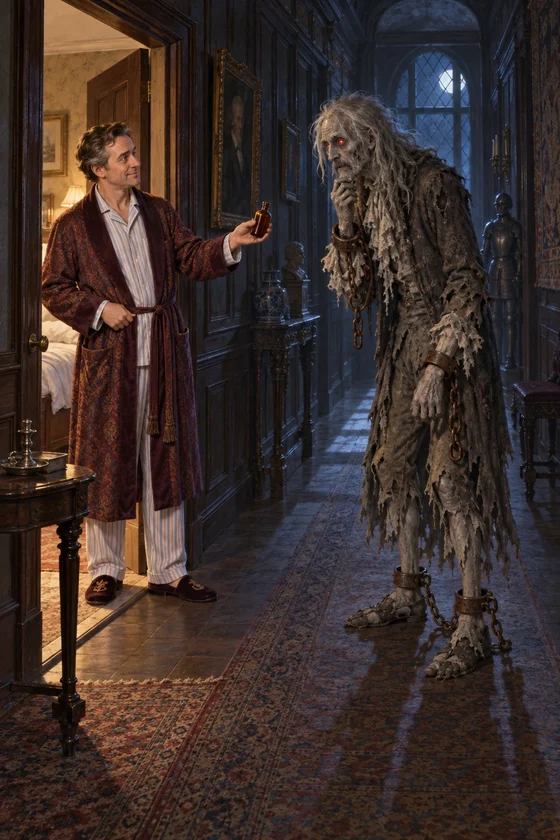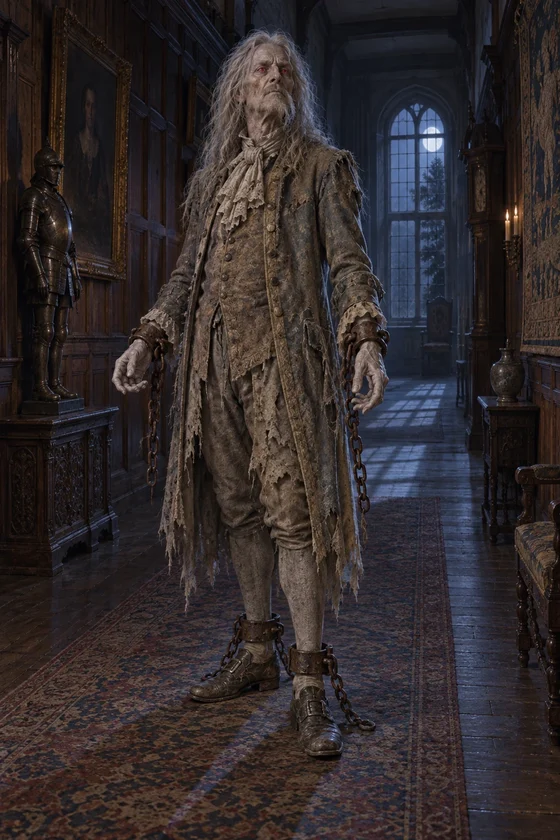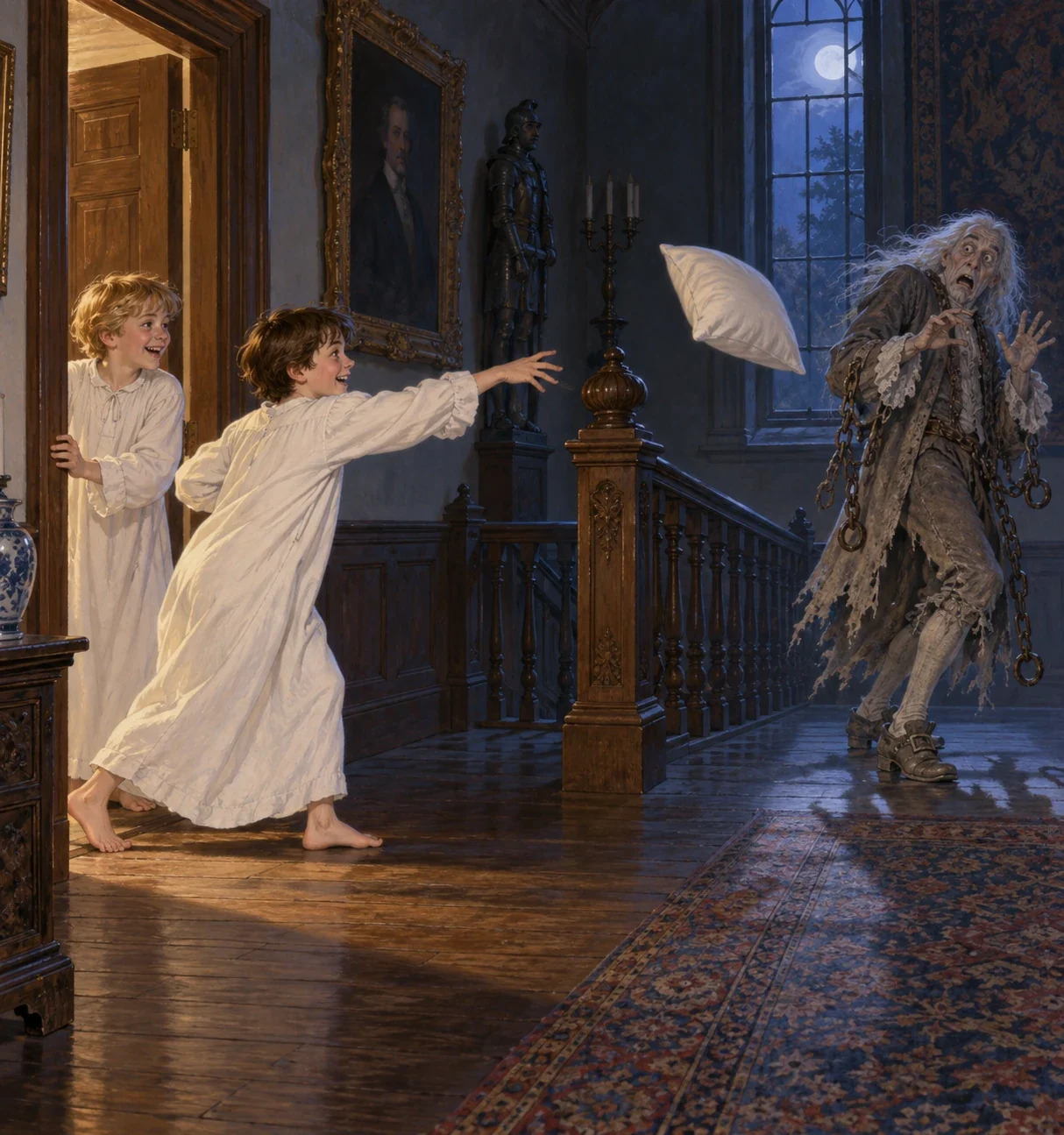
AI interpretation of the white-robed Otis twins throwing a pillow toward Sir Simon.
Boys' casting, robe details and room layout imagined; harmless original-story prank. Full-frame derivative; no upscaling.
Overview
The Otis twins are the two younger sons in the American family that moves into Canterville Chase in Oscar Wilde's tale. The narrator nicknames them The Star and Stripes and presents them as frequently punished, cheerful schoolboys. They remain a pair throughout the selected narrative; it does not supply individual first names or exact ages. Their responses differ from their sister Virginia's pity and from their father's calm offers of practical assistance. They approach the haunting as an opportunity for mischief rather than as an ancestral warning.
At the ghost's first encounter with the household, the twins appear in white night clothing and throw a pillow at him as he reaches the staircase. When an attempt to wear armour ends in a noisy fall, they arrive with pea-shooters and strike him with pellets. Their familiarity with such games makes the supposedly formidable spirit the vulnerable participant. Hiram Otis objects to throwing pillows at a long-standing resident, but the boys laugh at his attempt to extend ordinary hospitality to the apparition.
Sir Simon plans increasingly elaborate performances to punish the twins. The story instead surrounds him with humiliations: a false ghost resolves into a curtain, brush, cleaver and hollow turnip; strings obstruct the corridor; and a butter-slide causes a fall. The twins construct the slide and subsequently arrange a jug of water above their bedroom doorway. The headless ghost enters and is drenched, with the narrator joking that leaving his head behind spared him worse consequences. These tricks exploit material props and timing; the text does not give the brothers supernatural powers.
Their later ambush combines shouted surprise with Washington waiting near the staircase, leaving Sir Simon to escape through an unlit stove. Even preparations against a visiting young duke are abandoned because the ghost fears meeting the twins. The reversal helps explain his withdrawal into misery before Virginia intervenes. When she disappears, the boys join the search and become subdued because they love their sister. Her return restores their exuberance, including their insistence that practical jokes against the ghost should remain an exception to their father's prohibition. The pair therefore belongs to the tale's comic family dynamics, not an independent class of ghost-hunters.
First appearances & development
Oscar Wilde's authored tale supplies these characters; its ghost narrative is fiction rather than an independently documented haunting.
Canon & continuity
Original narrative passages support character claims. Project Gutenberg records ebook14522 as public domain in the USA; generated catalogue summaries are excluded.
Selected bibliography
Documented works and useful reading. This is not a list of every appearance.
- 01
The Canterville Ghost
Original narrative, distinguished from electronic custody and rights metadata.
Family & connections
A source-supported family tree or inspiration record has not yet been compiled for this profile. Related reading below indicates a connection in subject matter, not a proven lineage or creative influence.
References
Sources supporting this profile. Linked pages have their own scope and editorial standards.
- PrimaryThe Canterville Ghost: original narrativeResearch access: 2026-10-11
- CustodialProject Gutenberg ebook14522: custody and USA rightsResearch access: 2026-10-11
Image credits
AI literary interpretationAI interpretation of the white-robed Otis twins throwing a pillow toward Sir Simon.
Boys' casting, robe details and room layout imagined; harmless original-story prank. Full-frame derivative; no upscaling.