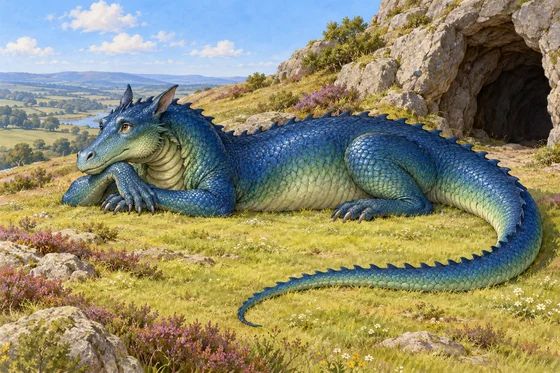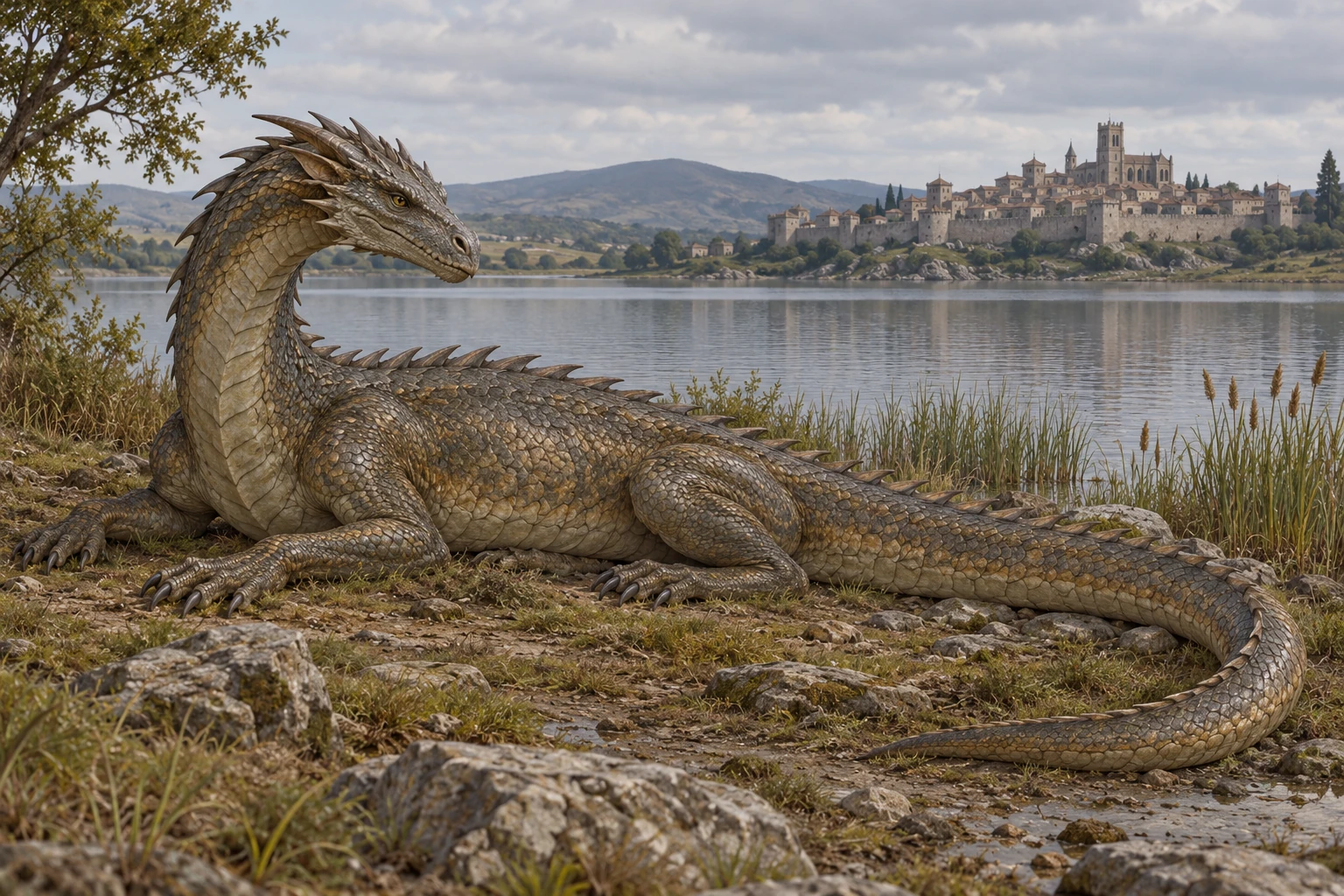
AI-generated interpretation of the dragon beside Silene’s pond in the selected Golden Legend encounter. Anatomy, scale colour, pose, buildings and landscape details are imagined. This is not an archaeological reconstruction of Silene or a depiction of a verified animal.
The source describes poisonous breath, not fire, and does not prescribe this dragon anatomy. The image represents a historical Christian legend, not Grahame’s different dragon or a modern franchise design.
Overview
The dragon in this Golden Legend encounter lives in a large pond beside Silene, a city the narrative places in Libya. Its poisonous breath threatens the surrounding country and the city. An attempt by the people to confront it ends in flight. They then provide two sheep each day to prevent further harm. When sheep become scarce, the arrangement changes to a person and a sheep, with the young inhabitants chosen by lot. The account makes the danger a civic system of repeated sacrifice before introducing an individual rescue.
The lot eventually falls on the king’s daughter. He offers his wealth to preserve her, but the townspeople reject an exception to the law that has already taken their own children. They threaten the king and his household if he refuses. An eight-day delay is granted, after which the princess is dressed as for a wedding and led to the appointed place. George meets her there and asks why she weeps. Her repeated warnings that he should leave preserve her expectation that another arrival will merely become another victim.
When the dragon runs towards them, George makes the sign of the cross and attacks on horseback. His spear wounds it and throws it down. The encounter does not end immediately in a killing: George tells the princess to bind her girdle around its neck, after which it follows her meekly. She brings the living creature into the city. The inhabitants again flee, and George links the promised removal of the danger to their acceptance of Christian baptism. The movement from threatening pond to captive procession is therefore an important stage of the narrative, not a different tame dragon substituted for the original threat.
After the king and people are baptized, George kills the dragon and cuts off its head. Four carts with oxen carry the body away. The text reports a large number of baptisms, a church dedicated to Mary and George, and a healing fountain there. These are claims within a Christian saint’s legend, rather than independently verified civic records or a medical account. George refuses the king’s offered money and directs it to poor people. His instructions concerning churches, priests, worship and care of the poor precede his departure and complete the selected encounter.
This profile follows the historical English text in the Temple Classics 1900 edition as identified by Fordham: Caxton’s English version is mediated by F. S. Ellis’s historical modernization. It is not a fresh translation of Jacobus de Voragine’s Latin or a collation with Caxton’s first printing. The selected episode establishes poisonous breath, a neck bound with a girdle, movement on the ground and the enormous removal of the body; it does not specify a universal dragon anatomy. The later martyrdom narrative and relic accounts belong to the wider life and are outside this profile’s bounded encounter.
Origins & earliest records
Jacobus de Voragine’s medieval compilation is read through William Caxton’s historical English version and F. S. Ellis’s modernization in the Temple Classics 1900 edition, vol. III, Of S. George, Martyr, as transcribed by Fordham. Fordham labels the English translation 1483; that is transmission metadata, not a claim that this digital wording is a diplomatic 1483 printing.
Records & interpretation
The complete opening dragon encounter was read from George’s arrival at Silene through his departure after the killing, conversion, church and fountain account, and charitable instructions. Original Latin, early printed Caxton witnesses, the later martyrdom sequence and historical Silene topography were not independently collated.
Selected bibliography
Documented works and useful reading. This is not a list of every appearance.
- 01
The Golden Legend, Temple Classics 1900, vol. III: Of S. George, Martyr, opening Silene encounter
Complete selected dragon encounter through George’s departure; later martyrdom and relic accounts outside scope.
Family, evolution & connections
The Reluctant Dragon (Grahame)
The Golden Legend’s Silene encounter wounds a threatening dragon, leads it into the city by the princess’s girdle, and ends in its killing after conversion. In Grahame’s original tale, the boy, St. George and dragon instead negotiate a staged fight; the dragon is spared, joins a banquet and returns home with them. This compares different Saint George narratives, using the Caxton–Ellis printing as a witness to the older legend. It is not a claim about Grahame’s source edition or every Saint George tradition.
References
Sources supporting this profile. Linked pages have their own scope and editorial standards.
- Primary historical textFordham, Golden Legend: St. George, historical Caxton–Ellis textResearch access: 2026-10-25
- Edition metadataFordham Golden Legend edition/transmission noticeResearch access: 2026-10-25
Image credits
Modern interpretation of a historical legendAI-generated interpretation of the dragon beside Silene’s pond in the selected Golden Legend encounter. Anatomy, scale colour, pose, buildings and landscape details are imagined. This is not an archaeological reconstruction of Silene or a depiction of a verified animal.
The source describes poisonous breath, not fire, and does not prescribe this dragon anatomy. The image represents a historical Christian legend, not Grahame’s different dragon or a modern franchise design.