
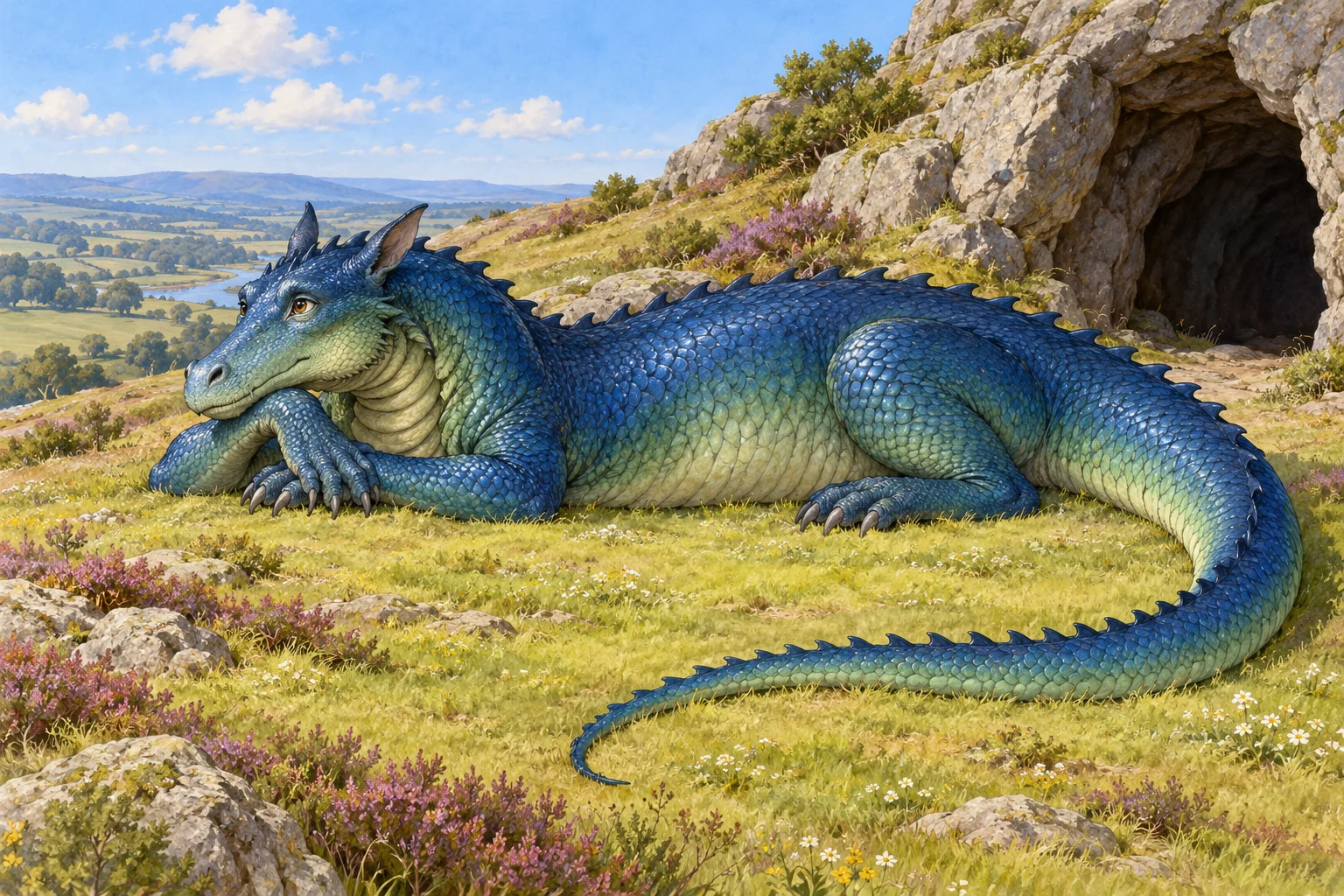
AI interpretation; independently composed.
Text-led interpretation; unspecified details imagined.
Overview
The dragon belongs to a story told by a circus-man to two children after their search for mysterious footprints in the snow. Within that story, a shepherd discovers him at a cave on the Downs. He is described as the size of four cart-horses, with shiny deep-blue scales above shading to green below, claws and a long spiky tail. His pointed ears and thick folds beneath the neck are specified later. At rest he puts his chin on his paws, enjoys the view and purrs. The impressive body does not establish the violent temperament that the villagers expect of a dragon.
He tells the shepherd’s bookish son that he escaped a long period underground by scratching and burrowing up to the cave. His explanation of the original upheaval is uncertain, and he presents his survival partly as a consequence of avoiding the energetic violence of other dragons. He prefers regular meals, quiet reflection and composing poetry. The boy becomes his listener and friend; the shepherd is introduced, while the boy’s mother offers practical help without formally accepting the unfamiliar visitor. Their evenings together are sociable rather than a campaign against the village.
The villagers nevertheless demand his destruction, although the narrative says he has not even damaged a hen roost. St. George arrives after hearing exaggerated accusations. The boy challenges those stories and arranges a meeting. The dragon flatly refuses genuine combat and says he can retreat down his underground passage until the saint leaves. They instead negotiate a public performance: St. George will spear a safe fold beneath the dragon’s neck, announce his conversion and introduce him to village society. The dragon values the promised banquet and social welcome.
During the three-round spectacle, he roars, sends smoke and fire from his nostrils, lashes his tail and performs elaborate movements for the crowd. His apparent defeat is convincing, but he winks at the anxious boy, and the agreed spear placement leaves him unhurt. St. George then rebukes the villagers’ prejudice and appetite for fighting, including their plan to torment a captive badger. The dragon succeeds at the banquet. Afterward his sleepiness makes the boy’s promise to escort him home burdensome, until St. George helps them climb the hill together. The outer story closes with the children still questioning its truth; it does not supply a later history confirming permanent settlement.
First appearances & development
An individual character in Kenneth Grahame’s original story The Reluctant Dragon.
Canon & continuity
Complete primary narrative, including its outer storytelling frame, staged combat and return-home ending.
Selected bibliography
Documented works and useful reading. This is not a list of every appearance.
- 01
Family & connections
A source-supported family tree or inspiration record has not yet been compiled for this profile. Related reading below indicates a connection in subject matter, not a proven lineage or creative influence.
References
Sources supporting this profile. Linked pages have their own scope and editorial standards.
- Primary literary textDream Days — The Reluctant Dragon, complete original narrativeResearch access: 2026-10-18
Image credits
AI-generatedAI interpretation; independently composed.
Text-led interpretation; unspecified details imagined.