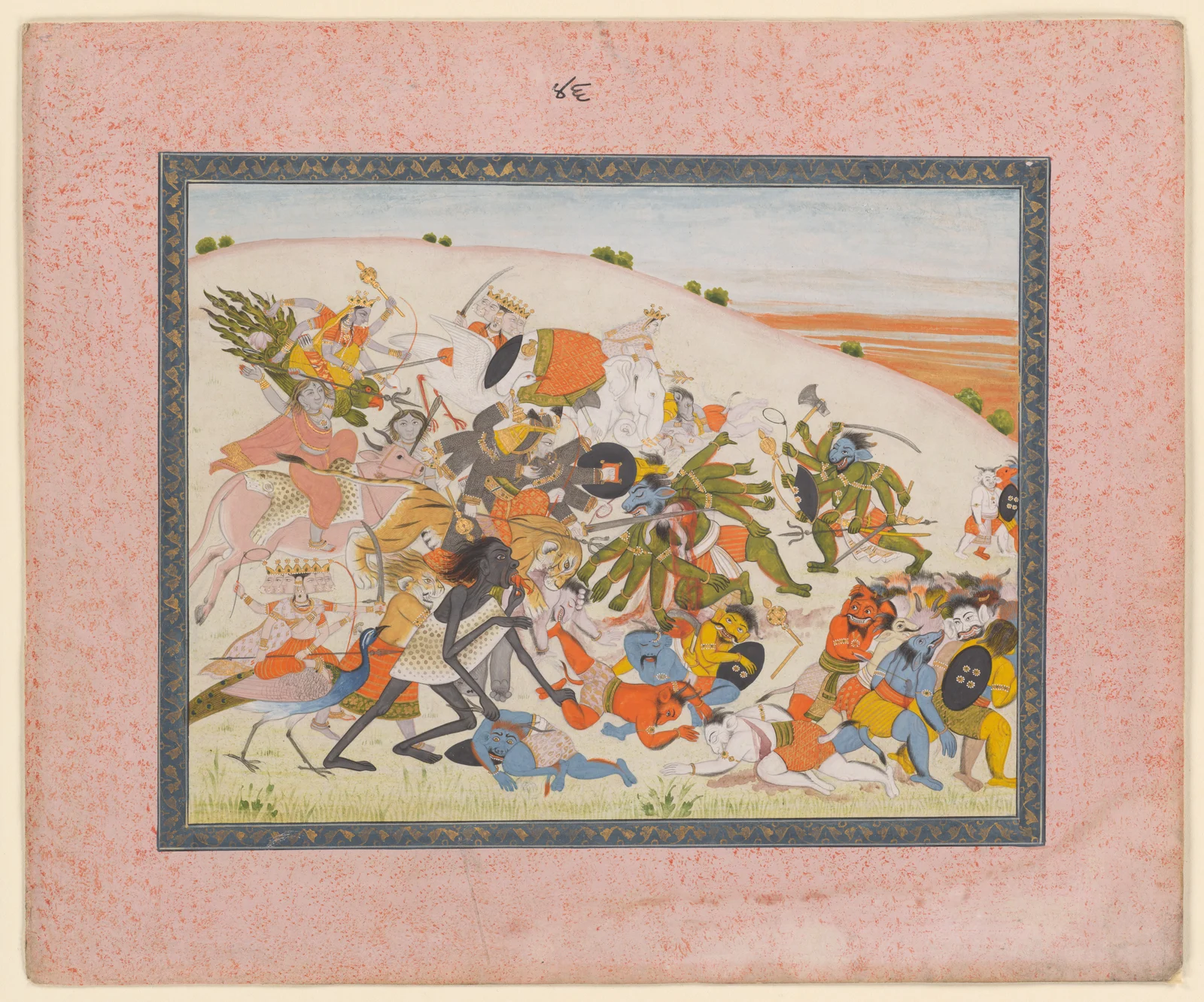
Durga on a tiger and allied goddesses attack a demon army. At upper right a green many-armed demon with a blue face charges toward her with raised weapons; another similar demon is struck in the centre.
The Met identifies the charging green demon at upper right as Shumbha, advancing after his brother Nisumbha’s defeat. His blue face, numerous arms and weapons belong to this eighteenth-century Guler artist’s depiction. The full folio preserves the related battle scene and borders.
Overview
Shumbha and his younger brother Nishumbha seize the gods’ domains and sacrificial shares. After Canda and Munda report the goddess’s beauty, Shumbha sends a messenger proposing marriage to himself or his brother. She answers that only someone who defeats her in battle can marry her. The episode attributes the possessive demand to the asura court.
In canto89 Shumbha advances in a chariot with eight weapon-bearing arms. After Nishumbha’s death, he accuses the goddess of relying on other goddesses. She absorbs them into herself and declares that they are manifestations of her own power. Shumbha continues fighting after losing his weapons, seizes her and rises into the sky. Their aerial struggle ends when she throws him down; he charges once more and is killed by her dart.
Origins & earliest records
South Asian Hindu sacred narrative
Records & interpretation
Full relevant hosted Pargiter passages directly read; Medhas’s narration within the Markandeya Purana.
Selected bibliography
Documented works and useful reading. This is not a list of every appearance.
- 01
The Mārkaṇḍeya Purāṇa
Canto 85, 89, 90; historical English edition date, not Sanskrit composition date.
Family & connections
A source-supported family tree or inspiration record has not yet been compiled for this profile. Related reading below indicates a connection in subject matter, not a proven lineage or creative influence.
Primary records and illustrations
The Mārkaṇḍeya Purāṇa, Pargiter translation
Devī-Māhātmya; hosted 1904 translation. Canto 85, 89, 90
Full relevant chapter narrative directly read on Wisdomlib; source-specific translation and narrator retained; no illustration claimed.
References
Sources supporting this profile. Linked pages have their own scope and editorial standards.
- Historical primary religious-text translationPargiter, Markandeya Purana — canto 85Research access: 2026-10-05
- Historical primary religious-text translationPargiter, Markandeya Purana — canto 89Research access: 2026-10-05
- Historical primary religious-text translationPargiter, Markandeya Purana — canto 90Research access: 2026-10-05
Image credits
Historical Devi Mahatmya narrative paintingDurga on a tiger and allied goddesses attack a demon army. At upper right a green many-armed demon with a blue face charges toward her with raised weapons; another similar demon is struck in the centre.
The Met identifies the charging green demon at upper right as Shumbha, advancing after his brother Nisumbha’s defeat. His blue face, numerous arms and weapons belong to this eighteenth-century Guler artist’s depiction. The full folio preserves the related battle scene and borders.